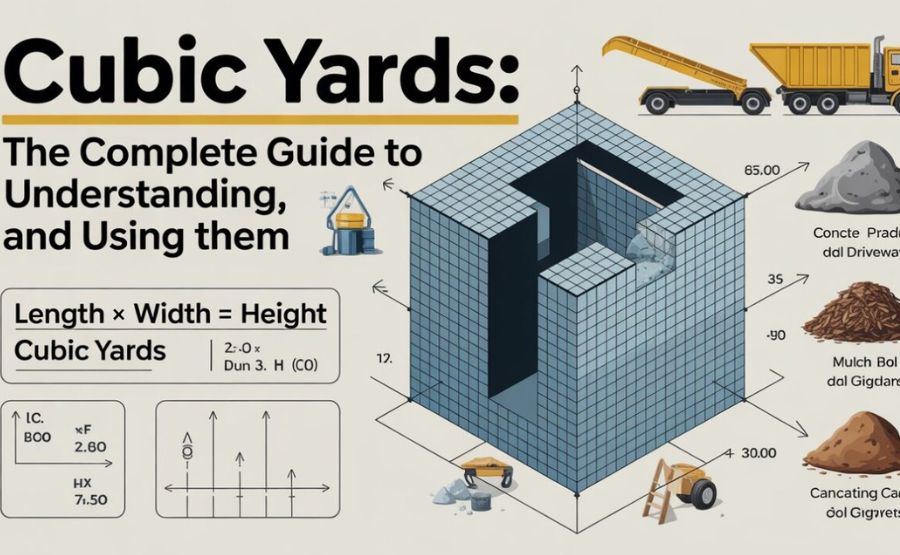
Cubic Yards: Everything You Actually Need to Know
Picture yourself standing in front of a standard kitchen refrigerator. Stare at it for a moment. That big, bulky thing takes up a lot of space in your kitchen — and as it turns out, it takes up almost exactly one cubic yard of space.
That is the best mental image anyone has ever given me for this unit of measurement. One cubic yard. The size of a refrigerator. Somehow that clicks in a way that “27 cubic feet” just never does.
If you’ve ever ordered mulch, poured a concrete driveway, had fill dirt delivered, or tried to figure out how many loads your pickup truck can haul — cubic yards were the invisible number running all those decisions. This article explains what a cubic yard actually is, where it came from, how to calculate it without losing your mind, and all the places where getting it wrong costs you real money.
Key Facts
| Detail | The Answer |
| What is a cubic yard? | A cube that measures 3 feet on every side: 3 ft × 3 ft × 3 ft |
| One cubic yard is equivalent to how many cubic feet? | 27 cubic feet |
| How many cubic inches? | 46,656 cubic inches |
| Metric equivalent | 0.7646 cubic meters |
| Formula to calculate | Length (ft) × Width (ft) × Height or Depth (ft) ÷ 27 |
| Shortcut for slabs with depth in inches | Depth (inches) × Length (ft) × Width (ft) ÷ 324 |
| Approx. size to visualize | About the same volume as a standard kitchen refrigerator |
| Wheelbarrow loads per cubic yard | Roughly 14 standard wheelbarrow loads |
| Dump truck capacity (typical) | 10 to 14 cubic yards of loose material |
| Pickup truck capacity | Approximately 1 to 2 cubic yards (depending on material density) |
| Weight of 1 cubic yard of water | Approximately 1,685 pounds |
| Weight of 1 cubic yard of concrete | Roughly 4,000 pounds |
| One cubic yard’s worth of dry topsoil | Approximately 2,000 pounds |
| How much extra to order | Typically 10–15% more to account for compaction and waste |
| Countries using cubic yards | Primarily the United States and UK in certain industries |
Where the Yard Itself Came From
Before we get to cubic yards, it helps to know where the word “yard” even comes from.
The word traces back to Old English — “gyrd” — meaning a stick or measuring rod. In early medieval England, a yard was quite literally the length of a standard measuring stick used for trade. Different regions had slightly different sticks, which caused exactly the headaches you’d expect when merchants from different towns tried to do business.
Over centuries, the yard got standardized. By the time England had an official measurement system, a yard was fixed at 3 feet, or 36 inches. When you cube that — multiply 3 feet by 3 feet by 3 feet — you get 27 cubic feet, which is exactly one cubic yard.
The international definition was nailed down more precisely in 1959, when the United States, United Kingdom, Canada, and several other countries agreed that one yard equals exactly 0.9144 meters. That agreement made conversions between imperial and metric clean and consistent. One cubic yard is now exactly 0.764554857984 cubic meters — a number precise enough to satisfy any engineer.
See also “The ACFT Score Chart: Everything You Need to Know About the Army’s Fitness Standard“
What a Cubic Yard Actually Looks Like
The refrigerator comparison is genuinely useful, but let’s take it further.
Stand outside and imagine a cube drawn in the air in front of you. The length of each side is three feet, or about the height of a standard kitchen countertop. The box that shape creates holds exactly one cubic yard of space.
Now pour concrete into that box. You’d fill it with about 4,000 pounds of material. That’s two tons. Poured into a typical 4-inch-thick driveway slab, one cubic yard of concrete would cover about 81 square feet — roughly a 9-foot by 9-foot area.
Switch the material to dry topsoil, and that same box weighs around 2,000 pounds — one ton. Switch to mulch, and it drops to somewhere between 400 and 800 pounds, depending on how wet it is.
This is something people regularly don’t account for. The volume stays the same — one cubic yard is always one cubic yard. But the weight changes dramatically depending on what fills it. A pickup truck rated for a certain payload in pounds might handle two cubic yards of mulch just fine, but could be dangerously overloaded with one cubic yard of wet sand. Always check the weight of the specific material, not just the volume.
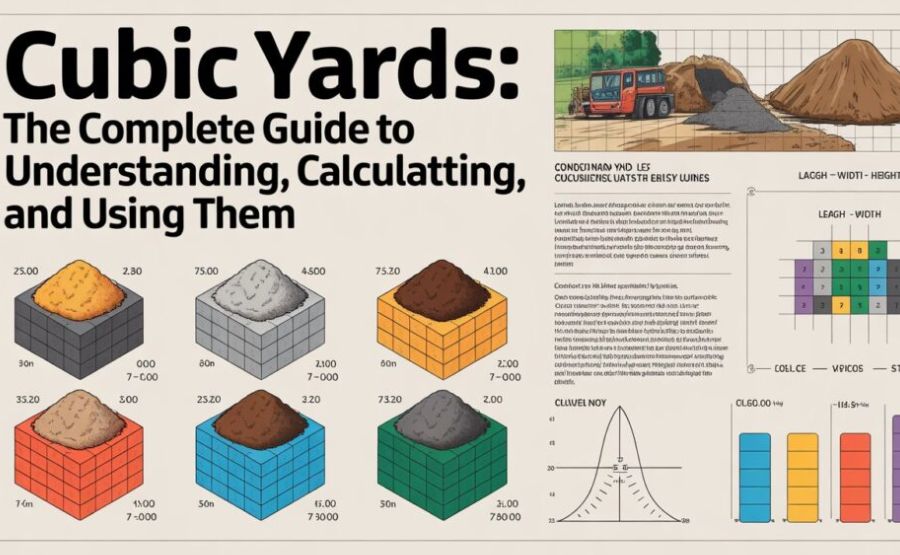
The Math: How to Calculate Cubic Yards Without the Headache
Here is the honest truth about cubic yard math: it only seems complicated because people forget to convert everything to the same unit before they start multiplying.
The formula is simple: Length × Width × Depth ÷ 27 = Cubic Yards
The catch is that all three measurements must be in feet. If your depth is in inches — which it almost always is for shallow projects like mulch beds or concrete slabs — you divide by 12 first to convert it to feet.
Example 1: A garden bed You have a garden bed that is 15 feet long, 4 feet wide, and you want 3 inches of mulch. 3 ÷ 12 = 0.25 feet is the conversion of 3 inches to feet. 15 × 4 × 0.25 = 15 cubic feet 15 ÷ 27 equals 0.56 when divided by 27. cubic yards Order 1 cubic yard and you’ll have plenty, with some left over.
Example 2: A concrete driveway Your driveway is 20 feet long, 10 feet wide, and 4 inches thick. Convert depth: 4 ÷ 12 = 0.33 feet Multiply: 20 × 10 × 0.33 = 66.7 cubic feet Divide by 27: 66.7 ÷ 27 = 2.47 cubic yards Order 2.75 or 3 cubic yards, factoring in that 10% extra buffer.
The shortcut formula for slabs: Length (ft) × Width (ft) × Depth (inches) ÷ 324
This works because 324 = 27 × 12, combining the two conversion steps into one. A lot of contractors memorize this shortcut and skip the intermediate calculation entirely.
For anything with an irregular shape — a circular garden bed, an L-shaped patio, a curved path — break it into simple rectangular sections, calculate each one separately, and add them together. That takes a bit more time but avoids the guesswork of trying to average out an odd shape.
Where Cubic Yards Show Up in Real Life
Once you start noticing cubic yards, you see them everywhere.
Concrete work is where most people encounter the term for the first time. Ready-mix concrete is ordered and delivered by the cubic yard. The truck that pulls up to your house is called a concrete mixer, and it typically carries somewhere between 8 and 11 cubic yards per load. If your project requires more than that, you’re looking at multiple trucks — and careful timing, because fresh concrete doesn’t wait.
Landscaping and gardening run entirely on cubic yards. Mulch, topsoil, compost, gravel, sand, decorative stone — all of it is sold by the cubic yard at landscape supply yards. The pleasant woman at the counter who asks “how many yards do you need?” is not asking about linear distance. She’s asking about volume. Knowing the answer before you arrive saves both money and embarrassment.
Excavation and earth moving are measured in cubic yards of material removed or relocated. When a contractor quotes you on digging a foundation, they’re calculating how many cubic yards of dirt need to come out of the ground. That number determines how many dump truck loads are required, which directly affects cost and timeline. A standard dump truck carries 10 to 14 cubic yards of loose soil. A project requiring 50 cubic yards of excavation means roughly 4 to 5 fully loaded trucks.
Waste management uses cubic yards to size dumpsters and measure landfill capacity. When you rent a 10-yard dumpster for a home renovation, that means it holds 10 cubic yards of material. This is different from the weight limit, which is separately specified. You can fill it by volume, run out of cubic yards, and still be under the weight limit — or overfill it with heavy material and hit the weight limit before it’s visually full.
Road and highway construction operates at scales that make residential projects feel tiny. A single mile of interstate highway involves thousands of cubic yards of gravel base, asphalt, concrete, and displaced earth. Project managers for large infrastructure work track cubic yards moved per day as a productivity metric, the way a factory tracks units produced per hour.
Why the Number 27 Keeps Coming Up
More than anything else, this makes people uncomfortable.
If a yard is 3 feet, why isn’t a cubic yard 3 cubic feet? Why is it 27?
Because volume is not linear. The numbers multiply against one another three times when a measurement is extended in three dimensions at the same time.
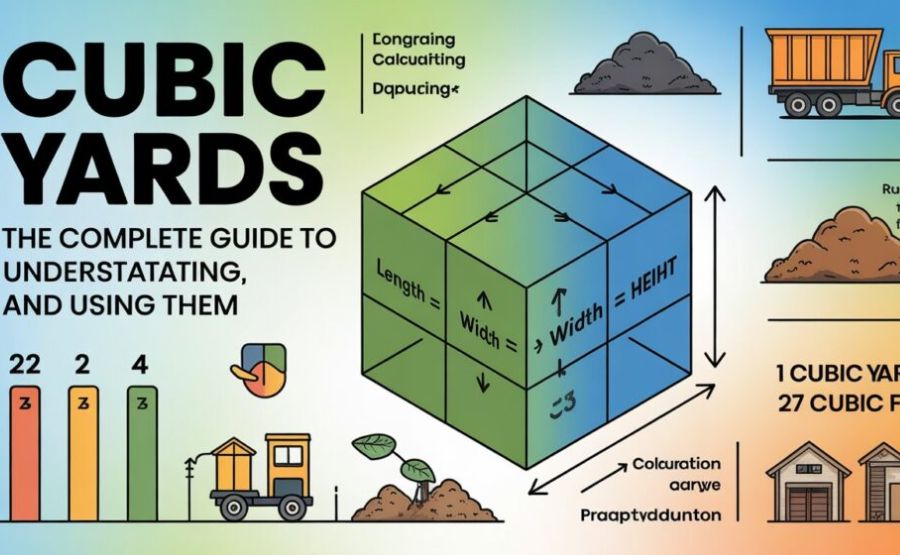
Think about it this way. A yard is 3 feet. A square yard — a flat square with 1-yard sides — is 3 feet × 3 feet = 9 square feet. A cubic yard — a cube with 1-yard sides — is 3 feet × 3 feet × 3 feet = 27 cubic feet.
Each time you add a dimension, you multiply by 3 again. Going from linear to area, you multiply by 3. Going from area to volume, you multiply by 3 again. So compared to a single cubic foot, a cubic yard is 27 times larger, not 3 times.
This is why small errors in your measurements have such large consequences. Miscount your length by 10 percent, and your final volume is off by 10 percent. But if you measure depth in inches and forget to convert — entering 4 instead of 0.33 for 4 inches — your calculation is off by a factor of 12. You’ll order 12 times too much concrete. That is a genuinely expensive mistake that happens to real people.
The Compaction Problem Nobody Warns You About
This is something that always takes folks by surprise.
When you order loose materials — gravel, topsoil, mulch, crushed stone — the delivered quantity is measured in its loose, fluffy state. Once that material sits in place and gets compacted by rain, foot traffic, or machinery, it settles and shrinks.
How much it shrinks depends on the material. Dry soil might compact by 10 to 15 percent. Gravel compacts significantly under weight. Fresh concrete doesn’t compact — it fills its form and stays there — but it can shrink slightly as it cures. Mulch compresses more when wet.
This is exactly why experienced contractors and landscapers always order 10 to 15 percent more than the calculated volume. Not as a safety blanket, but as a precise response to physics.
If your calculation says you need 10 cubic yards of topsoil, order 11 or 11.5. When that soil settles and you’re trying to get a level surface, the extra material becomes the difference between a good result and an expensive second delivery.
There’s also something called the “swell factor” in excavation. When you dig dirt out of the ground, it expands in its loose state by 10 to 15 percent compared to its compacted state underground. A hole that measures 100 cubic yards of in-place earth might yield 115 cubic yards of loose dirt in the dump truck. Project managers account for this when calculating haul trips and disposal costs.
Common Mistakes That Cost Real Money
Let me walk you through the errors that come up most often, because seeing them written out clearly is the best way to avoid them.
Forgetting to convert depth to feet. This is the single most common calculation error. If your project is 4 inches deep, that’s 0.33 feet — not 4 feet. Plugging in 4 instead of 0.33 gives you a result 12 times too large.
Confusing square yards with cubic yards. A square yard is two-dimensional — it measures area. A cubic yard is three-dimensional — it measures volume. Carpets and sod are sold by the square yard. Soil and concrete are sold by the cubic yard. Asking for “yards of topsoil” without specifying cubic can lead to a confusing conversation at the supply yard.
Assuming all trucks hold the same amount. A small single-axle dump truck holds 5 to 7 cubic yards. A tandem axle truck holds 12 to 14. A pickup truck holds 1 to 2, depending on the material’s weight. If you order 6 cubic yards expecting a big truck and a small one shows up, you’re getting two deliveries.
Not measuring depth in multiple spots. Depth is rarely perfectly uniform across a project area. If the ground is uneven, measuring depth in just one spot gives you a number that doesn’t represent the reality of the whole area. Take four or five depth measurements and average them.
Ignoring the weight limits of vehicles. A pickup truck that can carry 1,500 pounds of payload cannot safely carry one cubic yard of wet sand, which weighs close to 3,000 pounds. Volume and weight are separate constraints. Always check both.
Cubic Yards in the Metric World
Outside the United States, construction and landscaping primarily operate in cubic meters. One cubic meter is about 1.308 cubic yards. Or looked at the other way, one cubic yard is about 0.7646 cubic meters.
In practice, if you’re working with a supplier in a metric country or reading a building specification written in metric, you’ll need to convert. The math is simple enough with a calculator, but the underlying concept is identical. Volume is volume. A cube is a cube. The only thing that changes is the unit name and the number on the side.
In the UK, cubic yards were historically common in construction — and some older British documents, trade invoices, and engineering records still reference them. Modern UK construction has largely shifted to cubic meters, but anyone reading historical records or working with older properties may still encounter cubic yards.
The Environmental Side of Getting It Right
This is something worth pondering for a while.
Every time someone over-orders material that goes unused — or under-orders and has to make a second delivery — that’s extra truck trips on the road, extra fuel burned, extra emissions produced. The environmental cost of poor material estimation is real, even if it’s invisible on a project budget.
Accurate cubic yard calculation is one of the simplest and most direct ways a homeowner or contractor reduces waste on a job. Ordering exactly what you need — plus that sensible 10 to 15 percent buffer — means less leftover material sitting in someone’s yard, fewer dump truck runs, less concrete poured into forms and then broken out because it was the wrong amount.
In example, the manufacture of concrete has a large carbon footprint. Cement manufacturing accounts for somewhere around 8 percent of global CO₂ emissions. Overordering concrete and wasting it isn’t just a financial problem — it’s a small but real contribution to that footprint. Getting the cubic yards right matters beyond the invoice.
A Quiet Thought About Measurement
There is something genuinely satisfying about understanding a unit of measurement from the inside. When you know that 27 is the number because 3³ is 3 × 3 × 3, and you know that the yard came from a medieval measuring stick, and you know that your refrigerator is roughly the size of a cubic yard — the number stops being abstract.
Abstract numbers are easy to get wrong. Numbers you can picture are much harder to mess up.
The next time you’re standing in a garden center trying to figure out how much mulch to order, or on a job site trying to estimate a concrete pour, you’ll have the picture. The refrigerator. The 3-foot cube. The 27. The 10 percent buffer.
That’s really all you need.
FAQs
1. What exactly is a cubic yard?
A cubic yard is a unit of volume. It’s the space inside a cube where every side measures exactly 3 feet — 3 feet long, 3 feet wide, 3 feet tall. That works out to 27 cubic feet total. In practical terms, it’s about the size of a standard kitchen refrigerator.
2. How do I calculate cubic yards for a basic rectangular area?
Measure your length, width, and depth all in feet. To get cubic feet, multiply them all together. Then divide by 27 to convert to cubic yards. If your depth is in inches, divide by 12 first to convert it to feet, or use the shortcut formula: Length (ft) × Width (ft) × Depth (inches) ÷ 324.
3. Why do I divide by 27?
Because one yard equals 3 feet, and a cubic yard is 3 feet × 3 feet × 3 feet. That multiplication gives you 27. So one cubic yard contains exactly 27 cubic feet.
4. How much does one cubic yard weigh?
It completely depends on the material. Water: about 1,685 pounds. Concrete: roughly 4,000 pounds (two tons). Dry topsoil: around 2,000 pounds. Sand: roughly 2,700 pounds dry, heavier when wet. Mulch: 400 to 800 pounds depending on moisture. Always check material-specific weight before loading a vehicle.
5. How many wheelbarrow loads make one cubic yard?
Approximately 14 standard wheelbarrow loads. A standard contractor’s wheelbarrow holds roughly 2 cubic feet. Since a cubic yard is 27 cubic feet, you need about 13 to 14 full loads.
6. How much will one cubic yard of mulch cover?
One cubic yard is around 162 square feet at a depth of 2 inches. At 3 inches deep (the standard for landscape beds), it covers about 108 square feet. At 1 inch deep, it covers about 324 square feet.
7. How much will one cubic yard of topsoil cover?
At 2 inches deep, roughly 162 square feet. At 4 inches deep (recommended for new grass), about 81 square feet. At 6 inches deep, about 54 square feet.
8. How many cubic yards fit in a pickup truck?
Typically 1 to 2 cubic yards, but this depends heavily on the truck’s payload rating and the material’s weight. One cubic yard of mulch at 600 pounds might be fine. One cubic yard of wet sand at over 3,000 pounds likely exceeds the payload limit and is unsafe. Always refer to the owner’s handbook to find out your truck’s payload rating.
9. How many cubic yards does a dump truck hold?
A standard full-size dump truck holds 10 to 14 cubic yards of loose material. A smaller single-axle dump truck holds 5 to 7 cubic yards. Always confirm with your supplier before ordering, because truck sizes vary between companies.
10. How much extra should I order?
A standard buffer of 10 percent is common for concrete. For loose materials like topsoil, gravel, or mulch — which compact and settle after delivery — 10 to 15 percent extra is typical. If your terrain is uneven or your depth measurements are approximations rather than precise measurements, lean toward 15 percent.
11. What’s the difference between a square yard and a cubic yard?
A square yard measures a two-dimensional area — like the surface of a floor. It has length and width but no depth. A cubic yard measures three-dimensional volume — it adds depth to the picture. The carpet is sold by the square yard. Mulch is sold by the cubic yard. They are completely different types of measurement.
12. Can I use cubic yards for circular areas?
Yes. Calculate the area of the circle first: π × radius² (in square feet). Then multiply by the depth in feet, and divide by 27. For example, a circular garden bed 10 feet in diameter with 3 inches of mulch: radius = 5 ft, area = 3.14 × 25 = 78.5 sq ft, volume = 78.5 × 0.25 ft ÷ 27 = 0.73 cubic yards.
13. How do I convert cubic yards to cubic meters?
One cubic yard equals approximately 0.7646 cubic meters. To convert, multiply your cubic yard figure by 0.7646. Going the other direction, one cubic meter equals about 1.308 cubic yards.
14. How many bags of concrete mix make one cubic yard?
An 80-pound bag of premixed concrete yields about 0.60 cubic feet. Since one cubic yard is 27 cubic feet, you’d need about 45 bags of 80-pound mix. A 60-pound bag yields about 0.45 cubic feet, requiring about 60 bags. Ready-mix delivered by truck is almost always more practical and less expensive for anything over a few cubic yards.
15. Is a “yard” of concrete the same as a “cubic yard” of concrete?
In construction language, yes. When a contractor says “order 5 yards of concrete,” they mean 5 cubic yards. The word “cubic” is routinely dropped in trade conversations because context makes it clear. In everyday speech outside construction, “yard” usually refers to a linear measurement or a backyard. When someone in a concrete plant or landscape supply yard says “yards,” they always mean cubic yards.
Empowering curious minds to explore, learn, and think deeper with Fact Aura.