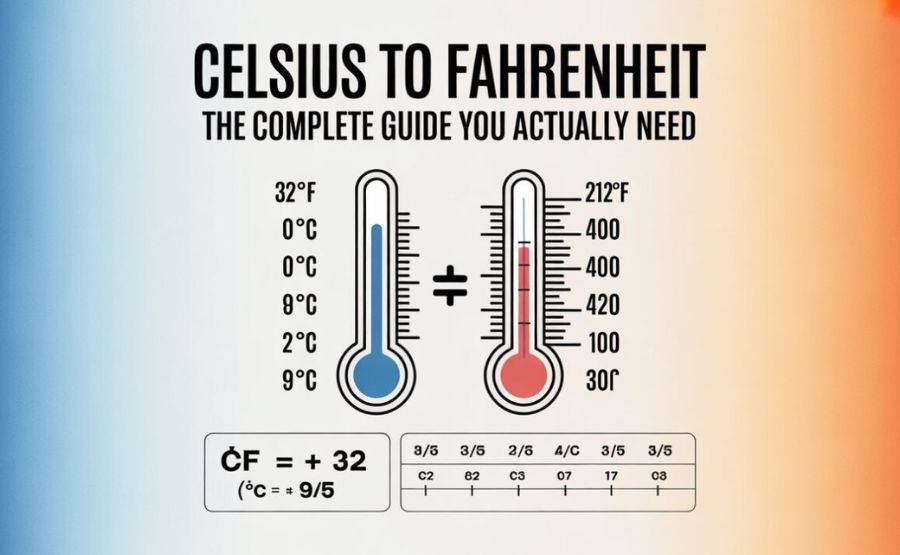
Celsius to Fahrenheit: The Full Story Behind Two Numbers That Describe the Same World
Here is something that stops people mid-thought more often than you’d expect.
You check a weather app set to the wrong units and see 37 degrees. For half a second, your brain panics. Is that a medical emergency or just a nice spring afternoon? It depends entirely on which scale you’re reading.
That uncertainty, that half-second of real uncertainty, serves as a tiny reminder that temperature is more than simply a number. It’s a number tied to a system. And the story of how humanity ended up with two completely different systems for measuring the same thing is one of the more entertaining chapters in the history of science.
Key Facts
| Detail | The Answer |
| Formula: Celsius to Fahrenheit | F = (C × 9/5) + 32 |
| Formula: Fahrenheit to Celsius | C = (F − 32) × 5/9 |
| Water freezes at | 0°C = 32°F |
| Water boils at | 100°C = 212°F |
| Human body temperature | 37°C = 98.6°F |
| Room temperature (comfortable) | Around 20–22°C = 68–72°F |
| The one constant temperature in both | −40° (negative forty is identical in both scales) |
| Who invented Fahrenheit? | Daniel Gabriel Fahrenheit, 1724 (born 1686, Danzig — now Gdańsk, Poland) |
| Who invented Celsius? | Anders Celsius, 1742 (born 1701, Uppsala, Sweden) |
| Celsius was originally called | Centigrade — renamed officially to “Celsius” in 1948 |
| Countries still using Fahrenheit primarily | United States, and a small handful of territories |
| Countries using Celsius | Nearly every other country on Earth |
| The quick mental shortcut (C to F) | Double the Celsius, then add 30 (gives a rough estimate) |
| The quick mental shortcut (F to C) | Subtract 30, then halve it (gives a rough estimate) |
Two Men, One Problem, Two Very Different Solutions
The story begins with the same frustration that every scientist of the early 1700s shared. There was no reliable way to measure temperature. Different thermometers gave different readings. Different makers used different reference points. Two doctors in the same city comparing a patient’s fever couldn’t even trust that their instruments agreed with each other.
Daniel Gabriel Fahrenheit was born in Danzig — today’s Gdańsk, in Poland — in 1686. When he was fifteen, his parents died on the same day. They’d eaten poisonous mushrooms by mistake. That loss sent young Fahrenheit to Amsterdam as a merchant’s apprentice. He was supposed to learn bookkeeping. Instead, he became obsessed with thermometers.
He wasn’t a rebel out of carelessness. He was a craftsman who genuinely believed that precision measurement could change the world. He borrowed money, fell into debt, and at one point was nearly arrested and shipped to Indonesia by furious guardians who were legally responsible for what he owed. He fled the country and kept working.
By 1724, Fahrenheit had built the first practical mercury thermometer — reliable, consistent, readable — and had proposed the scale that now bears his name.
His reference points were unusual. Zero degrees Fahrenheit was the coldest temperature he could reliably create in a laboratory, using a mixture of ice, water, and salt. He then set the human body temperature at 96 degrees, measured by placing the thermometer under his arm. Water happened to freeze at 32 degrees on this scale and boil at 212 — numbers that look random but aren’t, if you understand how the scale was built.
Other scientists recalculated Fahrenheit’s scale to determine the freezing and boiling points of water after he passed away in 1736, possibly from mercury poisoning, which has a sinister poetry to it. exactly 180 degrees apart. That adjustment moved human body temperature from 96 to 98.6, where it sits today.
Anders Celsius came next. He was a Swedish astronomer, born in Uppsala in 1701. His interests were largely the sky — he had published careful observations of the northern lights in Nuremburg in 1733, and that work might have been his main legacy if he hadn’t turned his attention to thermometers.
In 1742, just two years before his death at age 43, Celsius published a paper describing a new scale. It was elegantly simple. Two points: the freezing of water and the boiling of water. One hundred degrees between them. Clean, logical, tied to something every person on earth could observe.
There’s a twist, though. Celsius originally had his scale upside down. Zero was boiling. One hundred were freezing. Other scientists flipped it after he died, making cold the bottom and hot the top. The Celsius we use today is technically a version that Anders Celsius himself never actually used.
He was officially immortalized in 1948, when the international scientific community renamed “centigrade” — which it had been called for two centuries — to “Celsius.” Not bad, as someone once put it, for a man who would have told you your morning coffee was zero degrees.
See also “Does Instagram Notify When You Screen Record a Story? The Honest Answer“
The Conversion Formula (And Why It Looks the Way It Does)
Let’s get into the math, because it’s actually not as complicated as it first appears.
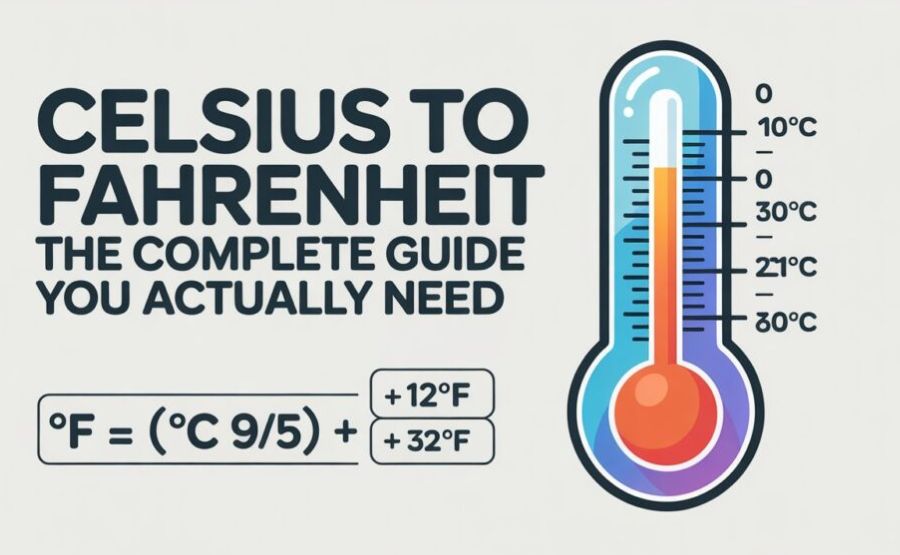
To convert Celsius to Fahrenheit, you use this: F = (C × 9/5) + 32
That 9/5 comes from the fact that there are 180 degrees between water’s freezing and boiling points on the Fahrenheit scale, and 100 degrees between those same points on the Celsius scale. The ratio 180 to 100 simplifies to 9 to 5. So every 1 degree Celsius equals 1.8 degrees Fahrenheit.
The +32 at the end corrects for the offset. Celsius puts zero at water’s freezing point. Fahrenheit puts it much lower — at that cold brine mixture Fahrenheit made in his lab. So when you finish scaling the degrees, you shift the whole thing up by 32 to align the two scales correctly.
Going the other direction — Fahrenheit to Celsius — you reverse it: C = (F − 32) × 5/9
You subtract 32 first to remove the offset, then multiply by 5/9 to scale it back down.
If you just want a quick rough estimate in your head, here’s the trick:
- C to F: Double the Celsius number, then add 30. So 20°C becomes about 70°F (the true answer is 68°F — close enough for most conversations).
- F to C: Subtract 30, then halve it. So 80°F becomes about 25°C (true answer: 26.7°C — again, close enough).
These mental shortcuts won’t serve you in a chemistry lab. But they’ll absolutely get you through a conversation where someone mentions the weather in a unit you’re not used to.
The Temperatures That Actually Matter in Daily Life
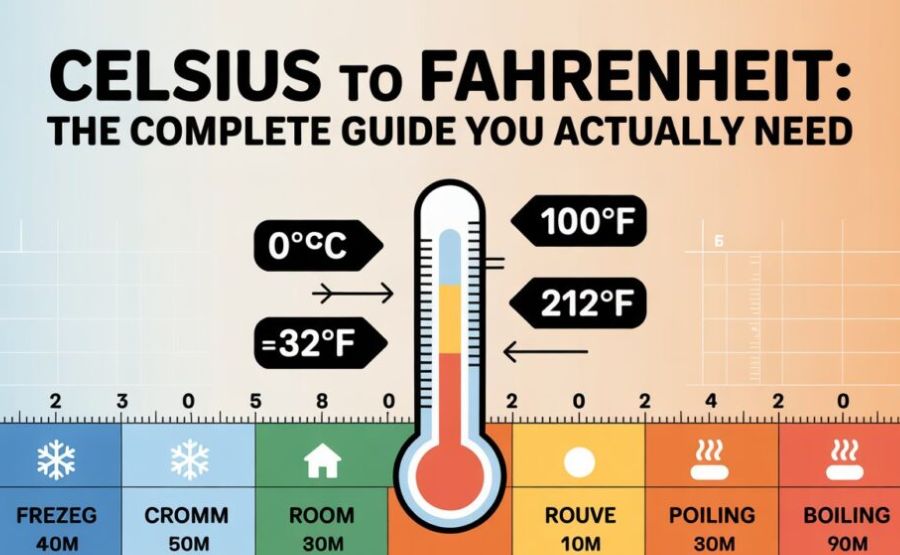
Formulas are fine. But what most people really want is a handful of anchor points — temperatures they can feel in their body and then map onto whichever scale is unfamiliar.
Let’s walk through them.
Freezing: 0°C / 32°F This one is the easiest. Zero Celsius is where water turns to ice. In Fahrenheit, that’s 32. Puddles freeze overnight if the temperature is below either of these, and you should drive carefully in the morning.
A cold winter day: around 0°C / 32°F to −10°C / 14° F. In Fahrenheit, anything in the teens feels genuinely bitter. In Celsius, that’s the negative single digits. Both scales agree that this is the range where you start questioning your life choices if you left the house underdressed.
Cool, pleasant weather: 15–18°C / 59–64°F This is the range that many people call perfect — light jacket weather, good for a walk. Americans might describe this as “the low sixties.” Europeans would say “about 16 or 17 degrees.”
Comfortable room temperature: 20–22°C / 68–72°F Most thermostats in homes and offices are set in this range. In Fahrenheit, the high sixties to low seventies. In Celsius, just over 20. In any case, most people feel at ease in this range without a fan or sweater.
Hot summer day: 30–35°C / 86–95°F Here’s where the scales start to feel quite different intuitively. Thirty degrees Celsius is hot but manageable. Ninety degrees Fahrenheit sounds more extreme than it is. Both describe the same sweaty afternoon at a barbecue.
Fever territory: 38–40°C / 100.4–104°F Normal body temperature is 37°C or 98.6°F. A fever starts officially at 38°C or 100.4°F. When a parent says their child has a temperature of 39 degrees, a European immediately understands that’s concerning. An American hearing that number in Celsius for the first time might wonder if the child needs a blanket.
Dangerous heat: above 40°C / above 104°F Above this threshold, the human body begins to struggle seriously. Heat stroke becomes a real risk. Whether someone says “it’s 42 degrees” or “it’s 107 degrees,” both are describing a situation that demands shade, water, and medical attention if symptoms appear.
Why the US Kept Fahrenheit While the World Moved On
This is the question that most non-Americans — and quite a few Americans — genuinely wonder about.
The honest answer has two parts: history and habit.
Fahrenheit spread through the British Empire. England adopted it in the 18th century, and wherever British colonists and influence went, Fahrenheit followed. America inherited this system and built its infrastructure around it — medical education, cooking traditions, weather broadcasting, construction standards.
Then came the metric revolution. After the French Revolution in the late 18th century, France adopted Celsius as part of a sweeping push toward the metric system. Over the next century and a half, country after country followed. Britain officially switched its meteorological office to Celsius in 1963, though it continued using Fahrenheit for public weather broadcasts into the 1980s.
In the 1970s, the US actually tried to switch. Congress established a Metric Board and made genuine efforts to move toward Celsius and the metric system. Gas stations briefly showed distances in kilometers. But public resistance was strong. People had grown up with Fahrenheit. They understood it in their bones. Asking someone to feel what 22 degrees means instead of 72 felt like asking them to think in a second language.
The effort quietly faded. Today, the US, the Cayman Islands, and a small number of territories remain the primary users of Fahrenheit in daily life. Liberia and Myanmar were mentioned as the only other holdouts for years — though both have announced intentions to change.
There is something interesting in the defense that Fahrenheit supporters make, and it deserves a fair hearing. They contend that human weather experiences are better described by Fahrenheit’s finer-grained scale. Zero to 100 Fahrenheit covers almost the entire range of temperatures a human being would experience in nature — from extreme winter cold to extreme summer heat. It’s a kind of human-centered scale. Zero means dangerously cold. One hundred means dangerously hot. Celsius doesn’t give you that intuitive frame — 0°C is cold but survivable, and 40°C is dangerous but feels like just another number.
Whether that logic justifies keeping an isolated measurement system is another question. But the argument is worth understanding honestly rather than dismissing.
The One Place Both Scales Agree
Here’s a piece of pure mathematical elegance hiding inside an otherwise messy history.
At exactly negative forty degrees, Celsius and Fahrenheit give the same number. Negative 40°C is exactly the same temperature as negative 40°F. The two lines on a graph, heading in different directions at different rates, cross at exactly that point.
This happens because of the math in the conversion formulas. It’s not a coincidence — it falls out of the algebra naturally when you solve for where the two expressions equal each other. But knowing why it happens doesn’t make it feel any less satisfying.
If you’re ever in a situation cold enough to reach −40, the good news is that you no longer need to worry about conversion. The bad news is everything else about being in that situation.
When Getting the Conversion Wrong Actually Matters
Most of the time, mixing up Celsius and Fahrenheit is a minor inconvenience. You pack the wrong jacket. You misjudge whether to bring an umbrella.
But there are situations where the confusion has caused genuine problems.
In medicine, a misread fever temperature can lead to under-treatment or over-treatment. A patient with a temperature of 38.5°C telling an American nurse “I have a temperature of 38 degrees” might get a calm response instead of the urgency warranted — or vice versa, if the nurse assumes Fahrenheit and panics at what sounds like a dangerously low number.
In cooking, Celsius and Fahrenheit oven temperatures are completely different. Setting an oven to 350 when you mean Celsius — if the oven is calibrated in Fahrenheit — means you’re cooking at 350°F (177°C) instead of 350°C (662°F), which would incinerate most things immediately. Most recipes specify which scale they use, but when following instructions from a different country, checking the scale is not optional.
In aviation and meteorology, international standards use Celsius everywhere. Pilots communicating across borders, weather systems that cross the Atlantic, global climate data — all Celsius. An American pilot flying internationally learns quickly that the outside air temperature of −50 they see on instruments is in Celsius, not Fahrenheit.
In science, essentially everyone uses Celsius or Kelvin. Fahrenheit barely exists in academic publishing. If you read a scientific paper about climate change, every temperature in it is in Celsius.
The Bigger Picture: What Temperature Scales Tell Us About How Knowledge Spreads
Step back for a moment and look at what this whole two-scales situation actually represents.
Two men, working within a few decades of each other in the early 18th century, each tried to solve the same problem with different tools and different assumptions. One anchored his scale in the coldest thing he could make in a laboratory. The other anchored his in the freezing and boiling of water — something anyone could observe anywhere on earth.
The global debate was won by Celsius’s scale, in part because it makes more sense, in part because France adopted it first and had a significant cultural influence during the Enlightenment, and in part because themetric system it belongs to is genuinely better suited to science and international trade.
Fahrenheit’s scale survived in one country because that country had built its entire culture, infrastructure, and intuition around it by the time the switch was being seriously proposed. Changing it would have meant retraining hundreds of millions of people to feel temperature differently — not just to do math differently, but to have a different gut reaction to a number.
There is something humanly understandable about that resistance. We measure temperature not just to record it, but to feel it. And how you feel a number is not something you change with a government announcement.
Final Words
The next time you see a weather forecast and you’re not sure which scale you’re reading, don’t feel embarrassed. Two of the brightest scientific minds of the 1700s couldn’t even agree on the right way to do it. One of them had his scale inverted after he died. The other might have been poisoned by the very mercury he used to perfect his thermometers.
Temperature measurement is a human invention. It is flawed, disputed, and closely linked to custom and history. That makes it more interesting than a purely logical system ever could be.
And whether your water boils at 100 or 212, it’s still the same hot water.
FAQs
1. What is the formula to convert Celsius to Fahrenheit?
Multiply the Celsius temperature by 9/5 (or 1.8), then add 32. Written as a formula: F = (C × 9/5) + 32. For example, 25°C becomes (25 × 1.8) + 32 = 45 + 32 = 77°F.
2. How can one convert Fahrenheit to Celsius?
After deducting 32 from the temperature in Fahrenheit, increase the result by 5/9. Written as a formula: C = (F − 32) × 5/9. For example, 98.6°F becomes (98.6 − 32) × 5/9 = 66.6 × 0.556 = 37°C.
3. Is there a quick mental trick for converting between the two?
Yes. For a rough Celsius to Fahrenheit estimate: double the Celsius number and add 30. So 20°C ≈ 70°F (exact is 68°F). For Fahrenheit to Celsius: subtract 30 and halve it. Thus, 80°F is about equal to 25°C (26.7°C). These are fast approximations, not precise answers.
4. In both Celsius and Fahrenheit, what temperature is the same?
Negative 40 degrees. At −40, both scales give identical readings. This is the only point where Celsius and Fahrenheit agree, and it happens because of the mathematics of the conversion formula.
5. What is 100°C in Fahrenheit?
100°C is 212°F. That is the boiling point of water at standard sea-level atmospheric pressure.
6. What is 37°C in Fahrenheit?
37°C is 98.6°F. This is normal human body temperature — the number most people in the US associate with “healthy” on a thermometer.
7. Is 40°C hot for weather or a fever?
Both, actually. As a weather temperature, 40°C (104°F) is dangerously hot — the kind of heat that causes heat stroke if you’re not careful. As a body temperature, 40°C is a high fever that warrants medical attention.
8. Why does the US still use Fahrenheit?
Mostly a historical habit. The US inherited Fahrenheit from British colonial tradition, built its culture and infrastructure around it, and resisted the metric conversion effort that gained momentum elsewhere in the 1960s and 70s. Public familiarity and intuition kept it in place even as nearly every other country switched to Celsius.
9. Who invented the Celsius scale?
Anders Celsius, a Swedish astronomer, published his scale in 1742 — just two years before his death at 43. His original version was inverted from what we use today: 0 was boiling, 100 was freezing. Other scientists flipped it after his death. The name “Celsius” wasn’t officially adopted until 1948, replacing the older term “centigrade.”
10. Who invented the Fahrenheit scale?
Daniel Gabriel Fahrenheit, born in 1686 in Danzig (modern Gdańsk, Poland). He created the first reliable mercury thermometer and proposed his temperature scale in 1724. He died in 1736 at age 50, possibly from mercury poisoning.
11. What is room temperature in both scales?
Comfortable room temperature is generally considered to be between 20°C and 22°C, which is 68°F to 72°F. Most home thermostats are set somewhere in this range.
12. What does 0°F feel like compared to 0°C?
Very different. Zero Celsius is the freezing point of water — cold, but a temperature people regularly experience in winter. Zero Fahrenheit is about −18°C — a serious, dangerous cold that occurs in severe winter storms. The two zeros describe completely different thermal realities.
13. Why does the Fahrenheit formula use 9/5 specifically?
Because there are 180 Fahrenheit degrees between water’s freezing and boiling points, and 100 Celsius degrees between those same points. The ratio 180:100 simplifies to 9:5. This ratio converts the size of degrees between the two scales.
14. Does Celsius make more sense scientifically?
Most scientists would say yes. Celsius aligns cleanly with the metric system and ties its reference points to observable, reproducible physical phenomena — the behavior of water. Kelvin, used in formal physics, simply shifts the Celsius scale so that zero represents absolute zero (the coldest theoretically possible temperature). Fahrenheit doesn’t connect neatly to either system.
15. Are there any other temperature scales besides Celsius and Fahrenheit?
Yes, two significant ones. The Kelvin scale starts at absolute zero (0 K = −273.15°C) and uses the same degree size as Celsius. It’s the standard in physics and chemistry. The Rankine scale does the same thing but for Fahrenheit — it starts at absolute zero using Fahrenheit-sized degrees and is used in some engineering applications, mostly in the US.
Empowering curious minds to explore, learn, and think deeper with Fact Aura.