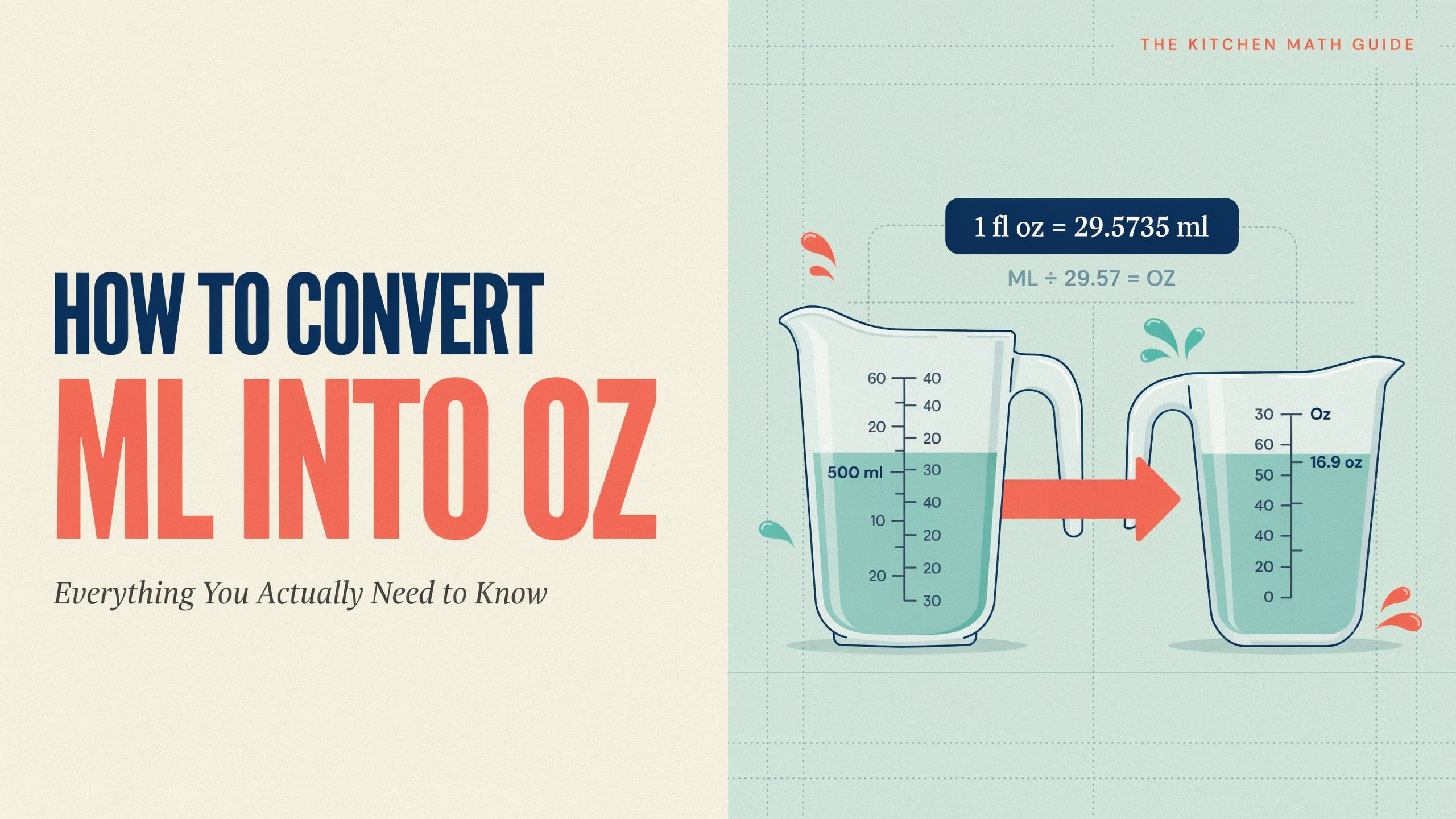
How to Convert ml into oz: Everything You Actually Need to Know
Let me start with something honest. The first time I tried baking a French recipe, I stood in my kitchen holding a measuring jug marked in millilitres, staring at the instructions calling for fluid ounces, and feeling mildly panicked. It looked like it should be simple. It was not, at first.
If you have ever found yourself in that same spot — converting a perfume bottle, measuring out children’s medicine, following a recipe from another country, or just trying to figure out how big that water bottle actually is — this article is for you.
Converting millilitres to fluid ounces is one of those everyday skills that feels small until the moment it really matters. And sometimes, as you will see later, it matters enormously.
Key Facts
| Category | Detail |
| 1 US fluid ounce in ml | 29.5735 ml (exact) |
| 1 UK/Imperial fluid ounce in ml | 28.4131 ml |
| Quick approximation (US) | Divide ml by 30 |
| Precise formula (US) | ml ÷ 29.5735 = fl oz |
| Precise formula (UK) | ml ÷ 28.4131 = fl oz |
| 100 ml in US fl oz | 3.38 oz |
| 500 ml in US fl oz | 16.91 oz |
| 1 litre in US fl oz | 33.81 oz |
| Standard glass of water | 8 US fl oz = 237 ml |
| 1 teaspoon | ≈ 5 ml |
| 1 tablespoon | ≈ 15 ml |
| 1 US cup | 8 fl oz = 237 ml |
| Origin of millilitre | French metric system, late 1700s |
| Origin of fluid ounce | Roman “uncia,” standardised in England |
| Who uses ml | Most of the world (metric system) |
| Who uses fl oz | Primarily USA, with some UK usage |
| Airport TSA liquid limit | 100 ml = 3.38 oz (the “3-1-1” rule) |
Where These Two Units Came From
To understand why converting between ml and oz feels a little clunky, it helps to know that these two units were invented by completely different civilisations, for completely different reasons, at completely different points in history.
The word “ounce” has been around for a very long time. It comes from the Latin word uncia, which meant “a twelfth part” of a Roman pound. Ancient Romans used this unit for both weight and smaller measures. Over centuries, the ounce migrated through different European cultures, picking up slightly different values along the way depending on who was using it and for what.
The fluid ounce specifically — the one we use for liquids — was originally defined in a beautifully practical way. It was simply the volume occupied by one ounce of liquid, usually water or wine. Simple. You had an ounce in weight, and you held it in a container, and that container’s capacity became one fluid ounce. The logic is almost poetic, though as you will discover shortly, that logic eventually led to two slightly different fluid ounces depending on which side of the Atlantic you were on.
In Britain, the Imperial gallon was formally defined in 1824 as the volume of exactly ten pounds of water at a specific temperature — 16.7 degrees Celsius. Working backwards from that gallon, the Imperial fluid ounce became exactly 28.4131 millilitres. In the United States, the fluid ounce had already taken a different path. It was based on the older wine gallon — an English unit that predated the 1824 Imperial definition. After the international inch was standardised in 1959, the US fluid ounce settled at exactly 29.5735 millilitres.
So today we have two fluid ounces with the same name, the same symbol (fl oz), but different sizes. The difference is roughly 4% — close enough that casual everyday use rarely notices it, different enough that precision tasks really do.
The millilitre came from an entirely different direction. When France was going through its Revolution in the late 1700s, reformers wanted to replace the chaotic jumble of regional and traditional measurements with something clean, logical, and universally shared. The result was the metric system — a decimal-based framework where everything scales neatly by tens. The litre became the base unit of volume, and the millilitre — one thousandth of a litre — followed naturally from it. The word “litre” itself came from the older French term litron, which had been a measure in its own right before the Revolution swept it into a new and tidier system.
The metric system spread across Europe and eventually most of the world. The United States, however, kept its own measurement traditions — the customary system built on those older British units — and that is largely why this conversion question comes up so often today.
See also “How to Find Jobs on LinkedIn: A Real, Honest Guide for Today’s Job Seeker“
The Actual Maths — and How to Do It in Your Head
The precise conversion for the US fluid ounce is:
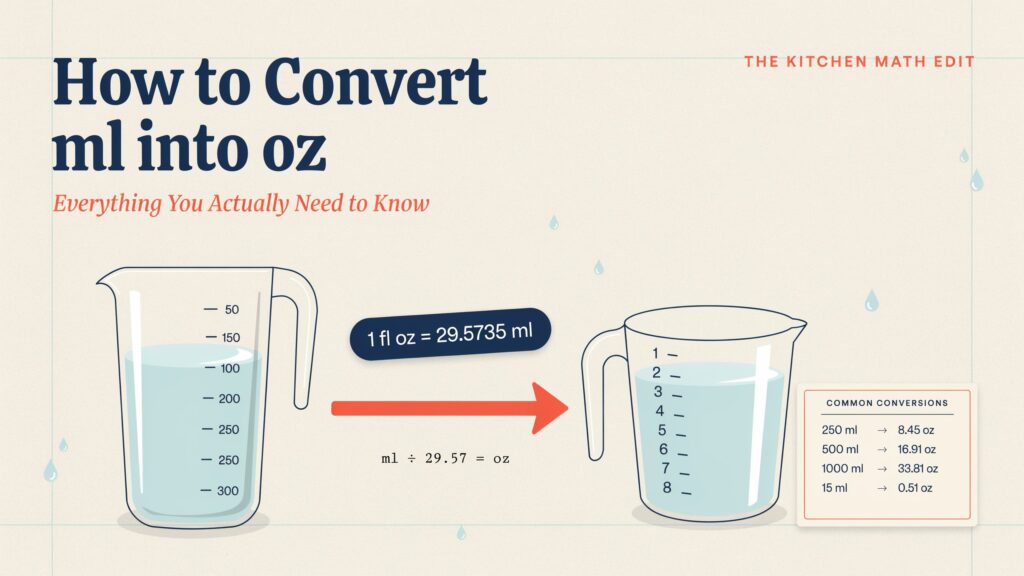
1 fl oz = 29.5735 ml
So to convert millilitres to US fluid ounces, you divide by 29.5735.
If you need the Imperial (UK) version, you divide by 28.4131 instead.
For most everyday purposes — cooking, making drinks, checking a shampoo bottle — dividing by 30 works perfectly well as a mental shortcut. It gives you a small rounding error (about 1.4%), but your soup or smoothie will not know the difference.
A few anchor numbers worth keeping in your head:
100 ml = 3.38 oz. This is the airport security liquid limit, and it is worth knowing cold. TSA’s “3-1-1” rule says carry-on liquids must be in containers of 3.4 oz or less. That is 100 ml. Most travel-sized products sold in airports and pharmacies mark both numbers on the label.
250 ml = 8.45 oz. Half a 500 ml bottle is roughly 8.5 oz — slightly more than one US cup.
500 ml = 16.91 oz. A standard 500 ml water bottle, the kind you might grab at a petrol station or gym, is just under 17 oz.
1 litre = 33.81 oz. A full litre is very close to 34 oz.
30 ml ≈ 1 fl oz. This is the bartender’s rough rule, the pharmacist’s quick estimate, and the shortcut that appears on nutrition labels.
Where You Encounter This Conversion in Real Life
Honestly, the places where you need to convert ml to oz are so varied that it is almost surprising this skill is not taught more deliberately.
In the kitchen. Recipes from different countries use different systems. A French recipe will specify liquid ingredients in millilitres. An American one will give you cups and fluid ounces. A British one might do either, or switch between them mid-recipe, which feels like a small betrayal. Knowing that 240 ml equals roughly one US cup, or that 30 ml is approximately one US tablespoon, gets you through most recipes without a converter on your phone.
At the airport. Every traveller who has had a full-sized bottle of conditioner confiscated at security understands this one viscerally. The rule is 100 ml maximum per container. Products sold in Europe and most of the world are labelled in ml. Products sold in the US are labelled in fl oz. Knowing that 100 ml = 3.38 oz means you can confidently read either label and know whether it will pass.
With medicines and supplements. This is where getting it right genuinely matters. Liquid paracetamol for children is typically dosed in millilitres. Liquid vitamins are sometimes labelled in ounces. Some supplement serving sizes are written one way while the shaker bottle is marked the other. Studies have found that parents giving children medicine by teaspoon rather than the prescribed millilitre dose can be 20 to 50 percent off in either direction — because kitchen spoons are not standardised. An actual 5 ml measuring spoon or a marked syringe is always safer.
With perfume and cosmetics. Fragrance is an interesting case because the industry has simply embraced both systems on the same label. A perfume bottle from a French house will say “50 ml / 1.7 fl oz” on the box. A moisturiser from Korea will say “100 ml / 3.4 fl oz.” These products are sold internationally, and manufacturers know their customers live in different measurement worlds. Once you know that 50 ml is about 1.7 oz and 100 ml is about 3.4 oz, reading those labels becomes second nature.
In coffee and cocktails. Specialty coffee recipes — pour-over ratios, cold brew concentrations — are often written in millilitres in brewing guides, while American home cooks measure in ounces. Bartenders deal with this constantly. A standard jigger pour of one ounce is about 30 ml. Cocktail recipes from different countries sometimes mix the two systems within a single recipe, which is genuinely maddening when you are trying to make a Negroni at midnight.
The Common Misconceptions Worth Clearing Up
“1 oz is exactly 30 ml.” This is close enough for most cooking, but not quite right. The precise figure is 29.5735 ml. For casual use, round to 30. For medicine, chemistry, or commercial labelling, use the exact number. The rounding adds up.
“An ounce is an ounce.” Not always. A fluid ounce measures volume. A regular ounce — the kind you weigh flour or gold with — measures mass. These are completely different things with the same confusing name. One fluid ounce of water weighs approximately one ounce (by mass), which is where the original definition came from. But one fluid ounce of olive oil weighs slightly less than one ounce, because oil is less dense than water. You cannot use a kitchen scale to measure fluid ounces unless you know the density of whatever you are measuring.
“50 ml is about 2 oz.” This one comes up enough to be worth addressing directly. Fifty millilitres is approximately 1.69 oz — noticeably less than 2 oz. If you round it up to 2 oz, you are adding nearly 20 percent extra volume. In baking, that kind of margin can genuinely change the result.
“US ounces and UK ounces are the same.” They are not, though they are close. A fluid ounce in the US equals 29.57 milliliters. A UK Imperial fluid ounce is 28.41 ml. For most everyday purposes this 4% difference is invisible. But for pharmaceutical production, food manufacturing, or international labelling, it can matter. Always check which system a measurement is using.
When Getting It Wrong Has Real Consequences
This is where the story gets genuinely serious, and it is worth spending a moment on.
In September 1999, NASA lost the Mars Climate Orbiter — a spacecraft that had taken nine months and $327 million to build and send to Mars. The cause of the loss was a unit conversion error. One engineering team at Lockheed Martin was sending thruster data in imperial units (pound-force seconds). Newton-seconds, or metric units, were anticipated by NASA’s navigation algorithms. Nobody caught the mismatch across months of mission planning. The spacecraft entered the Martian atmosphere at the wrong angle and burned up.
One calculation. One missed unit check. Three hundred and twenty-seven million dollars, and years of scientific research, gone.
A Boeing 767 operated by Air Canada ran out of fuel in midair in 1983. The ground crew had calculated the fuel load in pounds rather than kilograms — because it was the airline’s first aircraft to use metric fuel measurement, and the system was unfamiliar. The plane glided silently for over a hundred kilometres before the pilots managed an emergency landing on a disused airstrip in Gimli, Manitoba. This event is now called the “Gimli Glider.” Miraculously, only a few minor injuries occurred.
On a more personal scale, medical dosing errors involving millilitres and ounces cause real harm every year. Parents sometimes confuse ml with teaspoons when following dosing instructions, because kitchen spoons vary so widely in actual volume. That variability can mean a child receives half the dose they need — or double what is safe.
These examples are not meant to alarm you. Most of the time, rounding 29.57 to 30 and getting on with your day is entirely fine. But they are reminders that precision is not an abstract virtue. It is a practical one. In some contexts, it is a safety one.
A Quick Reference for Common Conversions
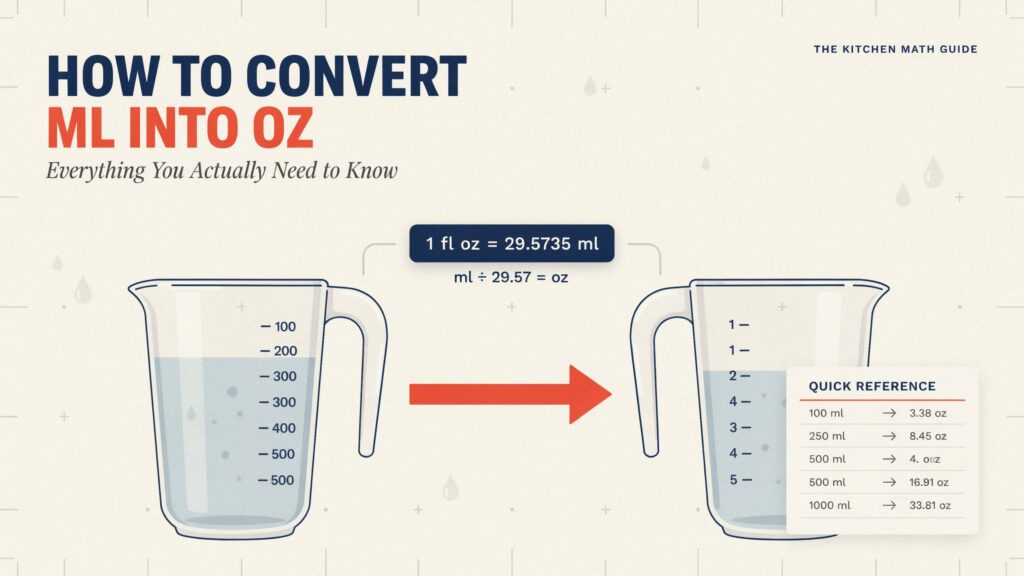
Rather than reaching for your phone every time, these are the ones worth memorising:
5 ml = 0.17 oz (one teaspoon — for medicine spoons and small recipe measurements)
15 ml = 0.51 oz (one tablespoon)
30 ml ≈ 1 fl oz (the bartender’s rule, the rough dosing guide)
50 ml = 1.69 oz (a small perfume, a single-serve spirit)
100 ml = 3.38 oz (the airport limit)
237 ml = 8 fl oz (one US cup, a standard glass of water)
330 ml = 11.16 oz (a standard small soda or beer can)
500 ml = 16.91 oz (a standard water bottle, close to 17 oz)
1000 ml = 33.81 oz (one litre — about 34 oz, or just over 4 US cups)
Why the World Still Uses Two Systems
This is something that many people find surprising. The goal of the metric system was to make it universal. It largely succeeded — the vast majority of countries in the world use metric as their primary system of measurement. Science operates almost entirely in metric, which is why your medication is dosed in millilitres and your lab results come back in litres and grams.
The United States is the most prominent holdout. It is one of only three countries in the world that has not formally adopted the metric system as its primary everyday standard (the others are Myanmar and Liberia). The US actually tried to switch twice — including with a formal Metric Conversion Act passed in 1975 — but the effort was voluntary, public enthusiasm was low, and the cost of industry retooling was significant. So the US kept its customary system, and the rest of the world kept metric, and the conversion question has been a fixture of everyday life ever since.
This is not a simple matter of stubbornness or backwardness. The infrastructure, labelling, packaging, tools, and cultural practices of the United States are all based on its traditional units. Changing those systems would cost billions of dollars and decades of adjustment. Whether the long-term benefits would outweigh those costs is a genuine debate — and one that does not have a simple answer. But it does explain why, for the foreseeable future, you will keep needing to convert between ml and oz in daily life.
The Broader Picture: Measurements and Trust
There is something quietly important about shared measurements that we rarely stop to think about.
When a pharmacist fills your prescription, they need to be working in the same units as the doctor who wrote it. When a food manufacturer labels a product for sale in multiple countries, they need to accurately represent what is inside. When a recipe is shared online and read by cooks in ten different countries, the measurements need to translate clearly across all of them.
Shared, accurate measurement is a form of trust. It says: what you see is what you get. The number on the label matches what is in the bottle. The dose in the instructions is the dose in the syringe. Measurement errors — even small ones — erode that trust, and sometimes they do worse than that.
There is also something worth appreciating about the elegance of both systems, even in their incompatibility. The metric system, built in a revolutionary spirit of rational order, is wonderfully consistent. Everything scales by tens. One millilitre of water weighs one gram. One litre weighs one kilogram. The whole thing clicks together like a well-designed machine.
The fluid ounce, meanwhile, carries centuries of human history in its name — from Roman merchants measuring wine, through medieval English markets, to the kitchens and pharmacies and airports of today. It is a unit that evolved through human use rather than being designed from the top down. There is a certain warmth to that, even if it makes the maths slightly harder.
Some Gentle Practical Wisdom
If you cook internationally — pulling recipes from websites and cookbooks across different countries — consider writing your own conversion cheat sheet and keeping it on your fridge. It takes five minutes to make and saves real frustration.
If you give liquid medicine to children, please use the measuring device that comes with the product or a proper pharmacist’s measuring spoon. Kitchen spoons vary wildly and the stakes are high enough to warrant the extra care.
If you travel frequently, remember that 100 ml and 3.38 oz are the same number wearing different outfits. Just one of them needs to stick in your memory.
And if you are using a digital converter — the kind you find online or on your phone — double-check that it is using US fluid ounces rather than Imperial ones. For most everyday purposes in a global context, US fluid ounces are the default assumption, but it is worth confirming for anything precise.
Thoughtful Reflections
Something I find quietly wonderful about this whole topic is how it connects us to such a wide sweep of human history. The Roman uncia. The French Revolution’s dream of a rational world. Two different definitions of a gallon, set by two different governments, a century apart. A NASA spacecraft lost to a single unconverted number.
Measurements are not just numbers. They are agreements between people about how to share and communicate reality. When those agreements break down — or when two groups are using different agreements without realising it — the consequences range from a slightly flat cake to a spacecraft burning up in a foreign atmosphere.
Most days, converting ml to oz is genuinely no big deal. Divide by 30. Move on. Enjoy whatever you are cooking or drinking or packing. But on the days when precision matters — in a hospital, in a laboratory, on a spacecraft — it matters completely.
That is worth knowing. And worth getting right.
FAQs
1. What is the formula to convert ml to oz?
Divide the number of millilitres by 29.5735 to get US fluid ounces. For UK (Imperial) fluid ounces, divide by 28.4131. For a quick mental estimate, dividing by 30 is close enough for most everyday purposes.
2. How many ml is 1 fluid oz?
One US fluid ounce equals 29.5735 ml. 28.4131 milliliters is one UK Imperial fluid ounce. In most global contexts, the US version is assumed unless specified otherwise.
3. Is 30 ml the same as 1 oz?
Very nearly, but not exactly. One US fluid ounce is 29.5735 ml — about 0.4 ml less than 30. For cooking and casual use, the “30 ml = 1 oz” rule works fine. For medicine or precise labelling, use the exact figure.
4. How many oz is 100 ml?
One hundred millilitres equals 3.38 US fluid ounces. This is the number that matters at airport security, where the TSA liquid limit is 3.4 oz (100 ml).
5. How many oz is 500 ml?
Five hundred millilitres equals approximately 16.91 US fluid ounces. A standard 500 ml water bottle is just under 17 oz.
6. Is a fluid ounce the same as a regular ounce?
No. Volume, or the amount of space a liquid occupies, is measured in fluid ounces. Weight or mass is measured in standard ounces. They have the same name because one fluid ounce of water originally weighed one ounce — but this relationship only holds for water, not for other liquids.
7. Why are there two different fluid ounces — US and UK?
They developed from different definitions of the gallon. In 1824, Britain redefined its Imperial gallon based on the weight of water, producing a fluid ounce of 28.41 ml. The United States kept the older wine gallon as its basis, resulting in a slightly larger fluid ounce of 29.57 ml. The difference is about 4%.
8. How can I reverse the conversion from oz to ml?
Multiply the number of fluid ounces by 29.5735 for the US version, or by 28.4131 for the UK version. So 8 oz × 29.5735 = 236.6 ml — roughly one US cup.
9. What is 250 ml in oz?
Two hundred and fifty millilitres equals approximately 8.45 US fluid ounces. It is close to one US cup, which is officially 8 fl oz (237 ml). Many countries treat 250 ml as one “cup” — slightly more than the US definition.
10. Why does airport security say 100 ml / 3.4 oz?
Because 100 ml equals 3.38 US fluid ounces, which is rounded to 3.4 oz on signage. The rule applies the same limit in both measurement systems — you can read it in whichever system your toiletry bottle uses and know you are within the limit.
11. Does temperature affect ml to oz conversions?
For most everyday purposes, no. Liquids do expand slightly when warm and contract when cool, but the change at normal temperatures is so small it does not affect cooking, medicine, or travel measurements. You would only need to account for temperature in very precise scientific or industrial laboratory work.
12. How do I convert ml to oz without a calculator?
Use the “divide by 30” shortcut. It introduces a small rounding error of about 1.4% but works perfectly for most daily needs. You can also memorise a few anchor numbers: 100 ml ≈ 3.4 oz, 250 ml ≈ 8.5 oz, 500 ml ≈ 17 oz, 1000 ml ≈ 34 oz.
13. Why does medicine use ml instead of oz?
The medical and pharmaceutical world operates in the metric system globally because it is more precise, more consistent, and less prone to confusion. A milligram is always a milligram. A millilitre is always a millilitre. The lack of ambiguity between systems reduces the risk of dangerous dosing errors, which is why doctors and pharmacists worldwide use metric units regardless of what country they work in.
14. Are perfume bottles labelled in both ml and oz?
Yes. Most internationally sold perfumes and cosmetics carry both measurements on the packaging — for example, “50 ml / 1.7 fl oz” or “100 ml / 3.4 fl oz.” Manufacturers do this because their products are sold in countries using both measurement systems and they want the label to be clear to all buyers.
15. What is the easiest way to remember ml to oz for everyday cooking?
Keep three numbers in your head: 30 ml is roughly 1 oz, 240 ml is roughly 1 cup (8 oz), and 500 ml is roughly 17 oz. With those three anchors, you can estimate almost any common cooking conversion without needing a calculator. For anything more precise, a phone calculator takes about four seconds.
Empowering curious minds to explore, learn, and think deeper with Fact Aura.