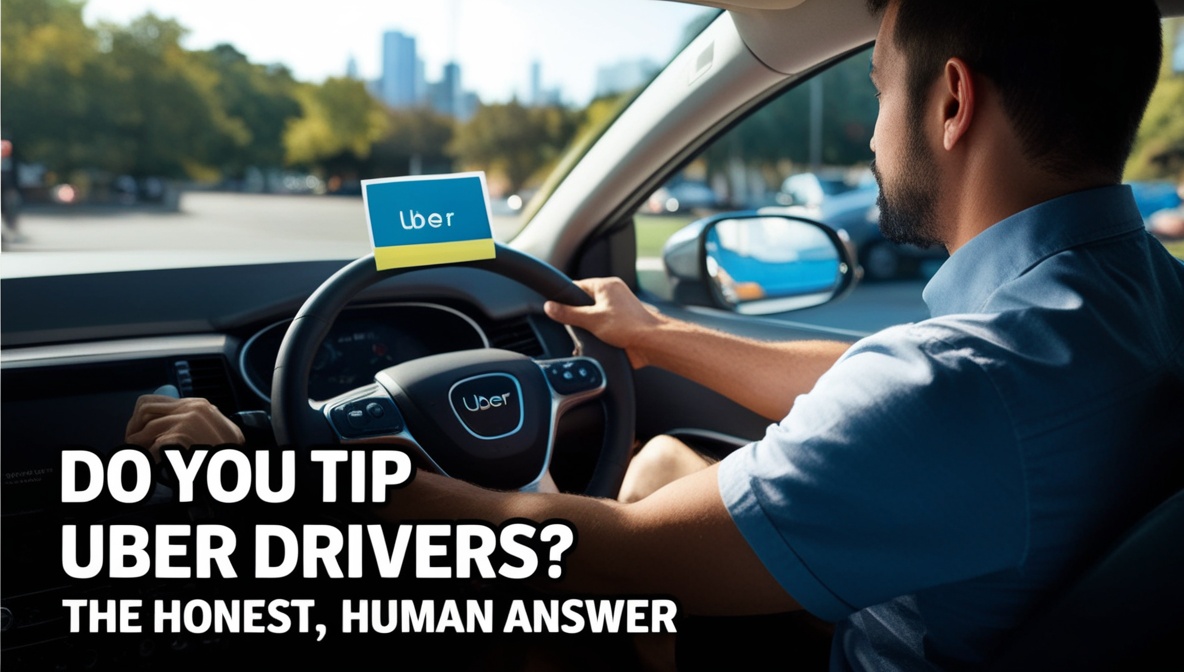
Do You Tip Uber Drivers? The Honest, Human Answer
Let’s be real — that moment right after your Uber ride ends can feel surprisingly awkward. The app pops up, you rate your driver, and then there it is: the tip screen. A few preset options staring at you. Your finger hovers. And somewhere in the back of your head a small voice whispers: am I actually supposed to do this?
You’re not alone at that moment. Millions of people feel the exact same flicker of confusion every single day. The reason the confusion exists in the first place is actually kind of interesting — and once you understand it, the answer to “should I tip?” becomes a lot clearer.
So let’s talk about it. All of it — the history, the money, the human side, the ethics, and what you probably want to know most: how much.
Key Facts
| Fact | Detail |
| Is tipping required? | No — Uber officially calls it optional |
| Does Uber take a cut of tips? | No — 100% goes directly to the driver |
| When did in-app tipping launch? | June 2017, as part of Uber’s “180 Days of Change” |
| What percentage of rides get tipped? | About 28% (roughly 1 in 4), per Gridwise 2024 data |
| How much do Americans tip (when they do)? | Etiquette experts recommend 15–20% of the fare |
| Minimum tip recommended? | $3, even on short cheap rides |
| How long do you have to tip after a ride? | Up to 30 days via the app |
| Can you tip in cash? | Yes — and many drivers actually prefer it |
| Do drivers earn a living wage without tips? | Often not — net pay after expenses can be $10–15/hour |
| How much of a driver’s income comes from tips? | Around 10%, far less than food delivery workers |
| Are riders affected by tipping behavior? | Possibly — some drivers rate passengers differently |
| Is tipping on Waymo/AV rides required? | No — autonomous rides don’t have tipping options |
How We Got Here: The Strange History of “No Need to Tip”
To understand why people are confused about tipping Uber drivers, you have to go back to when Uber first launched.
When the company started around 2010, one of its big selling points was how clean and cashless the whole experience felt. No fumbling for bills. No awkward handoff. The fare covered everything, they said. Some of their early marketing actually used language like “the tip is included.”
Except it wasn’t. Not even close.
Drivers were self-employed individuals who paid for their own vehicles, gas, and insurance. Driving in rain, snow, or extreme heat is genuinely harder and more stressful. And for years, the app didn’t even have a tip option. Cash tips were technically allowed, but Uber actively discouraged the whole idea. In 2016, Uber even published a post defending their no-tipping stance, claiming that tips could create bias — that people might tip certain types of drivers more than others based on things that had nothing to do with service quality.
There’s some truth in that. Studies show tipping does involve bias. But the bigger picture is that Uber was also cutting driver pay significantly during that same period. In the early days, an uberX driver in Los Angeles earned around $2.40 per mile and Uber took a 5% cut. By the mid-2010s, drivers were earning $1.10 per mile and Uber was pocketing 25%.
The drivers weren’t happy. And eventually, the pressure became too great to ignore.
In June 2017, as part of a campaign Uber called “180 Days of Change,” the company flipped its position and launched in-app tipping nationwide. Suddenly, the thing they had spent years telling riders wasn’t necessary became a feature they were actively promoting.
That reversal created a culture whiplash that still lingers today. Seven years of “you don’t need to tip” had settled into a habit for a lot of riders. And habits are sticky things.
See also “Keine Karriere-Subdomain Gefunden: What That Strange Message Actually Means“
What Tipping Actually Means for a Driver’s Life
Here’s where it gets personal. Because this isn’t just about percentages on a screen — it’s about real people trying to make a living.
Uber drivers are not employees. They’re independent contractors, which means Uber doesn’t pay their health insurance, doesn’t contribute to their retirement, doesn’t cover car maintenance, and doesn’t guarantee them a minimum number of rides per hour. The driver sitting in that front seat is running a small business with their vehicle as the only tool.
Think about what that means in practice. Every mile they drive wears down their car. Gas prices fluctuate and they absorb every penny of it. Insurance for a vehicle used commercially costs more than a standard personal policy. And in 2025, with vehicle costs running somewhere between 67 and 80 cents per mile just to operate, the math gets tight quickly.
Gross earnings for Uber drivers range from roughly $18 to $28 per hour during active driving time. But “active driving time” is the key phrase. It doesn’t count the waiting between rides, the driving to a pickup location, or the slow stretches where requests just aren’t coming in. Factor all of that in, subtract expenses and the self-employment taxes that gig workers pay entirely on their own, and many drivers end up taking home somewhere between $10 and $15 per hour — sometimes less in expensive cities.
That’s often below the minimum wage for salaried workers in many states.
One driver put it bluntly in a comment online: her passenger paid $96 for a ride. She received $27 of it.
Tips don’t fully fix that problem. But they help in a real, immediate way. According to surveys of rideshare drivers, roughly 80% say tips meaningfully affect both their total income and how happy they feel doing the job. It’s not just about the money. It’s about whether the person in the backseat sees you as a person doing real work.

The 28% Problem: Why Most Rides Don’t Get Tipped
Here’s a number worth sitting with: according to Gridwise Analytics’ 2024 data, only about 28% of Uber rides result in a tip.
That means about 3 in every 4 rides — someone gets into a car, gets delivered safely to their destination, and leaves without contributing anything extra.
Compare that to food delivery. Nearly 9 out of 10 delivery orders get tipped. And a delivery driver doesn’t share a moving vehicle with you for 20 minutes. They don’t navigate traffic, keep the car clean for you, or adjust their driving based on your comfort. They walk food to a door.
Why the gap? A big part of it traces directly back to Uber’s original messaging. When a company spends years telling you that tipping isn’t necessary, the habit of not tipping takes root. And once you stop expecting to tip somewhere, it genuinely doesn’t occur to you.
There’s also the psychology of the app itself. When you tap through a rating screen and a tip screen quickly, it’s easy to skip both without much thought. It doesn’t feel like someone is watching. It doesn’t carry the social weight of handing someone cash while they’re standing in front of you.
A Pew Research survey from 2023 found that 61% of Americans say they tip ride-share drivers. But the actual per-trip tipping rate sits at 28%. That gap tells you something real: people tip sometimes, not always. They remember tipping at the airport because they had heavy bags. They forget to tip on a Tuesday afternoon when they’re running to a meeting.
How Tipping Works in the App (and Why Cash Still Has Fans)
After your ride ends, Uber prompts you to rate your driver. Once you submit a rating, the tip option appears. The app usually suggests preset amounts — often something like $1, $2, or $5 — plus a custom amount field.
A few things worth knowing:
The tip is not connected to your name. It shows up in your driver’s earnings as being associated with a specific trip, not your personal profile. So there’s no reason to feel strange about what you tip — the driver won’t link it to “you” specifically in any ongoing way.
All of it goes to the driver. Uber takes zero fees on tips. That’s actually one of the few areas where Uber’s policy directly benefits drivers with no cut taken.
You have 30 days to tip after a trip. Forgot in the moment? Open the app, go to Trip History, find the ride, and you can add a tip any time within that window. You can also do it from the email receipt Uber sends you.
Now, cash tips. Many experienced drivers will tell you they genuinely prefer them. The reason is timing — a cash tip is immediate. No waiting for app processing or the next payment cycle. Drivers can use it that same day for gas. There’s also something about the directness of it. A folded bill passed between two people says something that a tap on a screen doesn’t quite capture.
If you want to tip in cash, just have a few small bills ready. Hand it over as you step out. A simple “thank you, this is for you” is all you need to say.

How Much Should You Actually Tip?
The consensus is pretty clear across etiquette experts, gig economy researchers, and driver surveys: aim for 15–20% of the fare.
That mirrors what you’d tip a restaurant server, and the logic is similar. These are people in a service role whose base pay doesn’t always reflect the full value of what they’re doing.
For a $15 ride, that puts you around $2.25 to $3. For a $30 ride, somewhere between $4.50 and $6. For longer or pricier trips, scale accordingly.
One practical floor: never tip less than $3, regardless of what the percentage math gives you. A 15% tip on a $10 ride is $1.50. That’s not nothing, but it doesn’t feel like much to someone who just drove across town in traffic. $3 is a meaningful baseline.
There are times when going higher makes real sense:
When the weather is bad. It is actually more difficult and stressful to drive in the rain, snow, or intense heat. Add a few dollars.
When you had a lot of luggage. The driver physically helped you. That’s worth something extra.
When the ride was long and late at night. Late-night and overnight drivers are sacrificing sleep to be available when you need them.
When the car was clean and comfortable, the driver was friendly, they offered water or a charger, or they simply made the ride pleasant. If you noticed it positively, tip accordingly.
On surge-priced rides, one smart tip: base your calculation on the standard fare, not the surge total. The driver didn’t set the surge price — Uber’s algorithm did. They benefit from some of it, but they don’t control it.
The Rating System: A Word of Honest Caution
Uber is a two-way street. You rate your driver, and your driver rates you.
Your passenger rating matters more than most riders realize. Before accepting a ride, drivers can view your rating. A rider sitting at a 4.5 is noticeably less attractive to pick up than someone at a 4.9. Some drivers will simply decline requests from low-rated passengers.
Does tipping affect your rating? Officially, Uber says no. Ratings and tips are handled separately, and drivers submit their passenger rating before they know whether you tipped. But in practice, the relationship is murkier. Some drivers have shared online that they do occasionally adjust ratings after a ride based on whether a tip came through. Others say they’d never do that. The driver community is genuinely divided on this.
What’s not disputed: riders who are polite, easy to talk to (or easy to leave in silence), ready when the driver arrives, and who tip regularly tend to have better experiences overall. There’s a natural positive loop that forms when you treat the whole exchange as a human interaction rather than a transaction.
Common Misconceptions Worth Clearing Up
“The fare already covers everything.” It doesn’t. The fare covers Uber’s platform fee, a portion to the driver, and any surge. It does not include a tip. Never has, despite what early marketing implied.
“Tipping Uber is different from tipping a restaurant.” Yes, in a sense. But in the ways that matter economically, they’re very similar. Both involve a service worker doing real labor for a fee that doesn’t always reflect that labor’s true value.
“Uber drivers make good money.” On paper, gross hourly rates look decent. Once you subtract vehicle costs, gas, self-employment tax, and unpaid waiting time, the real picture is much less comfortable.
“If the service was fine, I don’t need to tip extra.” This one comes from a reasonable place — we associate tips with exceptional service. But for gig workers, tipping on a standard solid ride is the norm, not the exception. A driver who got you where you were going safely, on time, in a clean car, without incident — that’s a job done well and worth acknowledging.
“I can’t afford to tip every time.” Totally fair. If money is genuinely tight, skip the tip and don’t feel guilt about it. What you shouldn’t do is have the money and just not bother because it feels optional.
The Bigger Question: Is It Right That Tips Fill This Gap?
Here’s where things get a little uncomfortable, and it’s worth sitting with.
The fact that Uber drivers depend on tips to make ends meet is, at its core, a sign that the base pay structure isn’t working for them. A driver who earns $27 from a $96 fare — while bearing all the vehicle costs — is in a system that’s tilted away from them.
Tipping in America has a complicated history. It started in medieval Europe and arrived in the United States in the 1800s, imported by wealthy Americans who’d seen it done abroad. After the Civil War, it became a way for employers — particularly in railroads and hotels — to avoid paying full wages to Black workers who had recently been freed from slavery. The system effectively made customers responsible for subsidizing labor that should have been employer-funded.
That history doesn’t make tipping wrong today. But it does raise a reasonable question: should workers’ incomes depend on the generosity of individual customers, or should companies be responsible for paying living wages?
A lot of people feel both things at once. They tip because drivers need it now. And they think the whole system should be reformed so that the need for tips is much smaller.
It is possible for both to be true simultaneously.
What the Future Might Look Like
Something worth mentioning: autonomous vehicles are already on Uber’s platform in a few cities. Waymo self-driving cars are available through the Uber app in Austin, Atlanta, and Phoenix. And when you ride in one? There’s no tip option. No one to tip.
That’s a glimpse of what might come. As autonomous vehicles expand, the role of human drivers — and the question of tipping — will slowly change shape. For now, millions of human drivers are on the road every day, and the tipping question is very much alive.
When the day comes that most rides are driverless, the confusion around tipping will dissolve on its own. But that day isn’t here yet. The person driving you this afternoon woke up this morning, insured their car, filled the tank, and showed up. That still means something.
Final Words
I’ve spent time with all of this — the statistics, the history, the arguments from every direction — and here’s where I land.
Tip your Uber driver. Not because you’re required to. Not out of guilt. But because 15–20% of a $20 fare is three or four dollars, and that amount is genuinely meaningful to someone who’s out there absorbing costs their employer isn’t covering.
The people who don’t tip are often not bad people. For years, they were assured they didn’t have to. That habit is hard to break. But now you know better, and knowing better is all it usually takes.
Give yourself five seconds this week to use the app to leave a tip when you exit an Uber. Or hand the driver a few bills and say thank you. It’s a small thing to you. It’s a small thing to them.
FAQs
1. Is tipping an Uber driver required?
No, it’s not required. Uber officially calls it optional. But etiquette experts and driver surveys consistently say it’s become the expected standard, much like tipping at a restaurant.
2. How much should I tip my Uber driver?
Aim for 15–20% of the fare, with a minimum of $3 on any ride. So a $20 ride warrants $3–4. A $40 ride, $6–8. Scale up for exceptional service, bad weather, or heavy luggage.
3. Does Uber take a percentage of my tip?
No. Every dollar you tip goes directly to the driver. Uber takes zero fees from tips.
4. Can I tip my Uber driver in cash?
Yes, and many drivers prefer it. Cash is immediate — they can use it for gas the same day without waiting for app processing.
5. What if I forget to tip right after the ride?
No problem. You have 30 days to add a tip through the Uber app (go to Trip History, select the ride), through riders.uber.com, or via the email receipt Uber sends you.
6. Will not tipping affect my passenger rating?
Officially, no — Uber separates ratings from tips, and drivers rate passengers before they know whether a tip is coming. In practice, some drivers may adjust ratings based on whether a tip eventually appears, though many say they don’t. It’s an area where honesty varies by driver.
7. Do Uber drivers actually need tips?
Many do. After subtracting car expenses, gas, insurance, and self-employment taxes, many drivers net $10–15 per hour or less — often below minimum wage in major cities. Tips add roughly 10% to total income on average, and about 80% of drivers say tips meaningfully affect their earnings and job satisfaction.
8. Should I tip on UberX versus Uber Black?
Yes to both, though amounts can differ. UberXL and premium services involve larger vehicles with higher fuel and maintenance costs, so tipping on the higher end of the range makes sense.
9. Should I tip during Uber Eats deliveries too?
Yes — and arguably even more so. A 2024 UC Berkeley study found that Uber Eats delivery drivers earn a median of around $5.97 per hour after expenses, excluding tips. For food delivery, 15–20% is appropriate, with a floor of $3–5.
10. Is it better to tip in the app or with cash?
Both get to the driver in full, but cash is immediate. App tips may take a day or two to process. If you have cash on hand, it’s a nice gesture. If not, the app works perfectly well.
11. Should I tip more on surge-priced rides?
You can base your tip on the standard fare rather than the surge total, since drivers don’t control surge pricing. That said, if the driver got you somewhere important during a difficult moment (a storm, a big event), tipping a bit more is a kind way to acknowledge that.
12. Does tipping affect the service I receive on future rides?
Not directly — your tip on one ride doesn’t follow you to the next driver. But your passenger rating does, and maintaining a good rating (ideally 4.8 or above) keeps you attractive to drivers in your area. Riders who are respectful, prompt, and generous tend to have smoother experiences over time.
13. What if I had a bad experience? Should I still tip?
If the driver did something genuinely concerning — drove unsafely, was rude, took a significantly wrong route — then no, you’re not obligated to tip. In serious cases, report it through the app. For minor hiccups, like a slightly less-than-ideal music choice or a GPS detour, the standard tip still applies. People have off days.
14. What happens to tipping if Uber eventually goes fully autonomous?
On current autonomous rides (like Waymo through Uber), there’s no tipping option. As driverless vehicles expand, the tipping question becomes moot for those trips. For now, human drivers still make up the vast majority of rides, and the tipping conversation is very much relevant.
15. I’m visiting the US from a country where tipping isn’t normal. Do I still need to tip?
Tipping culture in the US is genuinely different from most of the world. Drivers here operate under a system where tips form a meaningful part of income. As a visitor, tipping isn’t legally required, but understanding that your driver may depend on it is worth knowing. When in the US, the standard 15–20% applies.
Empowering curious minds to explore, learn, and think deeper with Fact Aura.