How Do You In Text Cite? A Real, Friendly Guide to Getting It Right
Let’s say you’ve just written a beautiful paragraph. You pulled in a fact from a book, paraphrased a researcher’s idea, and quoted someone perfectly. The paragraph hums. Then comes the question hovering at the end of every sentence: wait, do I need to cite this?
That moment — the little pause, the second-guessing — is something almost every student, writer, and researcher knows. And honestly, the confusion makes sense. In-text citations have rules, and those rules shift depending on which style you’re using. But once you understand the basic idea behind them, most of those rules click into place naturally.
So let’s talk through this properly, like a friend who just figured it all out and wants to save you the headache.
Key Facts
| Topic | Key Detail |
| What is an in-text citation? | A brief reference placed inside your writing whenever you use someone else’s idea or words |
| Why do they exist? | To credit original sources, avoid plagiarism, and let readers trace your information |
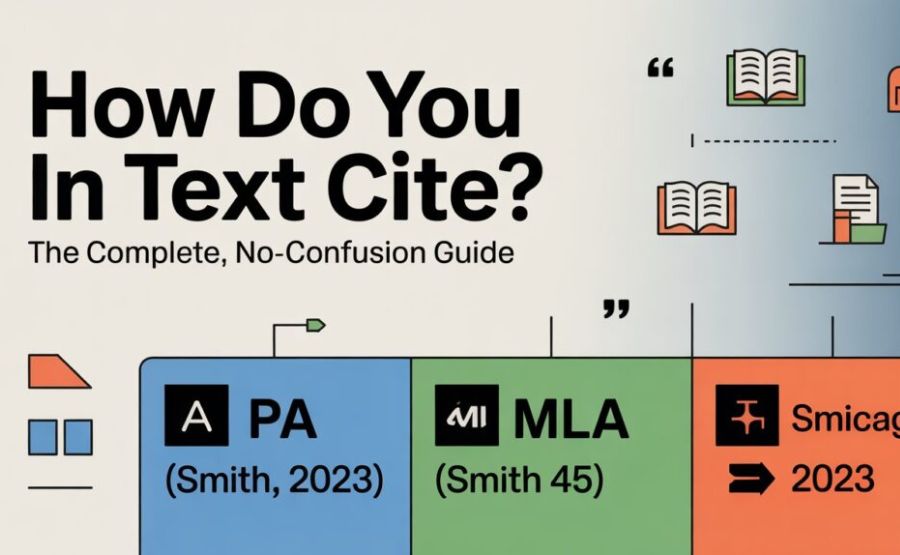
| Three main citation styles | APA (author-date), MLA (author-page), Chicago (footnotes or author-date) |
| APA in-text format | (Author Last Name, Year) – or (Author Last Name, Year, p. #) for direct quotes |
| MLA in-text format | (Author Last Name Page#) — no comma, no year in parentheses |
| Chicago in-text format | Either a superscript footnote number¹ or (Author, Year) in author-date style |
| What triggers a citation? | Direct quotes, paraphrased ideas, summaries, statistics, and specific facts not commonly known |
| What does NOT need a citation? | Your own original thoughts, common knowledge, and your own conclusions |
| Who uses APA? | Social sciences — psychology, education, sociology |
| Who uses MLA? | Humanities — literature, English, philosophy, arts |
| Who uses Chicago? | History, business, fine arts, and some interdisciplinary fields |
| What is “et al.”? | Latin shorthand meaning “and others,” used when a source has multiple authors |
| What is a signal phrase? | A phrase that introduces the author’s name in your sentence, reducing what goes in parentheses |
Where Citations Come From
Before we get into the mechanics, it’s worth knowing why any of this exists in the first place.
Scholarly citations didn’t just appear one day with a rule book and a deadline. It grew out of centuries of academic practice — writers building on other writers, scholars pointing back to the texts they were arguing with or agreeing with. Footnotes appeared long before parenthetical citations. For much of academic history, you’d find a small raised number in the text, and the full reference would live at the bottom of the page.
Modern citation styles as we know them took shape mostly in the twentieth century. The American Psychological Association published its first style guide in 1929 — a seven-page set of recommendations. The Modern Language Association began standardizing humanities citation practice across universities mid-century. The Chicago Manual of Style, published by the University of Chicago Press, has been through eighteen editions and is now one of the most comprehensive style references available anywhere.
Each style was built around the needs of its field. Psychologists care a lot about when a study was published, because science moves fast and a paper from fifteen years ago may have been superseded. So APA puts the year front and center. Literary scholars care more about where in a text something appears — which page, which line — because close reading is the whole point. So MLA puts the page number front and center. Historians and interdisciplinary writers sometimes need to add commentary alongside a citation, which is why Chicago’s footnote system gives you space to do both at once.
Once you see the logic behind each style, the rules start to feel less like arbitrary rules and more like sensible choices.
See also “How to Clear Cache of Website: A Friendly Walkthrough“
The Basic Idea Behind Every In-Text Citation
No matter which style you’re using, an in-text citation is doing one simple thing: it’s pointing your reader toward the full source information that lives at the end of your paper.
Think of it as a breadcrumb. The parenthetical note inside your paragraph is short and light — just enough to connect. The full details sit in your reference list, works cited page, or bibliography. Those two pieces always go together. Every in-text citation corresponds to a full entry at the end. Every entry at the end must appear somewhere in your text. If one is missing, the system breaks.
That’s really the whole structure. In-text signals, end-of-paper confirms.
How APA In-Text Citations Work
APA is author-date. Every time you use someone’s idea — whether you quote them directly or paraphrase them in your own words — you put their last name and the year of publication in parentheses.
Paraphrasing looks like this: research shows that students often struggle more with APA formatting than they expect (Jones, 2021).
If you’re quoting directly, you also add the page number. That looks like this: as Jones put it, “citation formatting trips up even advanced writers” (Jones, 2021, p. 45).
You can also bring the author’s name into the sentence itself. This is called a narrative citation. Jones (2021) found that most students underestimate the time required to format references correctly. When you do this, only the year goes in parentheses after the name. The page number, if needed, moves to the end of the quote.
When a source contains two authors, you always list their names, joined by an ampersand in parenthesis: (Smith & Patel, 2020). When there are three or more authors, you use the first author’s name followed by “et al.” — which is Latin shorthand for “and others.” That looks like this: (Garcia et al., 2019).
One thing that trips people up: in APA, when you use “and” in a regular sentence, you spell it out. But the moment those names go inside parentheses, you switch to the ampersand symbol. It feels inconsistent until you understand the rule. Then it becomes second nature.
How MLA In-Text Citations Work
MLA is author-page. No year in the parentheses — just the author’s last name and the page number, with no comma between them.
It looks like this: scholars have debated whether technology changes how we read stories (Benjamin 19).
If the author’s name is already in the sentence, leave it out of the parentheses: Benjamin argues that technology fundamentally changes how we read and share art (19).
MLA makes a specific distinction worth knowing. If your source has no author listed — like an unsigned article or a website — you use a shortened version of the title instead. That title goes in quotation marks if it’s an article, or italicized if it’s a book or larger work.
When citing poetry, you reference line numbers rather than page numbers, and you note that they’re lines. When citing plays, you use act, scene, and line numbers. The concept is always the same: provide the reader with all the information they need to locate the paragraph you are referring to.
How Chicago In-Text Citations Work
Chicago gives you two options, and the choice usually depends on your field or your instructor.
The first option is notes and bibliography. This is the footnote system. Every time you cite something, a small raised number appears in your text — like this¹ — and the full citation lives at the bottom of the page (or at the end of the paper as endnotes). This system lets you add commentary alongside your citation, which is why historians love it. You can explain a source, disagree with it, or flag its limitations — all in the footnote — without cluttering your main text.
The second option is author-date, which works very similarly to APA. You put the author’s last name and year in parentheses, and the full reference appears in a bibliography at the end.
If you’re in a history class, you’re almost certainly using the footnote method. If you’re in a social science class using Chicago, you might be using author-date. When in doubt, ask your professor. This is genuinely worth a quick email.
When Do You Actually Need to Cite?
This is the question underneath all the formatting questions. And the answer is cleaner than most people think.
You need a citation whenever you use information that isn’t your own and isn’t common knowledge.
That includes direct quotes — word for word from a source, with quotation marks around them. It includes paraphrases — when you restate someone else’s idea in your own words. It includes summaries of arguments, statistics, research findings, and specific facts that a reader couldn’t reasonably be expected to just know.
What doesn’t need a citation is common knowledge. The date of a well-known historical event. A basic scientific fact taught in every textbook. No one source “owns” this fact because it is so widely recognized. If you’re not sure whether something counts as common knowledge, the safest rule is simple: if you found it in a specific source, cite it. Erring on the side of citation is almost never wrong.
Your own opinions and your own conclusions don’t get cited. The analysis you generate from your sources is yours. The synthesis you build from multiple readings is yours. That’s the whole point of writing the paper in the first place.
The Thing Most People Get Wrong
Here’s the honest mistake that shows up constantly in academic writing, even in good papers: people paraphrase without citing.
There’s a common misconception that citations are only for direct quotes — for the sentences in quotation marks. But that’s not true. If you summarize someone’s research findings in your own words, you still owe them a citation. The words changed, but the idea belongs to them.
This is where plagiarism quietly creeps in, often without any intent to steal. A student reads a fascinating study, closes the tab, rewrites the finding from memory, and never adds the parenthetical. They didn’t mean to plagiarize. But they did. The consequences in academic settings can be significant — failed assignments, failed courses, and in serious cases, academic dismissal or degree revocation.
The good habit to build is this: if it came from somewhere, mark where it came from. Do it as you write, not after. Going back through a completed paper to add citations is much harder than dropping them in as you go.
The Mechanics That Always Confuse People
A few specific situations come up over and over, and they’re worth addressing directly.
Where does the citation go? For a sentence that ends with a parenthetical citation, the citation comes before the period. The period ends the whole unit, including the citation. (Smith, 2020) ends a sentence, so the period comes after the closing parenthesis.
What if there’s no author? Use the title. In APA, use a shortened version in italics or quotation marks depending on source type. In MLA, same approach. The title guides your reader to the right entry in your works cited list.
What about sources with no page number? This happens all the time with websites. For APA, if there are no page numbers, you just use the author and year. You can reference a paragraph number or section heading if that helps your reader find the passage. For MLA, if a source has no page numbers, leave the page number out of your citation.
What about quoting someone who’s quoting someone else? This is called a secondary source, and it should be used sparingly. In APA, you’d write something like (Thompson, as cited in Walker, 2018). Your reference list only includes Walker — the source you actually read. But the better practice, whenever possible, is to find the original source and cite it directly.
What about long quotes? In APA, any direct quotation of 40 words or more becomes a block quote — set off from the main text, indented, without quotation marks. The citation follows the closing punctuation of the block, rather than preceding it. MLA uses block quotes for passages exceeding four lines of prose. These formatting rules exist because a very long embedded quote can make a paragraph visually confusing.
Why This Actually Matters Beyond Your Grade
Citations exist for reasons that go well beyond satisfying an instructor’s checklist.
They build a trail. When a researcher cites sources carefully, other researchers can follow that trail backward through time — checking findings, verifying data, tracing how an idea developed over decades. The citation system is, in a real sense, how knowledge gets verified and accumulated. A broken chain of citations means a broken chain of accountability.
They protect people. When an idea gets attributed correctly, the original thinker gets credit. That credit can matter for careers, reputations, and funding. In science, being cited frequently is one way a researcher demonstrates impact. Proper attribution isn’t just etiquette — it’s how intellectual economies work.
And they protect you. A paper that cites its sources shows intellectual honesty. It signals that you’re a reader and a thinker engaging with real scholarship, not presenting borrowed ideas as personal insight. That matters to readers, to instructors, and if you go on to professional writing or research, to editors and peers as well.
Tools That Help — And Their Limits
Citation managers like Zotero, Mendeley, and EndNote are worth knowing about. They let you save sources as you research, organize them, and generate formatted citations in whatever style you need. Many universities offer free access to at least one of these tools. They can save real time.
Browser plugins like the Zotero connector let you capture a source from a webpage in one click. The citation details get saved automatically. When you’re ready to write, you can drop formatted citations directly into your document.
But these tools aren’t perfect. They pull information from whatever is on the page, and that information isn’t always complete or accurate. A DOI might be missing. An author’s name might be formatted wrong. A publication date might be absent. Always review auto-generated citations before submitting. Think of the tool as a helpful first draft, not a finished product.
The style manuals themselves are the authoritative sources. Purdue OWL, maintained by Purdue University’s Writing Lab, is one of the most reliable and freely available online guides for APA, MLA, and Chicago. The official APA Style website is thorough and well-organized. When in doubt, check the manual.
A Thought Before the FAQ
There’s something quietly satisfying about getting citations right. It’s one of those small, detailed skills that builds a kind of quiet confidence. You stop second-guessing every parenthetical. You stop the panic that comes from not knowing where you’re supposed to put the period. You just know, and you move on.
It also builds real respect for the writers and researchers whose ideas you’re drawing on. Every citation is a small acknowledgment: this person thought carefully about something, and their thinking made my thinking better. That’s not just academic courtesy. That’s something true.
FAQs
1. Do I need to cite a paraphrase, or only direct quotes?
Both. Anytime you use someone else’s idea — even if you completely rewrote the sentences — you need a citation. The words being yours doesn’t make the idea yours.
2. What’s the difference between APA and MLA in-text citations?
APA uses author and year: (Smith, 2020). MLA uses author and page number: (Smith 45). No comma between them in MLA. Year goes right after the name in APA; no year in MLA’s parenthetical at all.
3. What if my source has no author?
Use the title instead. In APA, use the first few words in italics or quotation marks (depending on source type). In MLA, do the same. This allows your reader to find the right entry in your reference list.
4. What if my source has no page numbers?
This happens often with websites. For APA, just use the author and year. You can optionally add a paragraph number or a section heading to help your reader locate the passage. For MLA, simply leave out the page number.
5. What is “et al.” and when do I use it?
“Et al.” is Latin for “and others.” In APA 7th edition, use it for sources with three or more authors after the first in-text reference. In MLA and Chicago, the rules vary slightly. Always write it as two words with a period after “al.”
6. Does the period go before or after the parenthetical citation?
After. The parenthetical citation comes before the final period. So: The results were surprising (Jones, 2021). The period closes everything.
7. What’s a signal phrase and why would I use one?
A signal phrase brings the author’s name into your sentence: “According to Jones (2021)…” or “As Smith argues…” When you do this, you reduce what needs to go inside the parentheses. It also makes your writing flow more naturally.
8. Do I cite my own ideas?
No. Your analysis, arguments, and conclusions are yours and don’t need a citation. Only information and ideas that came from external sources need to be credited.
9. What counts as common knowledge?
Well-established facts that most people in your field or your audience would recognize — historical dates, widely known scientific principles, famous events. If you’re unsure, cite it anyway. Over-citing is rarely a problem. Under-citing can be.
10. Can I use a citation manager to format citations automatically?
Yes, and tools like Zotero or Mendeley can save a lot of time. But always review the output. Auto-generated citations sometimes have errors or missing information. They’re a great starting point, not a guaranteed finish.
11. What’s a block quote, and when do I use one?
A block quote is for long direct quotations — 40 words or more in APA, more than four lines in MLA. You set it off from the main text, indent it, and drop the quotation marks. The citation follows the block’s final punctuation.
12. What is a secondary source, and when is it appropriate to utilize one?
A secondary source is when you’re citing something that was quoted or summarized in another source you read. In APA: (Original Author, as cited in Source You Read, Year). Use secondary sources sparingly — tracking down the original is almost always better.
13. What happens if two authors I’m citing have the same last name?
In APA, add their first initials to distinguish them: (J. Smith, 2020) and (R. Smith, 2018). In MLA, use their full first names if needed for clarity.
14. My professor told me to use Chicago footnotes, not parenthetical citations. How does that work?
Every time you cite something, you add a small raised number in your text. The full citation appears at the bottom of the page (footnote) or at the end of the paper (endnote). The first time you cite a source, you write the full information. Subsequent citations use a shortened form.
15. Where can I look this up when I get confused mid-paper?
Purdue OWL (owl.purdue.edu) is free, reliable, and covers APA, MLA, and Chicago with examples. The official APA Style website (apastyle.apa.org) is thorough for APA-specific questions. When in doubt, check the style guide for your assigned format — or just ask your professor.
Empowering curious minds to explore, learn, and think deeper with Fact Aura.