Taper Fade vs Fade: What’s Actually Different?
I want to save you that awkward moment in the barber’s chair when you’re asked “taper or fade?” and you freeze because, honestly, they sound like they might be the same thing. They’re not quite the same, but the confusion makes total sense. Let’s sort this out together, the way a friend who’s spent way too much time thinking about haircuts would explain it to you.
Key Facts
| Detail | Info |
| Taper | Hair gradually gets shorter, but never fully disappears |
| Fade | Hair gradually shortens all the way down to bare skin |
| Taper Fade | A hybrid style, more conservative, blends taper’s subtlety with a fade’s clean edges |
| Where Tapers Happen | Mostly around the neckline and sideburns |
| Where Fades Happen | Rise higher up the sides and back of the head |
| Taper Maintenance | Every 3–4 weeks |
| Fade Maintenance | Every 2–3 weeks (skin fades often need it every 2 weeks) |
| Best For Professional Settings | Taper or taper fade |
| Best For Bold, Modern Looks | Mid, high, or skin fade |
The Simple Way to Think About It
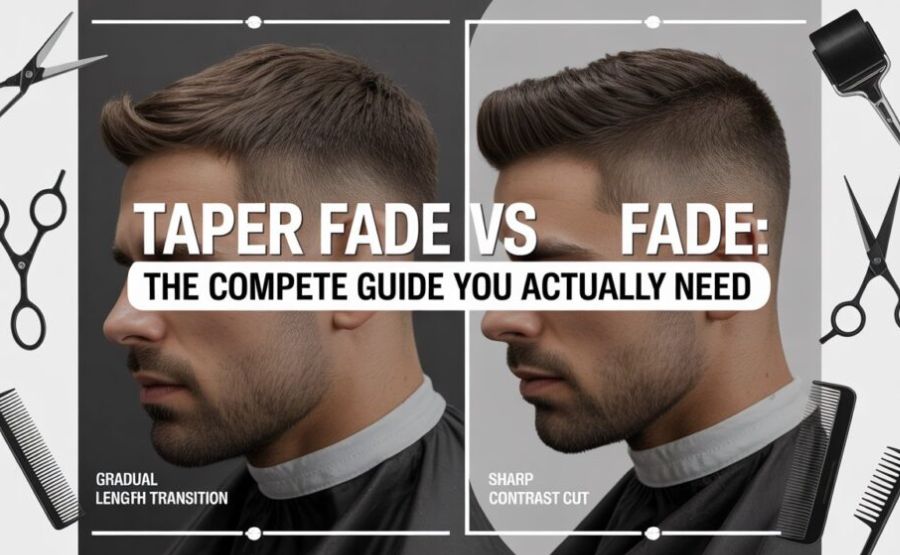
Here’s the easiest way I’ve found to keep this straight. A taper functions similarly to a dimmer switch. The hair slowly gets shorter as you move down your head, but there’s no dramatic moment where it suddenly disappears. A fade, on the other hand, works more like a light switch flipping off. There’s a real, visible point where the hair goes from noticeably present to essentially gone, right down to the skin.
Both start from the same basic idea, longer hair up top, shorter hair as you move down. But how they get there, and how dramatic that transition feels, is where the real difference lives.
See also “How Do You In Text Cite? A Real, Friendly Guide to Getting It Right“
What a Taper Actually Is
A taper haircut keeps things subtle. The hair gradually shortens as it moves down the sides and back of your head, but it never fully disappears into bare skin. Most of the actual tapering happens around your neckline and sideburns, the edges of the haircut, rather than sweeping dramatically up the sides.
The result is clean, classic, and honestly a little understated. There’s no sharp line anywhere on your head. Just a smooth, gentle slope from longer hair to shorter hair, finishing with a neat, rounded edge at the back of your neck.
What a Fade Actually Is
A fade takes that same basic idea and turns the intensity up. Instead of a gentle slope, a fade creates a real, visible transition, hair that goes from noticeably long to essentially gone, blending right down to the skin. That’s what barbers mean when they talk about a fade “blending into the skin.”
Fades also tend to start higher up the head than tapers do. Instead of just working the edges near your neckline, a fade climbs further up the sides, sometimes reaching all the way up near the temple or even higher, which is part of what makes the contrast feel so much more dramatic.
So What Exactly Is a “Taper Fade”?
Here’s where the confusion really sets in, and honestly, it’s a fair thing to be confused about. A taper fade is its own hybrid style, combining the subtlety of a taper with the clean, blended finish of a fade. Think of it as the most conservative member of the fade family. The sides and back keep some visible length, usually equivalent to a guard 2 or 3 on clippers, and the hair only gets noticeably shorter right around the sideburns and neckline.
One barber I came across described it perfectly: a taper fade reads as “a tidy haircut with a gradient around the edges,” rather than something that announces itself as a fade from across the room. It’s the choice for anyone who wants a little bit of that fade blending technique without the bold, high-contrast statement a mid or high fade makes.
The Different Types of Fades
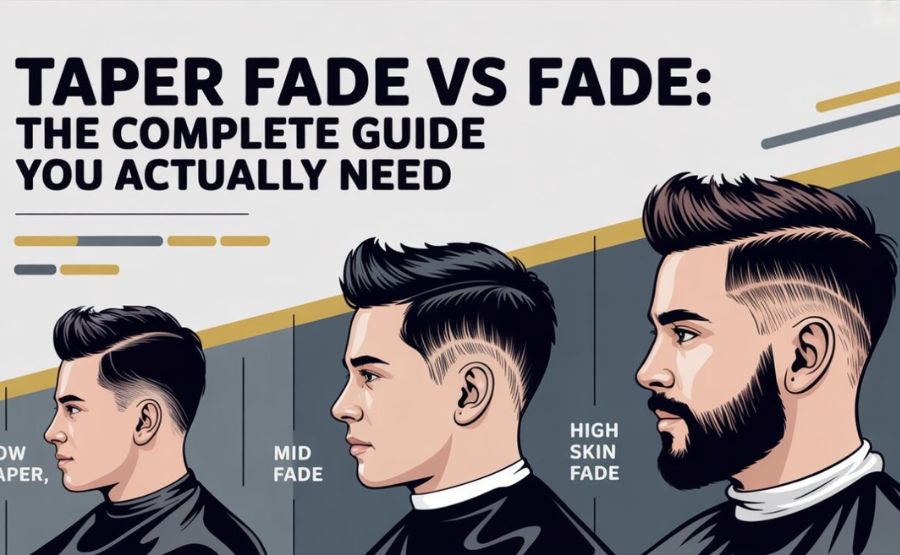
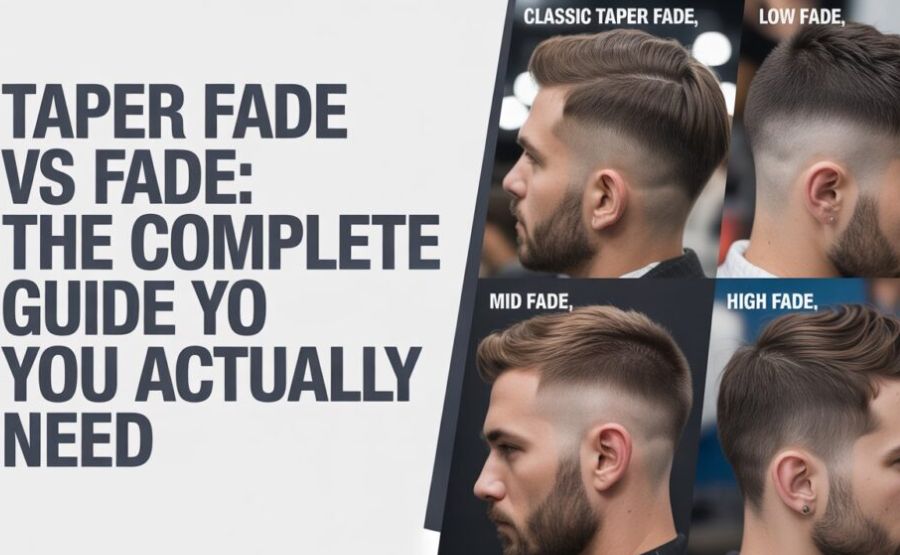
Fades come in several variations, and knowing the terms helps you actually communicate what you want instead of hoping your barber reads your mind. A low fade starts just above the ear, keeping things fairly subtle and closer to how a taper looks overall. A mid fade begins around the temple, striking a balance that tends to flatter the widest range of face shapes. A high fade starts much further up the head, often at or above the temple, creating serious contrast and giving your barber plenty of room to add design work on top if you want it.
There’s also the skin fade, sometimes called a bald fade, which is the boldest version of all. The hair at the bottom of the gradient disappears completely into bare skin with no guard at all. Done well, it looks like the hair is genuinely dissolving into your scalp. Done poorly, it can look like a bowl of hair sitting awkwardly on top of a shaved head, so this one really depends on finding a skilled barber.
And then there’s the drop fade, which curves downward behind the ear rather than following a straight horizontal line, adding a little extra shape and personality to the overall look.
How Maintenance Actually Differs
This is the part people don’t think about until they’re already three weeks past their last appointment. Tapers are genuinely lower maintenance. Because the transition is gradual and there’s no sharp line to protect, you can usually go three to four weeks between visits before it starts looking uneven.
Fades are a different story. The sharper the contrast, the faster it grows out and starts looking blurry rather than clean. A taper fade might still look sharp after four to five weeks. A mid fade usually needs attention every three to four weeks. A skin fade, with its dramatic drop to bare skin, often needs a fresh cut every two to three weeks to stay looking crisp. If you’re someone who can only make it to the barber once a month, a skin fade might frustrate you more than it satisfies you.
Choosing Based on Your Hair Type
Hair texture actually matters more here than most people expect. Fades tend to work especially well with thicker hair, since the sharp contrast creates a more structured, defined look. Tapers are more forgiving across hair types, working nicely with both thick and fine hair, since the gentler transition doesn’t demand as much from the hair itself.
If you have fine or thinning hair, a taper fade tends to be the friendlier option. The softer gradient does a better job hiding any scalp show-through that a full skin fade might expose more obviously.
Choosing Based on Your Face Shape
Face shape plays a real role too, and it’s worth thinking about before you commit to either style. If you have a round face, a mid or high fade can add some vertical lines that make your face read a little longer, while a low taper might actually widen your jawline in a way you don’t want. If you have a long or oval face, the opposite advice applies: a low taper or low fade helps keep your proportions balanced, while a high fade risks stretching your face out even further.
Square faces tend to have the most flexibility here, since pretty much any fade style works well with strong, balanced features. If you’re genuinely unsure which route to take, a mid fade is usually described as the safest, most universally flattering starting point.
A Bit of History Behind These Styles
Fades and tapers both grew out of military and barbershop traditions that valued clean, low-maintenance haircuts, practical styles that could handle physical activity without hair getting in the way. Over the decades, especially through hip-hop culture and modern streetwear influence, the fade specifically evolved from a purely practical cut into a genuine style statement, with barbers using it as a canvas for increasingly detailed line work and design.
Tapers, meanwhile, held onto their reputation as the more classic, professional option, the kind of haircut that quietly signals someone takes care of their appearance without trying to make a bold statement.
A Personal Reflection on Why This Choice Matters More Than It Seems
I think it’s easy to treat a haircut like a small, forgettable decision, but it actually shapes a lot of small daily moments. It’s the first thing people notice in a work meeting. It’s part of how put-together you feel walking into a first date. A taper quietly says you care about looking sharp without trying too hard. A fade says something a little bolder, that you’re not afraid of a little more attention.
Neither message is better than the other. It really just depends on which one sounds like you.
Common Misconceptions Worth Clearing Up
A lot of people assume “taper” and “fade” are simply two different names for the exact same haircut. They’re not, even though the confusion is completely understandable given how often barbers and clients use the terms loosely in casual conversation. The core difference comes down to how dramatic the transition is, and how far up the head it happens.
Another widespread misperception is that, without exception, a fade requires more maintenance than any taper. That’s mostly true, but not entirely. A low fade, with its subtler transition, can actually hold up nearly as well between cuts as a taper fade does, since the contrast isn’t as sharp as a mid or high fade.
The Benefits and Downsides of Each
A taper’s biggest strength is how forgiving it is. It grows out gracefully, works in almost any professional setting, and doesn’t demand frequent barber visits to stay looking clean. The tradeoff is that it’s a fairly quiet, understated style, not something that’s going to turn heads or feel especially bold.
A fade’s biggest strength is the opposite. It’s sharp, modern, and genuinely eye-catching, especially in its mid, high, or skin variations. But that boldness comes with real upkeep. Skip a few weeks of maintenance, and a once-crisp fade can quickly start looking messy and undefined, in a way a taper simply doesn’t.
Broader Impact: Why These Styles Became So Popular
Both tapers and fades became genuinely dominant men’s haircut styles because they solve a real, practical problem. They keep hair manageable without requiring a totally short buzz cut, while still giving plenty of room for personal style on top. That flexibility explains why you’ll spot both styles across nearly every setting, from corporate offices to red carpets to neighborhood barbershops.
Their popularity also reflects a broader shift in how openly men engage with grooming and personal style today, compared to a few decades ago, when haircut options felt a lot more limited and standardized.
What’s Likely Coming Next
Barbers keep pushing these styles into new territory, blending fades with intricate design work, textured tops, and increasingly specific customization based on curl pattern, hair density, and even someone’s daily wardrobe. As grooming culture keeps growing, expect even more hybrid variations sitting somewhere between a classic taper and a bold, high-contrast fade.
Final Words
If I had to boil this whole thing down, I’d say it this way: a taper is for someone who wants to look clean and put together without asking for attention, and a fade is for someone who wants their haircut to actually say something. Neither one is the “correct” choice. It really comes down to your lifestyle, your hair type, your face shape, and honestly, how often you’re realistically willing to sit back down in that barber’s chair.
Bring a couple of reference photos next time you go in. Be specific about how high or low you want things to start. And don’t be afraid to ask your barber directly which option fits your hair and face best. That conversation alone will save you from ever freezing up over “taper or fade?” again.
FAQs
1. What’s the main difference between a taper and a fade?
A taper gradually shortens hair without it ever fully disappearing, while a fade creates a sharper, more dramatic transition that blends all the way down to bare skin.
2. Is a taper fade the same thing as a regular fade?
No. A taper fade is a more conservative hybrid style that keeps visible length on the sides and back, only shortening noticeably around the sideburns and neckline, unlike a full fade which climbs higher and contrasts more sharply.
3. Which style is more professional, a taper or a fade?
A taper or taper fade is generally considered more professional and low-key, while mid, high, and skin fades tend to feel bolder and more fashion-forward.
4. How often do I need to get a taper touched up?
Usually every three to four weeks, since the gradual transition grows out more gracefully than a sharp fade does.
5. How often do I need to get a fade touched up?
Typically every two to three weeks, with skin fades sometimes needing attention as often as every two weeks to stay looking crisp.
6. Which style works better for thick hair?
Fades tend to work especially well with thick hair, since the sharp contrast creates a more structured, defined look.
7. Which style works better for fine or thinning hair?
A taper fade is usually the friendlier option, since its softer gradient hides scalp show-through better than a full skin fade would.
8. What’s a skin fade?
It’s the boldest fade variation, where the hair at the bottom of the transition disappears completely into bare skin with no guard used at all.
9. What’s a drop fade?
A fade that curves downward behind the ear instead of following a straight horizontal line, adding extra shape to the overall style.
10. Which fade height is considered the safest, most flattering choice?
A mid fade, since it tends to flatter the widest range of face shapes and hair types.
11. Can round faces wear a fade?
Yes, and it can actually help. A mid or high fade adds vertical lines that make a round face read a little longer.
12. What haircut works best for a long or oval face?
A low taper or low fade helps keep proportions balanced, while a high fade risks stretching the face out further.
13. Do tapers and fades work with curly hair?
Yes, both work well with curly or coily hair, though mid and high fades tend to showcase natural curl patterns on top more clearly than a taper does.
14. Should I bring reference photos to my barber appointment?
Yes, definitely. Since barbershop terminology can vary, bringing a couple of clear photos helps your barber understand exactly what you’re picturing.
15. Is one style objectively better than the other?
No. It comes down entirely to your personal style, hair type, face shape, and how often you’re willing to visit the barber for touch-ups.
Empowering curious minds to explore, learn, and think deeper with Fact Aura.