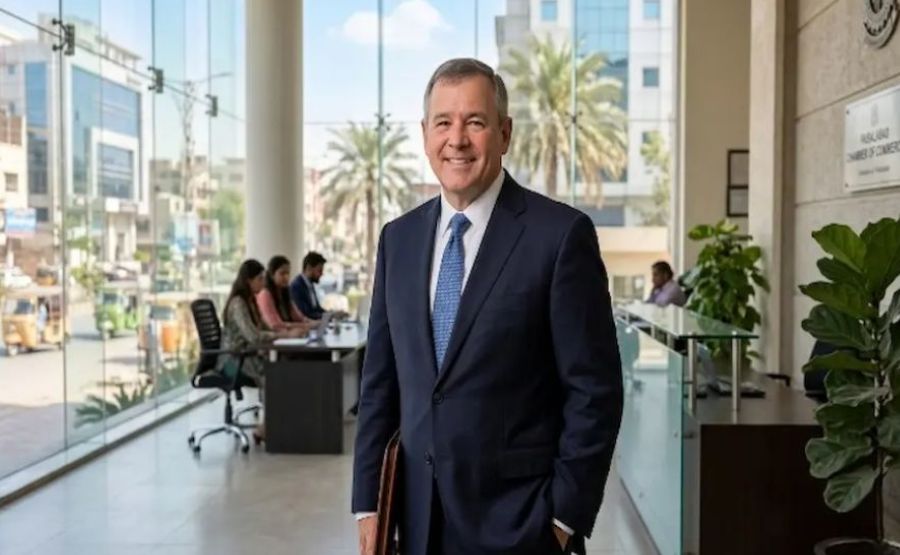
Claude Edward Elkins Jr: The Railroader Who Never Left the Tracks
In an era when American corporate culture rewards pedigree and prestige over proximity to actual work, Claude Edward Elkins Jr. built one of the most consequential careers in U.S. freight transportation by doing something unusual: he started at the bottom and learned every inch of the job before he was given authority over any of it.
Quick Bio
| Category | Details |
| Full Name | Claude Edward Elkins Jr. |
| Professional Name | Ed Elkins |
| Origin | Southwest Virginia (Appalachian region) |
| Nationality | American |
| Military Service | United States Marine Corps (pre-1988) |
| Current Role | Executive Vice President and Chief Commercial Officer (CCO), Norfolk Southern Corporation |
| Appointed CCO | December 2021 |
| Career Start | 1988, Road Brakeman, Norfolk Southern |
| Education | Harvard Business School Advanced Management Program; University of Virginia Darden; MBA in Port and Maritime Economics, Old Dominion University; BA in English, University of Virginia’s College at Wise (magna cum laude); of Tennessee Supply Chain Institute |
| Key Early Roles | Road Brakeman → Conductor → Locomotive Engineer → Relief Yardmaster |
| Intermodal Career | ~Two decades in Intermodal Marketing |
| Senior Promotions | Group VP, Chemicals Marketing (2016); VP, Industrial Products (2018); EVP & CCO (2021) |
| Board Memberships | National Association of Manufacturers; TTX Company; East Lake Foundation |
| Civic Leadership | Vice Chair, Georgia Chamber of Commerce; Georgia State University Marketing RoundTable; The Conference Board Council for CMOs |
| Company Scale | Norfolk Southern: 7 million+ carloads annually; most extensive intermodal network in eastern U.S. |
| Est. Net Worth | ~$470,000 (with ~$33,000 in NS stock, per public estimates) |
The Landscape That Formed Him
Southwest Virginia is not a place that produces many corporate vice presidents. It produces miners, soldiers, railroad workers, and people who understand, without anyone needing to explain it, the relationship between physical labor and economic survival.
Ed Elkins grew up inside that understanding. The Appalachian region of Southwest Virginia sits at the intersection of coal country and rail corridor, where trains are not abstract symbols of commerce but daily, audible facts of life. Freight railroads have threaded those mountain communities since the nineteenth century, and the people who maintain, operate, and depend on them carry a specific kind of knowledge — intuitive, tactile, earned through proximity rather than coursework.
That upbringing shaped the man who would one day oversee commercial strategy for one of America’s largest railroad corporations. It gave him something that no executive training program can fully replicate: an instinctive sense of what a railroad actually is, not just what it represents on a balance sheet.
See also “BigXthaPlug Age: The Dallas Heavyweight Who Rewrote His Own Story“
The Marine Before the Railroader
Before Elkins put on a work vest and walked onto a Norfolk Southern track for the first time, he wore a different uniform. He served in the United States Marine Corps — an experience he has cited as foundational, not merely biographical.
The Marine Corps operates on the logic that leadership means understanding the burden your decisions place on others. Officers are expected to know what enlisted personnel know. Sergeants are expected to have done what privates do. The institution structures its culture around the idea that authority without experience is hollow authority.
That framework fits naturally with the career Elkins built afterward. When he joined Norfolk Southern in 1988 as a road brakeman, he was not transitioning away from discipline — he was carrying it into a new context. The military had prepared him for exactness, physical rigor, and the kind of accountability that freight railroading demands every hour of every operating day.
His English degree from the University of Virginia’s College at Wise — earned before or alongside his military service, and completed magna cum laude — pointed toward yet another dimension. An English major who enlists in the Marines and then takes a job as a railroad brakeman is assembling a very particular education: one that combines analytical language skills with physical competence and institutional discipline. The combination would eventually prove devastating to any ceiling he encountered.
Starting Where the Work Is
In 1988, a road brakeman’s job at Norfolk Southern was not a prestigious posting. It required working in all weather conditions, often at night, along active tracks carrying heavy freight at speed. Brakemen assisted in the coupling and uncoupling of cars, monitored train movement, responded to mechanical issues, and performed safety inspections at a pace that allowed no complacency.
Elkins did that job. Then he moved to the role of conductor, responsible for the safe movement of the entire train and the coordination of crew operations. Then he qualified as a locomotive engineer — placing himself at the controls of machines that can weigh thousands of tons and stretch more than a mile in length. He also served as a relief yardmaster, overseeing the complex choreography of car classification and departure sequencing in a freight yard where dozens of movements occur simultaneously.
Each of these roles added a layer to the mental map he was building. A conductor who has never been a brakeman does not fully understand what a brakeman deals with. An engineer who has never been a conductor cannot fully anticipate what the rest of the crew is managing. Elkins accumulated all of these perspectives methodically, and the result was a leader who, decades later, would speak about railroad operations with an authority that had nothing to do with seniority titles.
Two Decades Building the Commercial Machine
After establishing himself operationally, Elkins crossed into the world of intermodal marketing — the business of coordinating freight movement across different modes of transportation, combining rail with truck and port logistics to serve customers whose supply chains span continents. He spent roughly twenty years in this space.
Intermodal marketing sits at the nervous center of modern freight commerce. It demands the ability to speak operations with engineers, supply chain logistics with procurement teams, and growth strategy with executive clients. A good intermodal marketer is part translator, part relationship manager, part logistics architect.
Elkins excelled in it. He pursued an MBA from Old Dominion University with a concentration in Port and Maritime Economics — a specialty that directly addressed the intersection of rail and ocean freight that intermodal marketing navigates. He later completed executive programs at Harvard Business School and UVA Darden, layering formal strategic education onto the operational and commercial experience he had built from the track up.
By the time he was named Group Vice President of Chemicals Marketing in 2016, he had already spent more than a quarter-century developing the combined vocabulary of labor, logistics, and strategy that the role required. Chemical freight is among the most technically regulated and safety-critical cargo categories in rail transportation. The role demanded someone who understood risk not as an abstraction but as a daily operational variable. Elkins understood it that way.
Ascending the Executive Suite
Two years after taking charge of chemicals marketing, Elkins was elevated to Vice President of Industrial Products in 2018 — a portfolio encompassing metals, construction materials, and forest products, commodities essential to the physical infrastructure of the United States economy.
Then, in December 2021, Norfolk Southern appointed him Executive Vice President and Chief Commercial Officer. The appointment gave him oversight of the company’s intermodal, automotive, and industrial products business divisions, along with real estate, industrial development, field sales, first and final mile markets, and customer logistics.
The scope of that responsibility is not easily summarized. The largest intermodal network in the eastern United States is run by Norfolk Southern. It is the largest rail shipper of automotive products in North America. Its network touches a majority of the U.S. population and manufacturing base. As CCO, Elkins sits at the junction of all of it — the person responsible for ensuring that customers choose rail over truck, that relationships survive operational disruptions, and that revenue strategy aligns with the physical realities of a freight network.
He was, by that point, one of the most internally experienced commercial leaders of any major Class I railroad in North America.
Crisis, Continuity, and the East Palestine Reckoning
Norfolk Southern did not have a quiet time in the years after Elkins was appointed CCO.
On February 3, 2023, a Norfolk Southern freight train derailed in East Palestine, Ohio — a small town near the Pennsylvania border. The accident involved the release of hazardous chemicals, including vinyl chloride, and the subsequent controlled burn created toxic plumes that drew national news coverage and federal scrutiny. Communities near the derailment reported health concerns, environmental contamination fears, and a collapse of the trust that residents had long placed in freight rail as a background fact of their lives.
The derailment was an operational event, not a commercial one, but its consequences reached every corner of the organization. As CCO, Elkins managed the customer-facing dimension of the fallout — reassuring shippers, maintaining relationships, and advocating for the service improvements that would eventually give customers a reason to trust NS again rather than divert freight to competitors.
In Progressive Railroading interviews following the crisis, Elkins spoke plainly about what the road back required. He noted that service metrics — including terminal dwell time and car miles per day — had to improve meaningfully before customers would believe the recovery was real. He acknowledged that trust, once lost, comes back slowly and only through consistent performance. He described meeting three times per week with EVP and Chief Operating Officer John Orr — who joined NS in March 2024 — to align operational improvements with commercial strategy. The cadence of those meetings revealed something about Elkins’s leadership style: he believes that the commercial and operational sides of a railroad cannot be managed in separate silos.
NS also weathered, during this same period, a months-long proxy battle with Ancora Holdings Group LLC in early 2024, which led to board changes. And in September 2024, CEO Alan Shaw was dismissed following the disclosure of an inappropriate workplace relationship. Through all of it, Elkins remained in his role. When CEO Mark George assumed leadership and began rebuilding the company under a total quality management framework — inspired partly by visits to Toyota facilities — Elkins was identified as a member of the core continuity team required to stabilize operations and restore business trust.
His survival through that period of institutional upheaval said something that no official biography could say directly: Norfolk Southern’s new leadership trusted him enough to retain him while systematically remaking everything else.
The Commercial Philosophy: Ownership of the Final Mile
One of the clearest windows into how Elkins thinks about commercial strategy came through his public statements on what Norfolk Southern called Project Home Stretch — a pilot program focused on making the final-mile segment of freight delivery transparent and reliable for customers.
“We want to own the final mile,” Elkins said in published remarks. “Customers want predictability and reliability, especially in the final mile.”
That statement is simple, but it encodes a competitive philosophy. Freight railroads have historically competed on lane capacity and price. Elkins has been pushing NS toward competing on reliability and information — giving customers the kind of shipment visibility that parcel carriers pioneered in consumer logistics and that industrial shippers have long demanded but rarely received from rail.
He also championed initiatives to provide car-order predictions in advance, giving customers lead time to plan their supply chain operations around NS scheduling data. The logic, as he described it, was that reducing uncertainty for customers creates efficiencies both for the shipper and for NS’s own network utilization.
By 2024, Elkins was citing a post-pandemic high in intermodal traffic — an 8% year-over-year increase in Q2 — as evidence that the combination of operational improvement and commercial trust-building was working. Premium parcels and LTL customers were returning to rail. Business partners like The Hub Group and J.B. Hunt was deepening intermodal commitments. The trajectory, after two difficult years, was pointing upward.
Board Rooms, Community, and Civic Engagement
Elkins’s influence extends beyond the NS organizational chart. He serves as Vice Chair of the Georgia Chamber of Commerce, connecting the railroad’s commercial interests with the broader economic policy environment in a state that plays a major role in southeastern freight logistics, particularly through the Port of Savannah.
He sits on the boards of the National Association of Manufacturers — an organization that represents the industrial customer base that NS depends on for commodity freight revenue — and TTX Company, a railcar management company jointly owned by major North American railroads. He also serves on the board of the East Lake Foundation, a community development organization in Atlanta with deep roots in education and neighborhood revitalization.
His membership on the Georgia State University Marketing RoundTable and the Conference Board’s Council for CMOs positions him at the intersection of business academia and C-suite peer exchange — the kind of forums where commercial strategy and leadership thinking are tested against practitioners from industries beyond rail.
Personal Life: Privacy as a Professional Statement
Claude Edward Elkins Jr. has maintained a private personal life with a consistency that itself communicates something. He does not appear in celebrity news. He has not published a memoir or cultivated a thought-leader platform independent of his professional role. His LinkedIn profile is functional and factual. His interviews are operational and strategic.
What is known is this: he is a native of Southwest Virginia, and the values of that region — work before profile, substance before presentation — appear to have stayed with him across decades of corporate ascent. People who have worked around him consistently describe a leader who defers to outcome over optics and who retains genuine respect for the workers who occupy the operational roles he once held himself.
His family life remains outside the public record, consistent with his overall approach to personal exposure. In a professional culture where executives increasingly curate personal brands, Elkins’s reticence reads not as evasiveness but as a deliberate choice — the preference of someone who believes the work should speak louder than the biography.
Legacy and Lasting Influence
Ed Elkins does not fit the template that business media most frequently celebrates. He is not a disruptor. He did not found a company or pivot an industry. He did not arrive at Norfolk Southern from a technology background or with a mandate to remake culture through external pressure.
What he did, over more than three decades, was master something harder: a single, deeply complex industry, from the physical bottom to the commercial top, without skipping any of the steps in between.
That mastery has made him one of the most internally credible commercial leaders in freight rail. When he advocates for specific customer programs or pushes back on service disruptions affecting commercial relationships, he does so with the authority of someone who has personally experienced what happens when those disruptions reach the track. It is not a trait that can be acquired through executive development programs, hired, or trained. It must be earned over time, and Elkins earned it the long way.
His influence on Norfolk Southern’s commercial architecture — particularly its intermodal expansion, its customer logistics philosophy, and its emphasis on final-mile reliability — will outlast his tenure. Project Home Stretch, the intermodal growth strategy, the customer trust rebuild after East Palestine: these are institutional choices that reflect his thinking and will shape how NS competes for freight against trucking, other Class I railroads, and eventually automated logistics platforms.
The broader lesson of his career is not glamorous, but it is durable. American freight infrastructure works because of people who understood it at ground level before they were given responsibility for it at scale. Elkins is among the clearest examples of that principle in the current generation of rail leadership.
Final Words
Claude Edward Elkins Jr. is not a household name, and that is almost certainly by his own design. He operates in one of the oldest and most capital-intensive industries in American commercial history, doing work that the public encounters only when it fails — derailments, service outages, fuel price volatility rippling into consumer goods prices.
What makes his story worth examining is what it says about a particular kind of excellence. He did not take shortcuts. He did not bypass the physical work that the industry rests on. He earned credentials while also earning calluses, and he carried both into the executive suite. At Norfolk Southern — a company that has weathered derailment, proxy battle, and C-suite scandal in rapid succession — he has been one of the steadying forces, the person trusted to maintain commercial relationships while the institution rebuilt itself.
The American freight network is among the largest and most economically consequential infrastructure systems on Earth. That network requires, at its commercial helm, someone who understands it in full. Ed Elkins understands it in full. That, more than any title or certification, is the substance of his significance.
FAQs
1. Who is Claude Edward Elkins Jr.?
He is an American railroad executive, known professionally as Ed Elkins, who currently serves as Executive Vice President and Chief Commercial Officer at Norfolk Southern Corporation, one of North America’s largest freight railroads. He began his career at Norfolk Southern in 1988 as a road brakeman and rose through operational and commercial roles over more than three decades.
2. What does Claude Edward Elkins Jr. do at Norfolk Southern?
As EVP and CCO, he leads Norfolk Southern’s commercial divisions: Intermodal, Automotive, and Industrial Products. He also oversees Real Estate, Industrial Development, First and Final Mile Markets, Field Sales, and Customer Logistics. He is responsible for revenue strategy, customer relationships, and commercial growth across a network that delivers more than 7 million carloads annually.
3. When was Ed Elkins appointed Chief Commercial Officer?
He was appointed Executive Vice President and Chief Commercial Officer in December 2021.
4. What roles did Ed Elkins hold before becoming CCO?
In order: Road Brakeman (1988), Conductor, Locomotive Engineer, Relief Yardmaster, approximately two decades in Intermodal Marketing, Group Vice President of Chemicals Marketing (2016), and Vice President of Industrial Products (2018) before becoming EVP and CCO in 2021.
5. Where did Claude Edward Elkins Jr. grow up?
He is a native of Southwest Virginia, a region historically shaped by coal mining, industrial rail corridors, and Appalachian working-class culture. Norfolk Southern’s official biography confirms this origin.
6. What is Ed Elkins’s educational background?
He earned a Bachelor of Arts in English from the University of Virginia’s College at Wise, graduating magna cum laude. He later earned an MBA from Old Dominion University with a concentration in Port and Maritime Economics. He completed additional executive education at Harvard Business School, UVA Darden, and the University of Tennessee Supply Chain Institute.
7. Did Ed Elkins serve in the military?
Yes. Before joining Norfolk Southern in 1988, he served in the United States Marine Corps. That military background is cited across his professional biography as foundational to his leadership approach and discipline.
8. What boards does Claude Edward Elkins Jr. serve on?
He serves on the boards of the National Association of Manufacturers, TTX Company, and the East Lake Foundation. He also serves as Vice Chair of the Georgia Chamber of Commerce and participates in the Georgia State University Marketing RoundTable and The Conference Board’s Council for CMOs.
9. How did Ed Elkins handle Norfolk Southern’s crisis following East Palestine?
As CCO, Elkins managed the customer-facing recovery following the February 2023 East Palestine, Ohio, derailment. He worked to rebuild shipper trust through improved service metrics and transparent communication, meeting three times weekly with COO John Orr to align operational improvements with commercial strategy. In published interviews, he acknowledged that customer trust returns only through consistent, measurable performance.
10. What is Project Home Stretch?
Project Home Stretch is a Norfolk Southern initiative developed under Elkins’s commercial leadership to improve transparency and reliability in the final-mile segment of freight delivery. The program was piloted with select customers and focuses on making shipment timing predictable and actionable, addressing a historically weak point in rail freight service compared to trucking.
11. What is Norfolk Southern’s intermodal network?
Norfolk Southern operates the most extensive intermodal network in the eastern United States, connecting rail with trucking and port logistics. The network reaches more than 50% of the U.S. population and serves all major container ports on the Atlantic coast, the Gulf of Mexico, and the Great Lakes. Intermodal traffic growth — including an 8% year-over-year increase in Q2 2024 — has been a key metric of Elkins’s commercial tenure.
12. What is Claude Edward Elkins Jr.’s estimated net worth?
Public estimates place his net worth at approximately $470,000, with roughly $33,000 in Norfolk Southern stock holdings. These are estimates based on public filings and compensation disclosures; exact figures have not been confirmed by Elkins personally.
13. How does Ed Elkins’s leadership style differ from typical executives?
He is consistently described as a practical, ground-level leader who combines operational credibility with commercial strategy. His background in manual railroad roles gives him a direct understanding of the challenges faced by frontline workers and enables him to translate between operational realities and business objectives in ways that purely executive-track leaders cannot.
14. What is Norfolk Southern’s corporate context as of 2025–2026?
Norfolk Southern has navigated a turbulent period including the East Palestine, Ohio, derailment (February 2023), a proxy battle with Ancora Holdings (early 2024), and the dismissal of former CEO Alan Shaw (September 2024). CEO Mark George assumed leadership in late 2024 and has implemented a total quality management framework. Elkins has remained in his CCO role through all of these transitions. Additionally, on July 29, 2025, Union Pacific and Norfolk Southern announced an agreement for UP to acquire NS in a stock and cash transaction.
15. Why does Claude Edward Elkins Jr.’s career matter beyond railroad circles?
His trajectory illustrates a broader principle about expertise, trust, and organizational resilience. In a sector that moves food, fuel, automobiles, chemicals, and construction materials across the eastern United States, the commercial leader’s credibility with customers depends directly on their understanding of how the system actually functions. Elkins built that understanding from the track up, and it has made him, in a period of institutional crisis, one of the most trusted figures in Norfolk Southern’s leadership.
Empowering curious minds to explore, learn, and think deeper with Fact Aura.