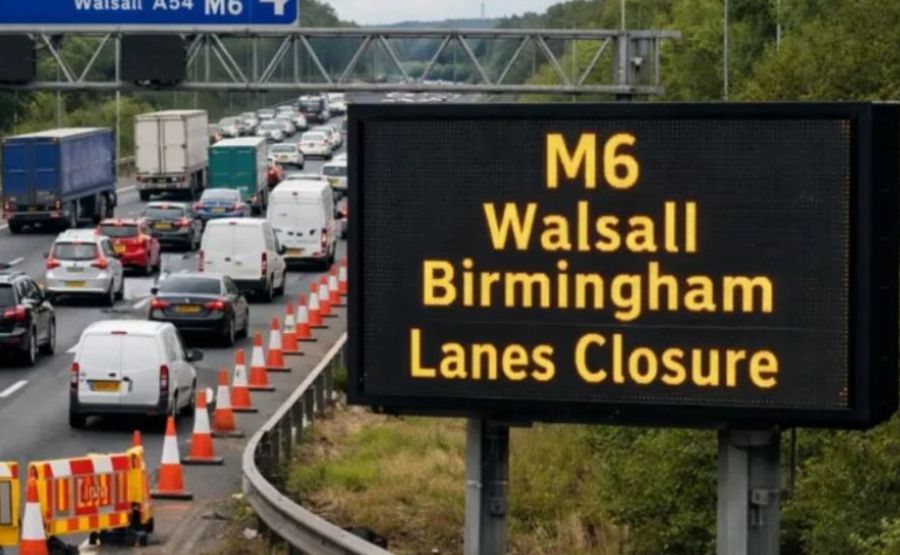
M6 Walsall Birmingham Lanes Closure: Why the Road Never Seems to Stop Changing
If you drive regularly between Walsall and Birmingham, you probably already know this feeling. You check the traffic app before leaving the house, see an amber warning, decide to risk it anyway, and then spend the next forty minutes watching cones blur past your window in the outside lane while your sat nav quietly recalculates. Again.
This stretch of motorway has been a constant companion to millions of Midlands drivers — and a constant source of frustration. But there is actually a lot more going on here than orange cones and reduced speed limits. The lane closures you sit in have real causes, real histories, and real long-term reasons behind them. Some of them are even quietly remarkable.
Let me take you through it properly.
Key Facts
| Category | Details |
| Motorway | M6 — UK’s longest motorway, over 230 miles total |
| Relevant stretch | Approximately Junctions 6 (Birmingham) to Junction 10 (Walsall) |
| Daily vehicle numbers | Around 120,000 vehicles per day on busiest sections |
| Original design capacity | Approximately 72,000 vehicles per day |
| Junction 10 improvement | Major upgrade completed March 2024 — 4-lane roundabout, wider slips, new bridges |
| HS2 M6 South Viaduct | 315m, 4,600-tonne structure being built above the M6 near Junction 4, 2024–2026 |
| Smart motorway sections | Between Junctions 4–10a (hard shoulder removed) |
| UK smart motorway breakdowns (2024) | 141,149 recorded incidents — average 387 per day nationally |
| Main alternative routes | M5, M42, A34, A38, A454 |
| Traffic management authority | National Highways (motorway), Walsall Council (local junction signals) |
| Typical delay during peak closures | 30–90 minutes between Walsall and Birmingham |
| HS2 viaduct project timeline | Ongoing through 2026 for West Deck installation |
A Road That Was Never Meant to Carry This Much
The M6 opened in sections across many decades. The part of the road running through Walsall was completed in the late 1960s. Back then, the traffic engineers who built it were working with projections that simply did not come close to what the road handles today.
Before the M6 Toll motorway opened in December 2003, the M6 near Wolverhampton was carrying around 180,000 vehicles per day. The road had been designed for 72,000. That gap — between what it was built for and what was actually using it — tells you everything you need to know about why this section of motorway has been in a near-permanent state of improvement, repair, and modification for years.
When the M6 Toll finally opened to divert some traffic, many expected a dramatic reduction in congestion. It helped, but not as much as hoped. The toll prices were set privately, and many drivers simply refused to pay them. Traffic did reduce a little, but by 2012 the busiest sections between Junctions 3A and 11A were still seeing around 120,000 vehicles every day.
That is the background. A road under enormous, relentless pressure.
See also “Riverbank Collapse Iford Playing Fields: What Happened, Why It Matters, and What Comes Next“
What Actually Causes the Closures
There is no single reason for lane closures on this stretch. There are several, and they operate on completely different timescales.
Some closures happen because of accidents. A lorry breakdown near Junction 9 or Junction 10 can bring traffic to a near-standstill for an hour or more, simply because heavy vehicles need specialist recovery equipment and take a long time to clear. A multi-vehicle crash in November 2025 closed three northbound lanes near Walsall, creating delays of over 90 minutes before the road was cleared. These events are unpredictable. They appear without warning and vanish when the last cone is pulled.
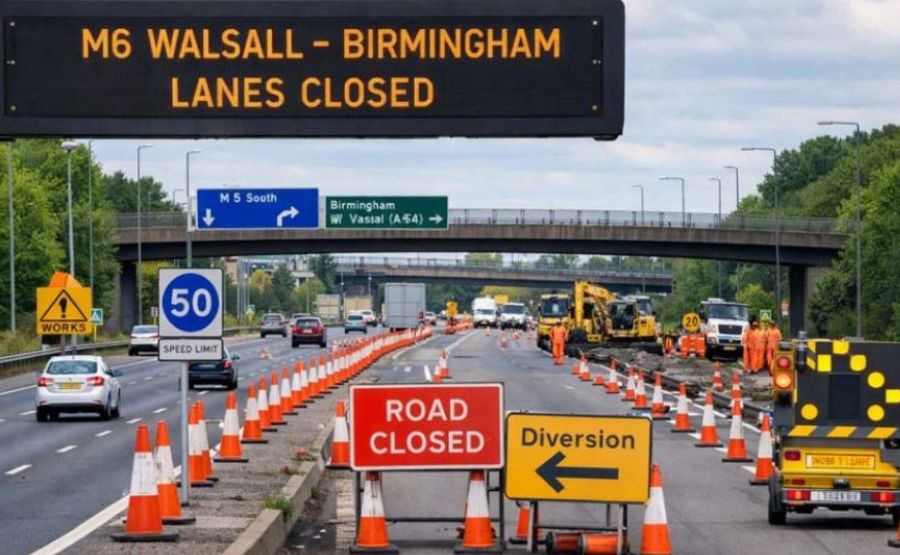
Other closures are planned well in advance. These are the maintenance works — resurfacing, bridge joint repairs, drainage work, safety barrier replacement, lighting maintenance. National Highways regularly schedules this kind of work across its West Midlands network. When possible, they do it overnight, usually from around 9pm to 5am, to catch the quietest traffic window. If you have ever driven the M6 through the Midlands late at night and noticed a reduced speed limit with workers visible under bright floodlights, this is what they are doing.
Then there are the big-ticket projects. The ones that reshape the road rather than just patch it. These are the ones worth understanding in more depth.
The Junction 10 Story: Years of Work, One Big Payoff
Junction 10 at Walsall was, for a long time, a genuine bottleneck. Road capacity problems at this junction had been formally identified as one of the main transport problems facing the Black Country in the West Midlands Local Transport Plan. Commuters who used it daily did not need a report to tell them that — the queues spoke for themselves.
The congestion would back up onto the motorway slip roads, spill onto the Black Country Route, and snake through surrounding streets during morning and evening peak hours. It was the kind of jam that makes people quietly decide to leave for work twenty minutes earlier every single day, just in case.
National Highways and Walsall Council worked together to fix it. The scheme brought in new bridges over the junction, a four-lane system on the roundabout, and widened slip roads. It also created a new shared footpath and cycleway with proper controlled crossing points — a detail that often gets ignored in traffic news, but matters to the people who actually walk or cycle near that junction. Previously there had been no controlled crossing point at either end of the bridge.
All the temporary traffic management measures were lifted at the end of March 2024. The junction that had caused years of peak-hour pain was finally open to full use. Walsall Council and National Highways noted they would continue monitoring it and adjusting traffic signal timings where needed.
It was a genuinely good outcome, even if the years of lane closures needed to get there were very much not fun to drive through.
HS2 and the Viaduct You Probably Did Not Know Was Being Built Above You
Here is the part of the M6 closures story that most people do not fully understand, and honestly it is quite something.
Near Junction 4 — the area close to Birmingham Airport, Birmingham Business Park, and the NEC — a huge structure is currently being built above the motorway. It is the M6 South Viaduct, part of the HS2 high-speed rail project. When complete, it will carry trains at high speed over the M6. Two decks of track, spanning 315 metres, supported on concrete piers.
The construction method is called incremental launching. Engineers build sections of the viaduct off to the side of the motorway, then slide the completed structure sideways, pushing it out over the carriageway in stages. Although it seems nearly impossible, it does work.
The first phase in June 2025 slid 119 metres of structure over the Junction 4 slip road. The second phase, in September 2025, required a full weekend closure of both the northbound and southbound carriageways between Junctions 4 and 4a. That closure ran from 3am Saturday to 10pm Sunday — but the engineers finished the work nine and a half hours early. The road reopened well ahead of schedule.
The third phase, in December 2025, achieved something genuinely remarkable. Teams from HS2’s main contractor, Balfour Beatty VINCI, developed a technique called a “fully restrained slide.” Using this method, they pushed the final section of the 4,600-tonne viaduct across the live motorway — while traffic kept flowing underneath. Only a slip road on the adjacent M42 needed to be closed.
Engineers used strand jacks to move the structure. The viaduct slid on low-friction pads made from a material similar to what you find coating a non-stick frying pan. The whole final slide took 17 hours, and it is thought to be the first time this specific technique has been used on a UK motorway. The West Deck — a parallel structure carrying trains in the opposite direction — will go through the same process during 2026.
This is happening on the same road you sit in on your commute. You might not know it, but the road is mid-transformation.
Smart Motorways: The Upgrade That Divided Opinion
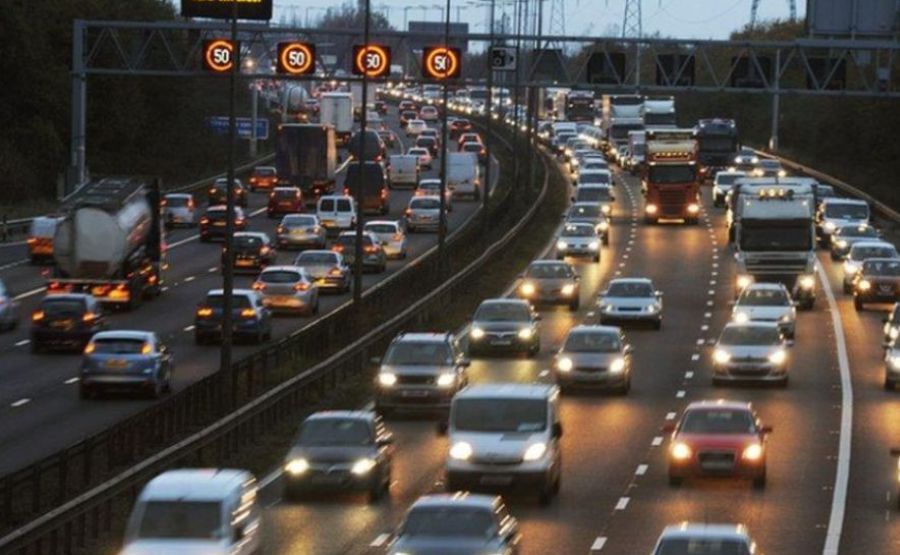
The stretch between Junctions 4 and 10a on the M6 was converted into a smart motorway in stages between roughly 2009 and 2014. Smart motorways use variable speed limit signs, dynamic traffic signals, and — most controversially — the conversion of the hard shoulder into a live running lane during busy periods.
The thinking behind it was sound enough. Rather than widening the motorway physically, which is enormously expensive and disruptive, you could increase capacity by using the space that already existed. A smart motorway can theoretically carry around 1,600 extra vehicles per hour in each direction.
But the safety concerns have been loud, persistent, and sometimes heartbreaking.
When a vehicle breaks down on a conventional motorway, the driver can pull onto the hard shoulder. There is a physical buffer between them and moving traffic. On an all-lane-running smart motorway, that buffer is gone. Broken-down vehicles must try to reach an emergency refuge area — smaller bays spaced at intervals along the road. If they cannot make it, they stop in a live lane.
In 2017, Anthony Marston from Telford was killed on the M6 in the West Midlands when his stationary car was struck from behind by a lorry. Eight-year-old Dev Naran perished in a 2018 traffic accident on the M6 close to Birmingham. His mother, Meera Naran, became a prominent safety campaigner. The AA recorded 141,149 smart motorway breakdown incidents in 2024 alone — an average of 387 per day across the national network.
MPs, motoring organisations, and grieving families pushed for change. In April 2023, the government announced it would build no new smart motorways. The existing ones on the M6 through the West Midlands remain. Work to add more emergency refuge areas and radar-based detection systems for stopped vehicles has been ongoing, but the debate about whether enough has been done is not over.
Some drivers support smart motorways because they do reduce peak-hour congestion when everything is working smoothly. Others feel deeply uncomfortable driving on a road with no hard shoulder. Both feelings are completely understandable.
What It Feels Like for the People Who Use This Road Every Day
For commuters, delivery drivers, and business owners in the Walsall-Birmingham corridor, lane closures are not an abstract infrastructure problem. They are lost time, rearranged schedules, stress, and extra fuel costs.
A 30-minute delay twice a day adds up to five extra hours a week for someone commuting five days. Over a working year, that is a significant chunk of a person’s life spent watching the same stretch of coned motorway crawl past. Businesses that depend on deliveries — warehouses, retailers, tradespeople — face real financial pressure when routes become unpredictable.
When the M6 slows, the surrounding roads absorb the overflow. The A34 between Birmingham and Walsall, the A38, and local roads through Great Barr and West Bromwich see surges of diverted traffic. Residential streets that are usually quiet can suddenly feel like rat runs. This matters to the people who live on them.
There is also the pollution side. Slow-moving and idling vehicles produce significantly more emissions than free-flowing traffic. A congested stretch of motorway during roadworks is not just a time problem — it adds to air quality concerns across the whole region.
Common Misconceptions Worth Clearing Up
A lot of people assume that when there are cones on a motorway, there must be workers actively present. That is often not true. Much maintenance and safety equipment is placed before overnight work begins, and lanes are sometimes held closed as a safety precaution even when crews are not yet on the road. This is frustrating to drive past, but it follows specific safety protocols.
Another common belief is that diversions always save time. They often do not. When thousands of drivers all decide to exit at the same junction and take the same alternative route, roads like the A34 or A41 can become just as slow as the motorway. National Highways genuinely advises that sometimes staying on the managed motorway route and waiting out the delay is faster than joining the diversion queue.
People also sometimes assume that lane closures are always a sign of poor planning or inefficiency. Some of them genuinely are unplanned — emergency works, accidents, sudden structural issues. But many are the product of careful scheduling, designed specifically to fall during lower-traffic windows to reduce the total disruption. The Junction 10 improvement and the HS2 viaduct work involved intensive planning with National Highways, local councils, Birmingham Airport, the NEC, and surrounding businesses.
The Ethical Dimension Nobody Talks About Much
There is a real question buried inside the smart motorway issue that deserves more honest attention than it usually gets.
Removing the hard shoulder increases road capacity. That genuinely helps millions of journeys go faster. But it does so partly by transferring risk onto the most vulnerable drivers — those whose vehicles break down unexpectedly. The people most likely to be stranded in a live lane are often those with older vehicles, who may not have the means to maintain them to the highest standards.
When a government decides to convert a hard shoulder to a running lane, it is making a collective calculation: more journeys improved, versus specific elevated risk to those who stop unexpectedly. The people making that calculation are rarely the ones most exposed to its consequences.
The government’s decision to halt new smart motorways in 2023 was shaped partly by public campaigning from bereaved families. That is a meaningful example of ordinary people influencing infrastructure policy through persistence and courage. It is worth acknowledging.
What Is Coming Next
The HS2 West Deck installation will continue through 2026, meaning more planned closures near Junction 4. The work is being managed carefully to reduce disruption, but some closures — particularly overnight ones — will still be needed.
Bridge joint repairs and maintenance between Junctions 8 and 10 are also ongoing. National Highways publishes updates on its West Midlands maintenance page and social media channels, and that is genuinely the most reliable place to check before a journey.
Variable speed limit technology and stranded vehicle detection systems continue to be improved on the existing smart motorway sections. Emergency refuge areas are being expanded on certain stretches. Whether these additions will fully address the safety concerns raised by campaigners is something only time — and continued monitoring — will answer.
Transport for West Midlands is also creating a bus priority corridor linking Walsall with Birmingham city centre, Solihull, and Birmingham Airport along the A34. That project, while not on the motorway itself, reflects the wider ambition to give people real alternatives to sitting in M6 traffic in the first place.
A Quiet Reflection
There is something genuinely bittersweet about this road. It was built to carry the Midlands forward — connecting people to jobs, families, opportunities. And it still does that, every single day, for a huge number of people. But it was also built for a world that looked very different from today, and it has been playing catch-up ever since.
The junction upgrades, the HS2 viaduct, the resurfacing crews working through the night — all of it is an attempt to keep a vital artery functioning in a region that depends on it. That work creates real disruption for real people. But it also, slowly and imperfectly, makes things better.
The next time you sit behind a line of orange cones on the M6, you might be directly below an engineering achievement that will carry trains above you in a decade’s time. That is worth knowing.
FAQs
Q1: Why are there so many lane closures on the M6 between Walsall and Birmingham?
Several reasons overlap here. The road was built for far fewer vehicles than it carries today. Ongoing maintenance, safety upgrades, smart motorway technology improvements, the Junction 10 improvement scheme, and the HS2 viaduct construction near Junction 4 all require managed closures at various points.
Q2: When did the Junction 10 improvement work finish?
National Highways lifted all temporary traffic management at Junction 10 at the end of March 2024. The improved junction features a four-lane roundabout, wider slip roads, new bridges, and improved facilities for pedestrians and cyclists.
Q3: What is the HS2 viaduct near Junction 4, and why does it close the M6?
The M6 South Viaduct is a 315-metre structure being built to carry HS2 high-speed trains over the motorway near Birmingham Airport and the NEC. It is being slid into position in stages, with some phases requiring full or partial motorway closures. Construction is ongoing through 2026 for the second deck.
Q4: What are the best alternative routes when the M6 is closed between Walsall and Birmingham?
The M5 and M42 are common alternatives for longer diversions. For shorter journeys, the A34, A38, and A454 are used. However, all alternatives become congested during major closures, so it is worth checking live traffic before diverting.
Q5: Are smart motorways on the M6 safe?
This is genuinely debated. National Highways says smart motorways are statistically among the safest roads. Safety campaigners and motoring organisations raise serious concerns about the removal of the hard shoulder, pointing to fatal incidents involving stationary vehicles in live lanes. The government stopped new smart motorway construction in 2023. Existing sections are having additional emergency areas and detection technology added.
Q6: Why does the M6 carry so many vehicles? Is there a limit?
The M6 between Junctions 3A and 11A carries around 120,000 vehicles per day on the busiest sections. Before the M6 Toll opened in 2003, it carried up to 180,000 near Wolverhampton, more than double its design capacity of 72,000. The M6 Toll provided some relief, though lower-than-expected usage meant the original M6 remained very busy.
Q7: Who is responsible for lane closures on the M6 — the council or National Highways?
National Highways is responsible for the motorway and its slip roads. Walsall Council operates the traffic signals at Junction 10 and is responsible for local roads. Both work together on schemes that affect both areas. The one.network website maps all active roadworks including local roads.
Q8: How much notice is usually given before planned closures?
Planned overnight closures are usually communicated through National Highways’ West Midlands maintenance page and social media in advance. Major closures like the HS2 viaduct weekends are announced weeks ahead. Emergency works happen with little or no notice.
Q9: Do lane closures at night actually reduce disruption?
Generally yes. Overnight closures, typically 9pm to 5am, catch the quietest traffic periods. This is why most planned maintenance happens during those hours. Full weekend closures are used for the most intensive work, as with the HS2 viaduct phases.
Q10: How do lorry and freight drivers cope with these closures?
Heavy goods vehicles take longer to clear when broken down or involved in accidents, which extends closure times. Planned closures affecting freight routes are generally communicated in advance through Highways England notices. Many freight operators now use live traffic software to route around restrictions.
Q11: Has the M6 near Birmingham had any serious accidents related to smart motorways?
Yes. A 2017 fatal collision involving a stationary vehicle on the West Midlands smart motorway section brought national attention. A 2018 incident involving a child near Birmingham also became a significant reference point in safety debates. These incidents contributed to the broader public campaign that led to new smart motorway construction being halted in 2023.
Q12: What is the Black Country Route, and why is it relevant to M6 closures?
The Black Country Route is a major local road running through the West Midlands. It connects directly with Junction 10 and is one of the roads that was specifically congested before the Junction 10 upgrade. It features in several official diversion routes when M6 slip roads at Junction 10 close.
Q13: Is there any plan to give people alternatives to driving on the M6 in this area?
Yes. Transport for West Midlands is developing a bus priority corridor along the A34 linking Walsall, Birmingham, Solihull, and Birmingham Airport. This is designed to give commuters a faster, more reliable public transport option and reduce car dependency in the corridor.
Q14: How do I check for current M6 lane closures before I travel?
National Highways’ website and their West Midlands social media account (@HighwaysWMIDS on X) post updates. The one.network website maps active roadworks across local roads too. Apps like Waze, Google Maps, and the National Highways app provide live traffic updates.
Q15: Will the M6 between Walsall and Birmingham ever be completely finished with major works?
Honestly, probably not for a sustained period. The HS2 viaduct work continues through 2026. After that, routine maintenance, bridge inspections, drainage work, and safety upgrades will still require periodic closures. The most significant major upgrade — Junction 10 — is done, and that should noticeably improve daily conditions. But a motorway this busy will always need attention.
Empowering curious minds to explore, learn, and think deeper with Fact Aura.