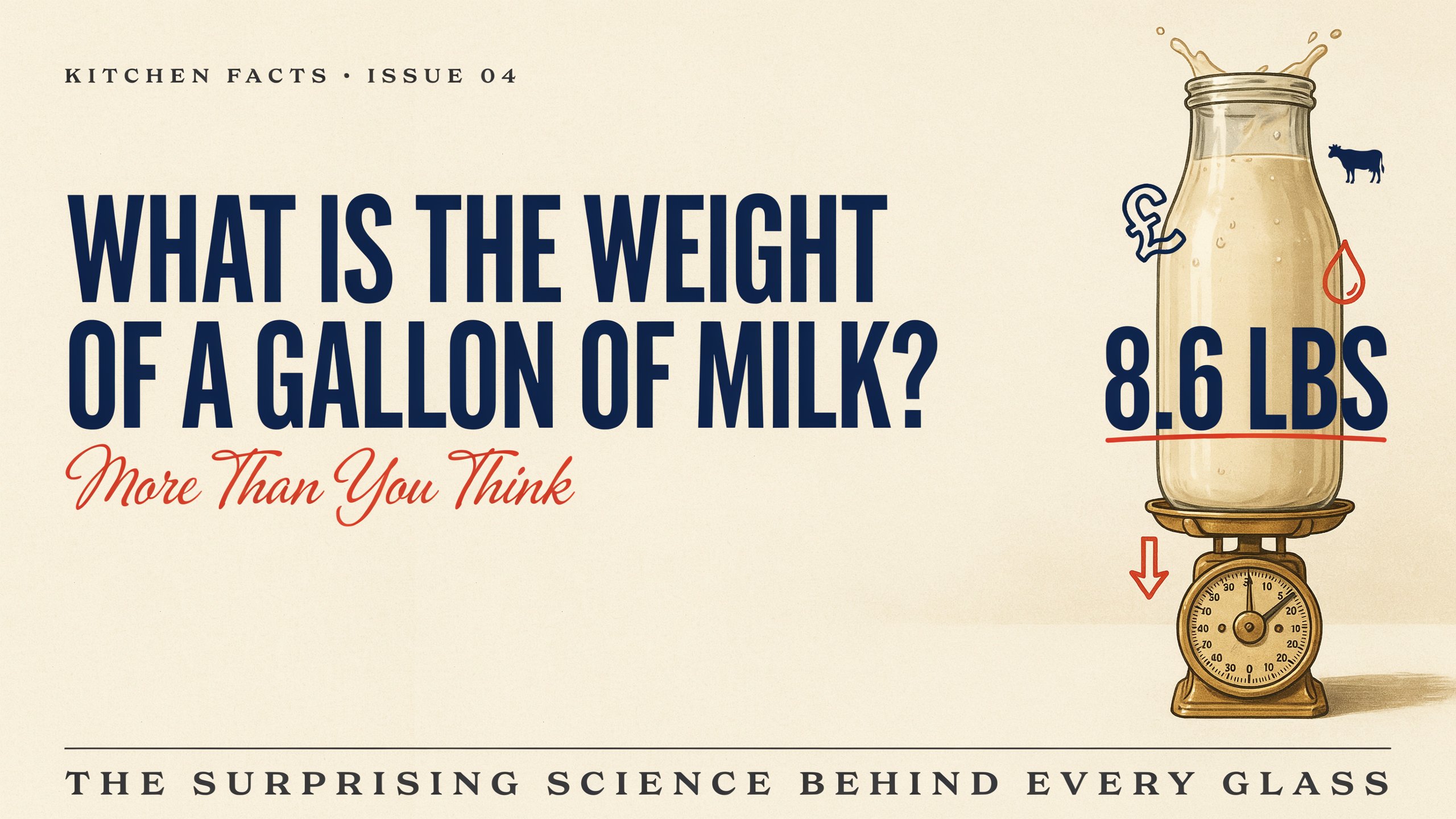
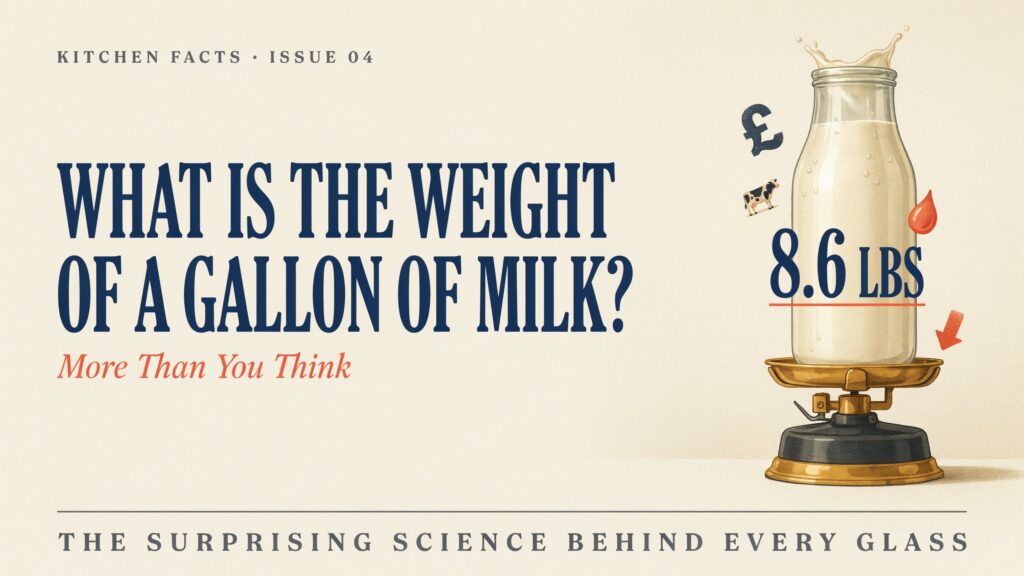
What is the Weight of a Gallon of Milk? More Than You Think
There’s a quiet moment most of us have had — standing in the grocery store, fingers hooked around that plastic handle, and thinking, this thing is heavy. And you’re right. That gallon jug you’re carrying weighs about as much as a brick, and there’s some genuinely interesting science behind why.
Let me walk you through everything I’ve found out about this topic, from the chemistry hiding inside your fridge to the quirky history of how a “gallon” even came to mean what it does today.
Key Facts
| Fact | Detail |
| Weight of a US gallon of whole milk | ~8.6 pounds (3.9 kg) |
| Weight of a UK/imperial gallon of milk | ~10.3 pounds (4.67 kg) |
| Weight of a gallon of water (for comparison) | ~8.34 pounds (3.78 kg) |
| Milk density (average) | ~1.03 g/cm³ |
| US gallon volume | 3.785 liters |
| UK imperial gallon volume | 4.546 liters |
| Whole milk weight per gallon | ~8.6 lbs |
| 2% milk weight per gallon | ~8.5 lbs |
| Skim milk weight per gallon | ~8.3–8.5 lbs |
| Milk composition | ~87% water, 4% fat, 3% protein, 5% lactose, 0.7% minerals |
| Plastic jug weight (not included above) | ~0.2–0.3 lbs extra |
| Number of chemical compounds in milk | Over 250 |
The Number Everyone Wants to Know
A standard US gallon of whole milk weighs approximately 8.6 pounds, or about 3.9 kilograms. That’s if you’re in the United States. If you’re in the UK or Canada, things get a little different — more on that in a moment.
That number — 8.6 pounds — is what most people in America will encounter. It’s not a perfectly fixed number, though. It can shift ever so slightly depending on what kind of milk you have, how cold it is, and even what the cow was eating. But for everyday life, 8.6 pounds is your answer, and it’s close enough for almost anything you’d ever need.
See also “How to Check Website Position on Google: What It Really Means and Why It Matters“
Why Milk Weighs More Than Water
Here’s something that surprises a lot of people. Milk is heavier than water, even though it looks very similar, is mostly made of water, and comes in the same-sized container.
The weight of a gallon of ordinary water is approximately 8.34 pounds. Milk, in the same jug, weighs about 8.6 pounds. That’s almost three ounces heavier. So what’s going on?
The answer comes down to what’s inside the milk. Cow’s milk is roughly 87% water, but the remaining 13% is packed with stuff — proteins like casein and whey, fat globules, lactose (that’s the natural sugar in milk), minerals like calcium and phosphorus, and all sorts of vitamins. Scientists have actually identified over 250 individual chemical compounds in milk. Each one adds a tiny bit of mass to the liquid.
Together, these components push the density of milk to around 1.03 grams per cubic centimeter, compared to water’s 1.0. That modest difference is exactly why the same volume of milk ends up weighing more.
Does the Type of Milk Change the Weight?
Yes, slightly. This is one of the more fun details in this whole topic.
You might expect whole milk to be heavier because it has more fat. But here’s the twist: fat is actually less dense than water. So removing fat should make the remaining milk denser, not lighter. And that’s exactly what happens.
Skim milk, which has had nearly all the fat removed, ends up with a higher proportion of proteins, lactose, and minerals — all of which are denser than fat. So ounce for ounce, skim milk can actually be slightly denser than whole milk.
In practice, the weight differences between milk types are very small — we’re talking about fractions of a pound per gallon. Whole milk comes in around 8.6 lbs, 2% milk around 8.5 lbs, and skim milk somewhere between 8.3 and 8.5 lbs. For home cooking and grocery shopping, none of these matter much. Where they start to add up is in large-scale shipping and dairy processing, where even small variations multiplied across thousands of gallons can mean real money.
The Temperature Question
Cold milk from your fridge weighs very slightly more than warm milk. When a liquid gets colder, it contracts a little — the same amount of liquid takes up slightly less space, making it denser per unit of volume.
That said, this difference is genuinely tiny for everyday purposes. We’re talking a tenth of a pound or less per gallon under normal conditions. You don’t need to let your milk warm up before weighing it for a recipe. The 8.6-pound figure holds reliably across the temperatures you’d encounter at home.
A Brief, Surprising History of the Gallon
Here’s something a lot of people don’t know: the word “gallon” has different meanings depending on where you live — and there’s a historical reason for that.
Back in medieval England, different goods were measured using different gallons. There was a wine gallon, a beer gallon, a grain gallon — and they were all slightly different sizes, because different trades had their own conventions. It was messy, confusing, and honestly just a very British approach to standardization.
When American colonists were still part of the British Empire, they used the wine gallon — also called the Queen Anne gallon, defined in 1706 as 231 cubic inches. When the United States declared independence in 1776, the young country kept that old measurement as its standard.
Back in England, however, the British decided to clean things up. In 1824, they passed the Weights and Measures Act and created a brand-new “imperial gallon,” defined as the volume of exactly 10 pounds of water at 62°F. This came out to about 4.546 liters — roughly 20% larger than the American gallon.
So the US gallon (3.785 liters) is actually the older of the two measurements. It’s the one Britain used and then abandoned. America just kept it.
This is why a gallon of milk in the UK weighs about 10.3 pounds, while the same “gallon” in the US weighs 8.6. They’re genuinely different amounts of liquid. If you ever try a challenge involving drinking a “gallon of milk,” make sure everyone agrees on which gallon they mean — because British participants would need to drink about 20% more.
What This Means When You Carry It Home
Think about what 8.6 pounds actually feels like in your hand. A standard hardback book weighs around 1–2 pounds. A full gallon of milk weighs as much as four or five of those stacked together. That’s why your fingers start to ache on the walk from the parking lot to the kitchen.
Old-time dairy farmers knew this well. Before modern delivery trucks, farms stored milk in large metal cans — each holding about 10 gallons. Full, one of those cans weighed around 80 pounds. Farmers moved two of these cans twice a day. It was physical, grueling work. Those old cans are now collectibles, often turned into flower pots or decorations — a small, quiet tribute to the labor that once filled them.
Today, the plastic gallon jug itself adds another quarter-pound or so to what you’re lifting. Not much, but worth knowing if you’re calculating total weight for something specific.
The Dairy Industry’s Hidden Math
For individual consumers, 8.6 pounds is just a trivial answer. But for the dairy industry, knowing the precise weight of milk is genuinely important.
When trucks haul milk from farms to processing plants, weight affects fuel costs, vehicle load limits, and freight pricing. If a truck is carrying 1,000 gallons of milk, that’s roughly 8,600 pounds of liquid — before you account for the truck itself or the containers. Getting that number wrong, even slightly, can push a vehicle over legal weight limits.
In food manufacturing, recipes for things like cheese, butter, and yogurt are scaled up to enormous volumes. A small error in density assumptions — thinking milk weighs the same as water, for instance — could throw off batches by hundreds of pounds.
And in quality control, dairy scientists actually measure milk’s density routinely. If a batch comes in lighter or heavier than expected, it might signal that the milk was watered down, or that the fat content is off. The weight of milk, in this sense, is a built-in honesty test for the product.
How Plant-Based Milks Compare
If you’ve switched to almond milk, oat milk, or another plant-based option, the weight picture looks a little different.
These alternatives are mostly water with dissolved or suspended plant material. Almond milk, for instance, is essentially water with a small amount of ground almonds mixed in — then strained. It’s typically lighter than dairy milk per gallon, around 8.4 pounds. Oat milk, because it contains more dissolved oat starch, lands closer to dairy milk in weight.
None of these differences would feel significant if you picked up the jugs in a store. The physical experience of carrying them home is nearly the same.
What is meaningfully different is the environmental picture. Producing a gallon of dairy milk requires significant land and water resources. But some plant-based alternatives have their own concerns — almond milk, for example, requires a surprisingly large amount of water per nut to grow. Oat milk tends to fare better from a land and water perspective. The “right” choice depends on which trade-offs matter most to you.
Common Misconceptions Worth Clearing Up
“A gallon of milk weighs 8 pounds.” Close, but not quite. It’s 8.6 for whole milk — that extra 0.6 of a pound matters when precision counts.
“Whole milk is heavier because fat is dense.” Fat is actually less dense than water. Skim milk can be marginally denser, though the practical difference is tiny.
“A UK and US gallon are the same.” Although they have the same name, their volumes are actually quite different. The UK gallon is about 20% larger.
“Temperature doesn’t affect milk weight.” Density, which determines the weight of a particular volume, is influenced by temperature. The change is small but real.
“Organic milk weighs more.” The term “organic” describes cultivation methods rather than composition. Organic milk and conventional milk of the same fat percentage weigh the same.
Why This Matters in the Kitchen
Most home recipes measure milk by volume — cups, tablespoons, liters — not by weight. So the 8.6-pound figure doesn’t come up much in everyday cooking.
Where it does matter is in professional baking and large-scale food production. Serious bakers often prefer to measure by weight rather than volume because it’s more accurate. If a recipe calls for milk measured by weight and you assume it weighs the same as water, your measurements will be off by around 3%. Over a large batch, that adds up.
If you’re converting between volume and weight for a recipe or project, just remember: a US gallon of milk weighs about 8.6 pounds, and a liter of milk weighs about 2.27 pounds (very close to 1.03 kilograms).
Final Words
There’s something oddly satisfying about knowing the weight of something as ordinary as a gallon of milk. It’s one of those questions that feels simple on the surface but opens up into history, chemistry, and physics the moment you pull at the thread.
Every time I pick up one of those plastic jugs now, I think about the old milk cans on farms, the fractional difference between a British and American gallon, and the dozen types of proteins and sugars quietly suspended in that white liquid. Something as mundane as groceries turns out to have a pretty rich story.
FAQs
1. How much does a gallon of whole milk weigh in the US?
About 8.6 pounds, or 3.9 kilograms. This is the standard figure for whole cow’s milk in the United States.
2. How much does a gallon of milk weigh in the UK?
In the UK, a gallon refers to the imperial gallon, which is larger — about 4.546 liters versus the US gallon’s 3.785 liters. A UK gallon of milk weighs around 10.3 pounds.
3. Is milk heavier than water?
Yes. A gallon of water weighs about 8.34 pounds, while a gallon of milk weighs about 8.6 pounds. Milk’s proteins, fats, sugars, and minerals make it denser than pure water.
4. Does skim milk weigh more or less than whole milk?
Skim milk can actually be marginally denser than whole milk because fat is less dense than water — so removing fat raises the overall density slightly. The real-world difference per gallon is usually less than 0.3 lbs.
5. Does temperature affect how much milk weighs?
Very slightly. Colder milk is a tiny bit denser than warmer milk, so a gallon of refrigerator-cold milk weighs a fraction more than a gallon at room temperature. For most everyday purposes, you can ignore this.
6. How much does a half-gallon of milk weigh?
About 4.3 pounds — exactly half the weight of a full gallon, which makes sense since you’ve got half the volume.
7. Does the plastic jug add significant weight?
Yes, though not much. A typical gallon milk jug adds around 0.2 to 0.3 pounds. So if you weigh a full, sealed gallon jug off the shelf, you’d get closer to 8.8 to 8.9 pounds total.
8. Why is the US gallon different from the UK gallon?
American colonists used the old Queen Anne wine gallon (231 cubic inches) when they separated from Britain in 1776 and kept that standard. In 1824, Britain redefined its gallon as a larger “imperial” unit based on the weight of water. The two countries never reconciled the difference.
9. Does the breed of cow affect how much a gallon of milk weighs?
Indirectly. Different breeds produce milk with slightly different fat content. Jersey cows, for example, tend to produce richer, higher-fat milk than Holsteins. Higher fat content slightly lowers density, but the difference per gallon is very small.
10. How does a gallon of milk compare in weight to other common liquids?
A gallon of water: 8.34 lbs. Milk: 8.6 lbs. Orange juice: about 8.7–8.9 lbs. Cooking oil: about 7.3 lbs (lighter, because oil is less dense than water). Gasoline: about 6.2 lbs.
11. Does organic milk weigh the same as regular milk?
Yes. “Organic” describes how the cows are raised and what they eat, not the composition of the milk itself. If both are whole milk, they’ll weigh the same.
12. Does chocolate milk weigh more than regular milk?
Yes, a little. The added sugar syrups and cocoa increase the total dissolved solids, which raises density. Chocolate milk can weigh noticeably more per gallon than plain whole milk.
13. Why do dairy farms care about milk weight?
Shipping logistics, fuel costs, vehicle weight limits, and quality control all depend on knowing accurate weights. A small error per gallon, multiplied across thousands of gallons, becomes a significant problem.
14. Can I use milk weight to calculate calories?
Roughly. Whole milk contains about 150 calories per cup, and there are 16 cups in a gallon, so a full gallon contains around 2,400 calories. Knowing the weight helps when you’re tracking precise dietary amounts by mass rather than volume.
15. Does freezing milk change its weight?
No. Freezing changes the volume slightly (ice takes up more space than liquid water), but the mass — and therefore the weight — stays the same. Whether the milk is liquid or frozen, you will still have the same 8.6 pounds.
Empowering curious minds to explore, learn, and think deeper with Fact Aura.