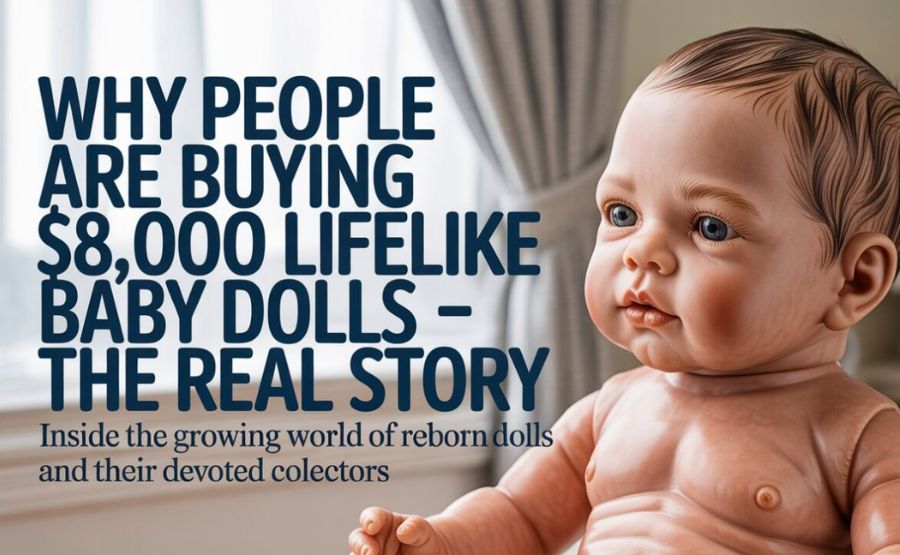
Why People Are Buying $8,000 Lifelike Baby Dolls
Something happens when you walk past a woman pushing a high-end stroller through a shopping mall. You glance over, see a tiny face, rosy cheeks, wispy hair. Your brain registers: baby. Maybe you smile.
Then you look a little closer and realise the baby isn’t breathing.
Welcome to the world of reborn dolls — and one of the most quietly misunderstood communities in modern life.
Key Facts
| Detail | Information |
| What are they called? | Reborn dolls (or reborns) |
| Price range | $200 basic to $10,000+ for premium silicone |
| When did they emerge? | Early 2000s as a niche art form |
| Materials used | Real goat/alpaca hair, strand by strand; vinyl kits or whole silicone |
| Realistic features added | Hand-painted veins, weighted bodies, heartbeat simulators, micro-rooted hair |
| Who buys them? | Collectors, grieving parents, dementia patients, artists, grandmothers, children |
| Who makes them? | Independent artists — many work from home studios |
| Community size | Global — active forums, social media groups, conventions worldwide |
| 2025 Dolls of the World expo | Greensboro, NC — over 1,500 attendees |
| Research backing therapy use | 2022 peer-reviewed study: doll therapy improves emotional state in dementia patients |
| Institutional recognition | Alzheimer’s Society UK and Dementia UK endorse doll therapy in care homes |
| What critics say | “Creepy,” “unhealthy,” “confusing real for fake” |
| What owners say | “Healing,” “misunderstood,” “deeply personal” |
The First Time You See One, It Stops You Cold
There’s something called the uncanny valley. It’s that slightly eerie feeling you get when something looks almost human — but not quite. Your brain flickers between “real” and “not real” and can’t settle.
A high-end reborn doll lives right in that space.
Look at one up close and you’ll see translucent skin with pale blue veins painted underneath. Tiny wrinkles at the knuckles. Eyelashes so fine they seem impossible. Hair that was inserted into the scalp one strand at a time, using real goat or alpaca hair. A body weighted to feel like an actual infant in your arms.
Some of these dolls have a small mechanism inside that creates the sensation of breathing or a faint heartbeat.
The experience of holding one, according to people who have, is genuinely disorienting. Your arms respond before your brain catches up. The weight is right. The warmth of soft silicone is right. Your instincts register: baby.
That is exactly the point.
See also “Juntos Seguros: Two Stories Behind One Powerful Phrase“
Where This All Started
The story of reborn dolls begins in the early 2000s, which is recent enough that we can trace it clearly.
A small number of doll artists in the United States started experimenting with taking basic vinyl baby doll kits and transforming them. They stripped off factory paint. They repainted the skin layer by layer using translucent specialist paints. They added weight. They rooted real hair. They were trying to create something that moved them as artists — something that felt real in a way mass-produced dolls never had.
The results spread online. Other artists saw what was being made and wanted to try it. Collectors saw what was being made and wanted to own one. Communities formed on early internet forums. Then on Facebook groups. Then on YouTube, where some channels showing reborn doll hauls and “nurturing routines” gathered hundreds of thousands of followers.
What started as a tiny corner of the doll-collecting world became something much larger.
By 2025, these dolls were showing up at international expos that drew over 1,500 attendees. Celebrity artists within the community were signing autographs. Custom commissions for top silicone artists had waitlists stretching months out.
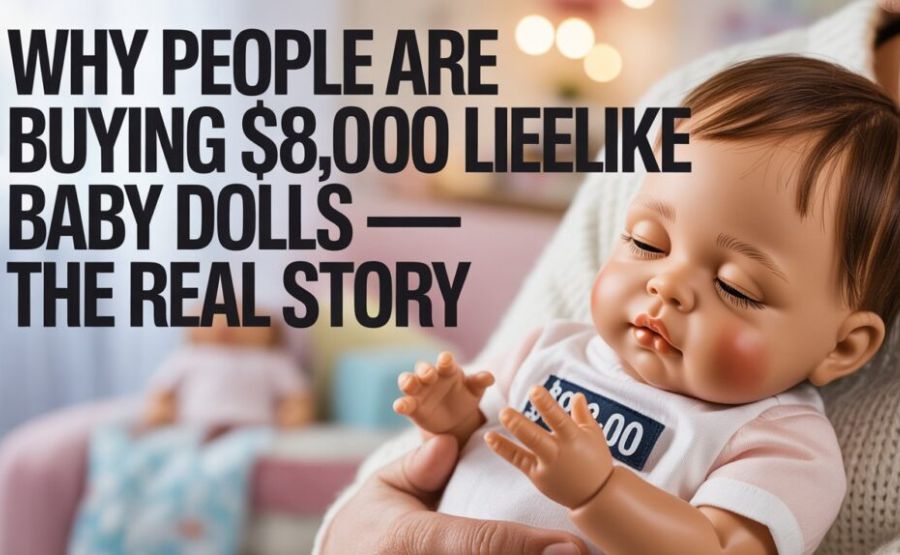
The People Who Buy Them
If you imagined a typical reborn doll owner before reading this article, you might have pictured someone lonely, or grieving, or perhaps someone the outside world would quietly label as eccentric.
The reality is far more varied.
At the Dolls of the World expo in Greensboro, North Carolina in 2025, the crowd included grandmothers who’d raised five children and seven grandchildren — buying dolls as a collector’s passion they shared with those same grandkids. It included 12-year-old girls who liked coming because nobody judged them for what they loved. It included husbands patiently carrying six-year-old sized reborn dolls in carriers around a hotel ballroom, supporting their wives’ hobby without needing to understand it fully.
One grandmother had her husband building a dedicated shed in their Texas backyard just to house her collection. A spiritual advisor from New York spent $6,000 on a silicone reborn named Lucy. A 23-year-old woman named Kelli Maple dressed her doll Naomi in a onesie and hair bow, placed her in a luxury stroller complete with a sound machine and pacifier, and took her shopping at the mall.
The community, it turns out, contains multitudes.
The Grief Connection That Most People Miss
Here is where the story goes somewhere genuinely moving.
Many of the people who feel the deepest bond with their reborn dolls have experienced a particular kind of loss. They’ve lost a baby. Or they’ve had a miscarriage. Or infertility closed a door they desperately wanted open.
The grief that follows infant loss is unlike most other grief. It’s largely invisible to the outside world. There may be very few physical memories — no years of photographs, no school reports, no shared holidays. Just absence where something was supposed to be.
For some of these parents — mostly mothers, though not exclusively — a reborn doll becomes a place to put the love that has nowhere else to go.
They hold it. They dress it up. They give it a name. They sit quietly with it. Not because they believe it’s real. But because the ritual of caring provides something that grief counselling and well-meaning sympathy sometimes can’t: a physical anchor for emotion that has no other outlet.
A licensed therapist or grief counsellor might call this a transitional object — something that holds emotional meaning and provides a pathway through loss. The fact that these particular objects look like babies is precisely why they work for this purpose.
Critics who dismiss this as delusional are missing something important.The doll’s owners are aware that it is not a baby. That’s not the point. The point is what it allows them to feel and process.
What the Science Actually Says
This isn’t just an anecdote. There’s real research behind it.
A 2022 peer-reviewed study looking specifically at doll therapy and dementia patients found something striking. Participants who engaged with dolls showed reductions in aggressive and agitated behaviors. They communicated more with staff and caregivers. Their emotional state improved measurably.
The researchers — working from a systematic review of multiple studies involving nearly 300 participants — concluded that doll therapy can diminish disruptive behaviors and promote communication in people with moderate to severe dementia.
That’s not a fringe observation. That’s published, peer-reviewed medical science.
Dementia UK and the Alzheimer’s Society in the UK have both formally endorsed doll therapy as a legitimate person-centred care approach for use in care homes and memory units. They provide guidance to care facilities on how to introduce the practice appropriately.
The mechanism behind why it works connects to something simpler than you might expect. Holding a warm, weighted, soft object — any such object — measurably reduces the stress hormone cortisol and activates the body’s rest-and-calm systems. This is the same principle behind weighted blankets, which have peer-reviewed evidence supporting their use for anxiety, ADHD, and autism.
Reborn dolls add something layered on top of that basic physical effect. They activate nurturing instincts. They create a sense of role and purpose. For someone with dementia who may have forgotten what year it is or who is in the room with them, holding a weighted doll can bring a few minutes of calm focus and warmth that medication alone often can’t deliver.
One Connecticut woman, Jaime Beebe, started bringing her personal reborn dolls to visit dementia patients at local care facilities in 2017. She described the moment an Alzheimer’s patient who couldn’t remember whether she’d eaten breakfast that morning became completely present and joyful on seeing the doll. That kind of moment is hard to argue with.
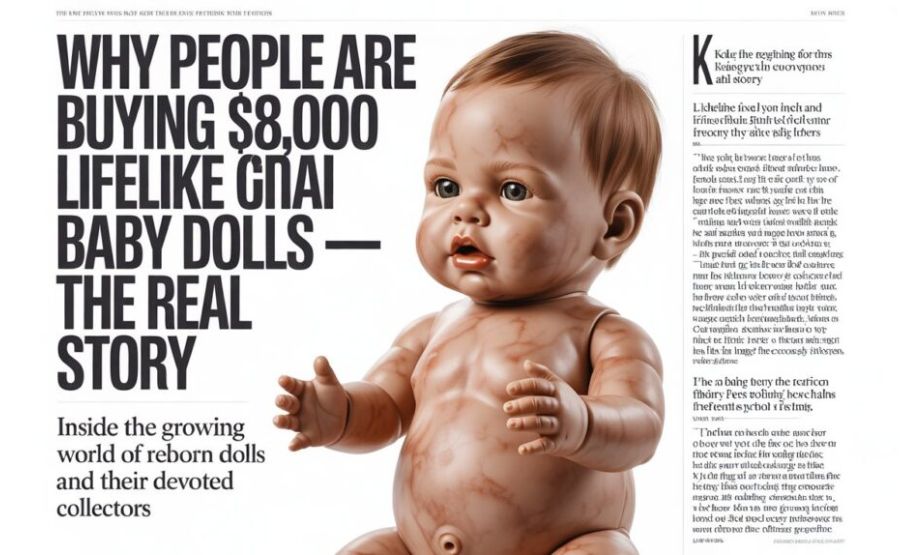
The Art and the Craft
Let’s talk about what it actually takes to make one of these dolls, because the price tag makes a lot more sense once you understand what goes into it.
The majority of resurrected artists frequently work alone in their homes.They start with either a vinyl kit — a set of blank doll parts designed specifically for reborning — or with full silicone, which is a more expensive and more realistic material to work with.
Then the real work begins.
Skin is painted in thin, translucent layers. Multiple coats, each dried between applications, building up the subtle variation of real human skin — the slightly warmer nose, the faint blue around closed eyelids, the pale tracery of veins just visible beneath the surface of a forearm.
Mottling and capillary detail gets added by hand with fine brushes or sponges. Tiny creases at the joints. Milk spots. The reddish tinge of newborn skin around the ears.
Then hair. Each strand is inserted individually into pre-made holes in the scalp using a small felting needle. A single doll head might require thousands of individual insertions. This process alone can take many hours over several days.
Then the body gets weighted — often using glass beads or sand inside cloth pouches — to match the feel of a real infant’s weight distributed across a held body. Some artists add heartbeat mechanisms or breathing movements.
A skilled reborn artist might complete three or four dolls in a month. A high-end silicone piece from a sought-after artist might take considerably longer, with a price tag to match.
When you hold the finished result of 40 to 100 hours of precise handiwork, eight thousand dollars starts feeling like less of a mystery.
The Stigma Is Real — And Mostly Unfair
Here’s the honest part that needs saying.
People who own reborn dolls face real unkindness from the world around them.
They get called disturbed. They get mocked on social media. Some have family members who refuse to accept the hobby and say things at family gatherings that leave marks. One Texas grandmother said something quietly wise when her eldest son couldn’t accept her collection: “You don’t have to get it. You just have to respect it.”
The discomfort people feel is understandable. These dolls trigger something instinctual. We are wired to respond to baby-shaped faces and baby-sized weights. When we see someone treating a doll with the care you’d give a baby, our brains flag something as “off” and the emotion that follows often gets expressed as mockery or alarm.
But that discomfort says something about the observer, not the collector.
A grandmother who keeps a nursery for her reborn dolls — with bunk beds that her grandchildren share when they visit — is not confused about what’s real. She’s a person with a hobby she finds meaningful, who has built a community around it, and who is causing no harm to anyone.
The people who use reborn dolls to move through grief or to manage anxiety are engaged in something that therapists recognise as legitimate. The judgment they receive from outsiders adds an extra layer of difficulty to situations that are already hard.
The Uncomfortable Questions
Being honest about this topic means looking at the parts that raise real questions too.
There are moments in the reborn community where the line between comfort and confusion needs attention. For dementia patients who may no longer consistently recognise the doll as a doll, care professionals recommend thoughtful introduction with family consent. Not everyone with dementia should be given a doll without that conversation.
For younger, cognitively healthy adults who begin to retreat entirely from human relationships in favour of time with a reborn doll, a good therapist would want to explore what’s happening underneath. The dolls can be helpful companions through hard periods, but any object — beloved book, pet, hobby — can become a way of avoiding connection that needs to happen.
The question is always: is this helping you move through something, or helping you avoid it? A thoughtful answer makes the difference.
Most reborn owners fall clearly in the “moving through” category. The community itself is social, warm, and full of people who are deeply connected to other humans — including each other.
What’s Next for This World
The reborn doll market is not shrinking. If anything, it’s expanding.
Artists are experimenting with increasingly sophisticated heartbeat and breathing mechanisms. Some dolls now include warming elements that maintain a gentle body temperature. The fantasy side of the hobby — dolls that look like dragons, werewolves, fairies — is growing alongside the hyper-realistic side.
Online communities on YouTube, TikTok, Instagram, and dedicated forums continue to grow. New collectors find the community every week, often through a video that shows up in their feed and makes them stop and look twice.
What’s quietly remarkable is that this community opened up a conversation that was always needed — about grief, about non-traditional ways of coping with loss, about what it means to care for something, about the line between art and therapy and comfort.
Those conversations are worth having.
Final Words
When a stranger pushes a stroller through a shopping mall and the passenger is a doll that costs as much as a used car, the easiest response is a smirk.
But behind that doll there’s often a story. Maybe a pregnancy that didn’t go the way it should have. Maybe an elderly parent in a care home who calms down when the doll comes out. Maybe just a person who found something beautiful in the work of a skilled artist and wanted to hold it.
We contain more complexity than a first glance suggests. So do the people around us. The reborn doll community is a small but vivid reminder of that.
Sometimes the things that look strangest from the outside are the things holding people together on the inside.
FAQs
1. What exactly is a reborn doll?
A reborn doll is a hand-crafted baby doll made to look and feel as close to a real infant as possible. Artists paint skin in translucent layers, root real hair strand by strand, add weighted bodies, and sometimes include heartbeat or breathing mechanisms. They’re made from vinyl kits or full silicone and can cost anywhere from $200 to well over $8,000.
2. Who buys reborn dolls?
All kinds of people. Collectors, grandmothers, mothers grieving infant loss, parents who can’t have children, people managing anxiety or loneliness, children who love dolls, dementia patients in care homes, and people who simply appreciate them as art. The community is far more diverse than most people expect.
3. Is it psychologically healthy to have a reborn doll?
For most people, yes. Mental health professionals recognise the therapeutic value of transitional objects, nurturing rituals, and tactile comfort. For people grieving infant loss or managing anxiety, reborn dolls can provide real comfort. Like anything, if ownership becomes a way of completely withdrawing from human relationships, that’s worth exploring with a therapist.
4. Are reborn dolls actually used in medical therapy?
Yes. Doll therapy is endorsed by Dementia UK and the Alzheimer’s Society UK for use in care homes. A 2022 systematic review published in peer-reviewed journals found that doll therapy improves the emotional state of dementia patients, reduces aggressive behaviors, and promotes communication.
5. Why do some reborn dolls cost $8,000 or more?
Because of the extraordinary amount of skilled handwork involved. A premium silicone reborn might represent 40 to 100 hours of detailed painting, individual hair rooting strand by strand, body weighting, and mechanical additions. Sought-after artists have months-long waitlists. The price reflects craft, materials, and scarcity.
6. What’s the difference between a vinyl and a silicone reborn?
Vinyl is the more common material — it’s durable, paintable, and less expensive. Full silicone feels much closer to real skin — slightly warm, soft, and flexible in a way vinyl isn’t. Silicone reborns are significantly more expensive and harder to make, which is why they command the highest prices.
7. Where do people buy reborn dolls?
From independent artists directly (often through personal websites or marketplaces like Etsy and Reborn Doll Market), at collector expos and fairs, and from established reborn studios. Be cautious of very cheap imitations on mass-market sites — they’re almost never the real thing.
8. Are reborn collectors ever mocked or judged?
Unfortunately, yes. Owners report being taunted online, criticised by family members, and made to feel embarrassed about their hobby. Most of the reborn community says the judgment comes from misunderstanding. Events like reborn doll conventions exist partly because they’re spaces where nobody needs to explain or justify themselves.
9. Do reborn doll owners believe the dolls are real babies?
No. The vast majority of owners are fully aware their reborns are dolls. The comfort they provide comes not from confusion about reality but from the rituals of care, the tactile experience of holding something weighted, and the emotional meaning the owner gives to the object. This is the same principle behind any beloved comfort object.
10. What about reborn dolls for children?
Plenty of kids collect reborn dolls, just as they might collect any detailed figurine or toy. A 12-year-old at a 2025 reborn convention said she loved coming because people didn’t judge her for what she liked. At lower price points, fantasy-style reborns designed for younger collectors are popular.
11. Are there reborn dolls that don’t look like babies?
Yes. The fantasy side of the hobby includes dolls that look like werewolves, dragons, fairies, elves, and other characters. These can be just as detailed and just as expensive as realistic baby reborns. The community has expanded well beyond realistic infants.
12. What happens if a reborn doll gets damaged?
Vinyl reborns can often be repaired by a skilled artist — repainting, re-rooting hair, or replacing damaged parts. Silicone is harder to repair but not impossible. Some collectors insure high-value pieces. Artists who made the original doll may offer repair services.
13. Is the reborn doll market growing?
Clearly yes. The community is expanding globally, with active online communities in the US, UK, Australia, Europe, and beyond. Artists are innovating with new features. The 2025 Dolls of the World expo drew over 1,500 attendees, and demand for top artists’ work continues to outpace supply.
14. Could a reborn doll be right for someone I know who’s grieving?
It depends on the person. For someone who has experienced infant loss, miscarriage, or infertility, the idea might feel comforting or might feel uncomfortable — people respond differently. If you’re considering it as a gift, a conversation first would be wise. For an elderly parent with dementia, speak with their care team before introducing one. When it’s the right fit, the impact can be genuinely moving.
Empowering curious minds to explore, learn, and think deeper with Fact Aura.