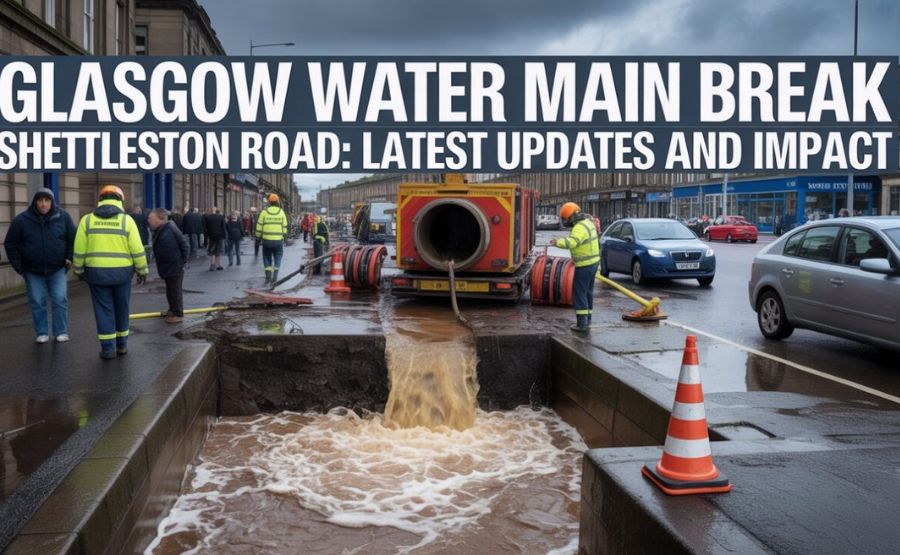
Glasgow Water Main Break Shettleston Road: What Happened, Why It Happened, and What It Means for Glasgow
It was an ordinary Thursday morning in Glasgow’s East End. People were heading to work. The morning buses were running their usual routes. Kids were walking to school. And then, somewhere under the tarmac of Shettleston Road, something gave way.
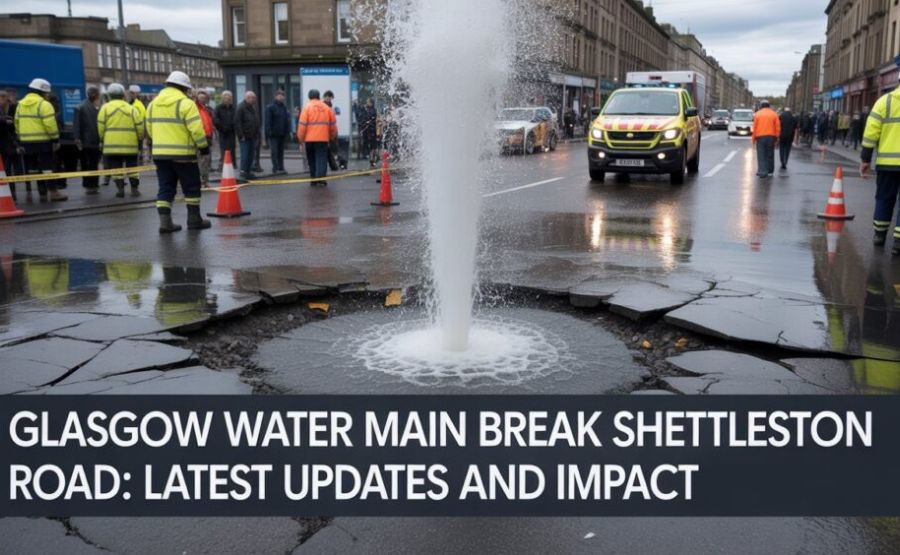
Water — thousands of litres of it — started forcing itself up through the road surface. Within minutes, the street was flooded. People stood watching from their windows, confused and slightly alarmed, as the road they’d driven down a hundred times turned into something resembling a small river.
This is the story of what happened on May 29, 2025, why it happened, and what it quietly tells us about the city we live in.
Key Facts
| Detail | Information |
| Date of incident | May 29, 2025 |
| Time first reported | Around 7:00–8:30 AM |
| Location | Shettleston Road, Glasgow East End |
| Specific junction affected | Near St Mark Street / Old Shettleston Road to Fernan Street |
| Postcode affected | G32 |
| Cause | Burst underground water main (aging cast iron pipe) |
| Contributing factors | Corrosion, pressure fluctuations, soil movement, traffic vibration |
| Road closure | Between Old Shettleston Road and Fernan Street |
| Bus routes diverted | First Bus Glasgow routes 2, 46, 60 (among others) |
| Water restored | Within 24–48 hours for most households |
| Discolouration | Sediment and trapped air — advised to run taps to clear |
| Responsible authority | Scottish Water |
| Previous nearby burst | Hallhill Road (January 2025), near Shettleston Station |
| Wider Scottish Water programme | £4.5 billion investment in infrastructure 2021–2027 |
| Glasgow Resilience Project | £95 million, 12km of new ductile iron pipe across Glasgow |
A Street That Was Already Busy
Shettleston Road isn’t a side street. It’s one of the main arteries running through Glasgow’s East End, connecting local neighbourhoods straight to the city centre.
On any given morning, it carries buses, delivery lorries, commuters, parents, and school kids. It’s the kind of road where a disruption doesn’t just affect one block — it ripples outward across the whole area.
When the water main went, it didn’t just flood the road. It brought the East End’s morning routine to a complete stop.
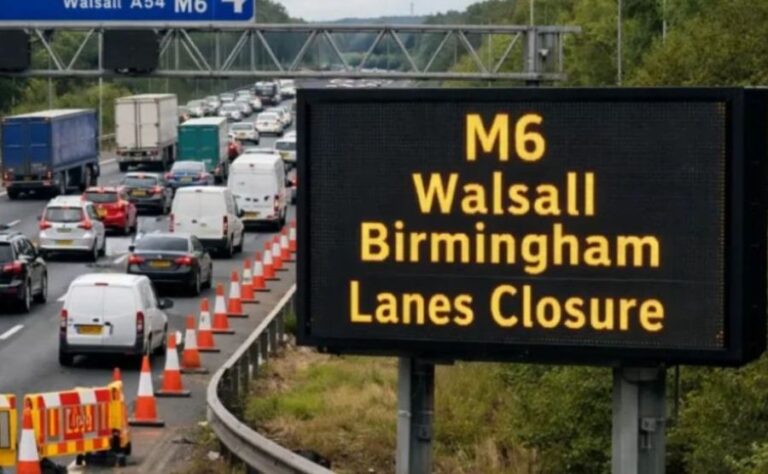
See also “M6 Walsall Birmingham Lanes Closure: Why the Road Never Seems to Stop Changing“
What Actually Happened That Morning
The first signs weren’t dramatic. They rarely are.
Residents near St Mark Street started noticing their water pressure had dropped. Some turned on their taps and got a trickle. Others got water that came out brown and cloudy. A few called Scottish Water’s helpline straightaway. Something was clearly wrong underground.
Then came the point of no return. The pipe — an old cast iron main running beneath the road surface — cracked under pressure and gave way entirely.
Water erupted upward through the tarmac. It spread quickly across the carriageway, pooling in ankle-deep puddles along the pavement. Shopfronts had water lapping at their doors. Drivers who hadn’t heard the news yet found their path blocked and their morning plans dissolved.
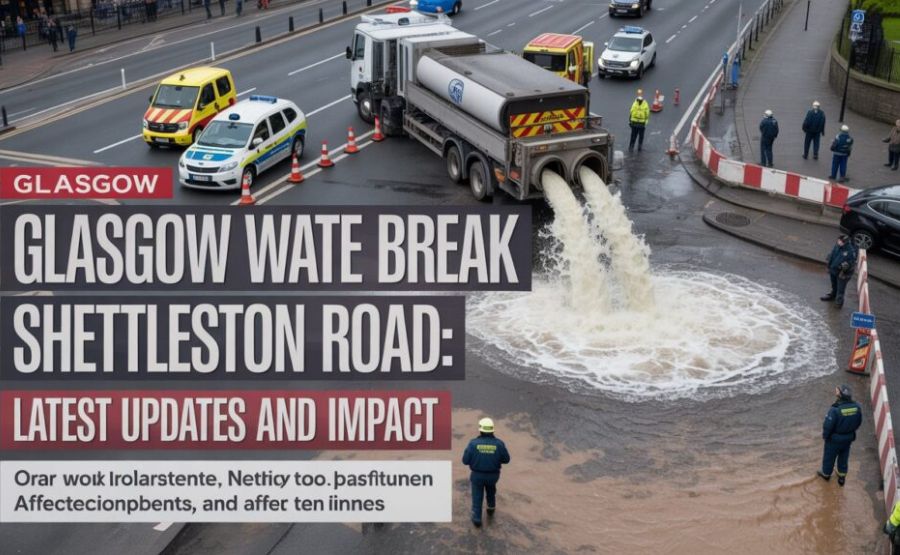
Scottish Water crews arrived quickly. But here’s the thing about a burst like this — arriving fast and fixing it fast are two very different challenges. First you have to find where exactly the break is, isolate the damaged section by closing valves, then bring in the heavy machinery to dig down through the road surface. Only then can you actually see the damage and start repairing it.
That whole process took hours. For some households, the water was off for most of the day. For others, supply returned within hours but the water came out discoloured for some time after — a perfectly normal result of sediment being disturbed inside the pipe during the burst.
Why the Pipe Gave Way
In reality, most people are asking this question. Why did it happen, not what happened?
The short answer is: the pipe was old. Very old.
Some of Glasgow’s underground water mains date back to before the Second World War. A significant portion was laid down in cast iron — a material that was absolutely reliable for its time but which corrodes slowly and steadily over decades. Inside, rust builds up. The walls of the pipe thin out. The strength that was there a century ago simply isn’t there anymore.
Glasgow’s water story actually goes back even further than that. In the 1850s, a civil engineer named John Frederick Bateman designed an ambitious scheme to bring fresh water from Loch Katrine in the Scottish Highlands all the way down to Glasgow. Queen Victoria opened the sluice gates personally in 1859. The pipes and aqueducts from that era — nearly 26 miles of them — still supply Glasgow today in various forms.
That’s remarkable engineering. It’s also a long time for metal to sit underground under a busy city.
Corrosion is only part of the story. There are other forces at work too.
Glasgow’s clay-heavy soil shifts when it gets wet and when it dries out. That constant small movement puts stress on pipes buried within it. Heavy vehicles — buses, delivery lorries, refuse trucks — pass over Shettleston Road dozens of times a day, sending vibrations down through the tarmac and into the ground below. Each individual tremor is tiny. Over years, those vibrations add up.
Then there are pressure changes inside the water system itself. When valves are opened or closed to manage the network, pressure waves travel through the pipes. Engineers call this “water hammer.” In a healthy, new pipe, it’s not a problem. In an old, corroded pipe, it can be the final straw.
That’s likely what happened on Shettleston Road. Not one single cause — more like a combination of age, corrosion, ground movement, and a pressure change that pushed a weakened pipe past its limit
What It Was Like for Residents
Let me be honest: a burst water main affects people differently depending on their circumstances.
For a young, able-bodied person who works from home, a day without tap water is inconvenient. You buy a bottle from a shop, you wait it out, and life goes on.
But for an elderly resident who lives alone and can’t easily get to a shop, it’s a different situation entirely. Getting medication with water matters. Personal hygiene matters. Cooking matters.
For a family with young children or a baby, water becomes urgent very fast. Baby formula needs clean water. Hands need washing. Baths need filling.
Several elderly residents in the affected G32 area needed support getting bottled water during the outage. Neighbours helped out. Some local shops tried to stay open and assist where they could. That kind of quiet community response — people checking on each other without being asked — is genuinely heartening.
For the businesses on Shettleston Road, though, the impact was financial and immediate. A café with no running water cannot serve food. A hair salon cannot operate. A takeaway has to close. In some cases, business owners reported standing behind closed doors watching potential customers pass by on the other side of the barriers, unable to do anything.
Bursts like this don’t tend to make the national news. But for the shop owner who lost a full day’s trading, or the elderly resident who spent a confused and stressful morning without water, it was very much a significant event.
The Traffic Chaos That Followed
Shettleston Road was closed between Old Shettleston Road and Fernan Street while repairs were carried out. That sounds like a contained stretch. But in a busy East End corridor, it was enough to cause significant congestion right through the area.
Drivers were diverted via Westmuir Street and other surrounding roads. During morning rush hour, commute times reportedly doubled on some of those alternative routes. People who usually sailed through in fifteen minutes found themselves sitting in queues they hadn’t expected.
Several First Bus Glasgow routes — including 2, 46, and 60 — were diverted away from Shettleston Road entirely. Bus stops along the affected section were suspended. Passengers waiting at stops that were no longer served had to figure out alternatives on the fly, often without clear information about what was happening or when it would resolve.
This is a detail that doesn’t get much attention when a water main bursts. The repair gets sorted, the road reopens, and everyone moves on. But for the person who missed their job interview, or the parent who was late picking up a child, or the worker who turned up late to a shift — those small disruptions were real, even if they’re hard to measure.
Glasgow’s Bigger Infrastructure Problem
The Shettleston Road burst wasn’t an isolated event. That’s important to understand.
In January 2025, a water main broke on Hallhill Road, close to Shettleston Station. In February 2025, there was a burst on Pollokshaws Road on the city’s south side — that one disrupted supply to around 6,500 homes. In 2023, a major failure in Milngavie affected around 250,000 customers across the city. The pattern is consistent.
About one in five water pipes in UK urban systems was installed before 1931. Almost all of those pipes are now approaching the end of their practical lifespan — and those aging mains are responsible for close to half of all water main leaks in the country. Scotland is no different from England or Wales on this front. Old pipes break.
The challenge is that you can’t replace everything at once. Digging up an entire city’s water network would cost billions and cause disruption that would make individual bursts look minor. So it has to be done progressively, prioritising the most at-risk pipes while managing the ones still holding together.
Scottish Water isn’t ignoring this. They’re currently halfway through a £4.5 billion investment programme running from 2021 to 2027, focused specifically on replacing aging infrastructure, improving water quality, and modernising the network.
Their Glasgow Resilience Programme — a £95 million project to install 12 kilometres of new ductile iron pipe through the city — is one of their biggest ever investments. The new pipes are stronger than the old cast iron ones, designed to handle pressure changes better and last far longer.
There’s also a move toward smart technology. Acoustic sensors that can detect leaks underground before they become bursts. Pressure monitoring systems that spot weak points in the network before they fail. The idea is to move from reacting to problems after they happen — the way things have worked for most of the last century — to catching them before they do.
That shift is the right one. But it takes time, funding, and coordination. And in the meantime, old pipes are still old.
The Brown Water Question
One thing that worried a lot of people during the Shettleston Road burst was the discoloured water coming out of their taps.
When a main breaks, sediment that’s been sitting quietly inside the pipe for years gets disturbed. Air gets into the system too. When water service is restored, that sediment and those air bubbles make their way through the pipes and out through household taps. The result is water that looks brown, orange, or cloudy.
This is almost always a temporary problem. Scottish Water’s advice is to run the cold tap for a few minutes until the water runs clear. If it doesn’t clear after several minutes, or if you notice a taste or smell, report it.
Here’s the thing that worries people though: they see brown water and they don’t know whether it’s safe. And understandably, they don’t want to use water they’re uncertain about for drinking, cooking, or making baby formula.
Scottish Water’s position — that discolouration from sediment is typically safe — is accurate. But in the absence of clear, fast communication to residents, uncertainty fills the gap. One of the quiet lessons of the Shettleston Road burst is that communication during an emergency matters as much as the technical response. Telling people what’s happening, what to expect, and what to do is not a nice-to-have. It’s part of the essential response.
The Ethical Question Behind the Pipes
There’s a question here that doesn’t often get asked directly. Who is responsible for the state of Glasgow’s underground pipes?
On one level, it’s Scottish Water’s responsibility. They own and manage the network. They’re accountable for maintenance, replacement, and response.
But Scottish Water is a public corporation. Its investment programme is funded through customer charges and borrowing from the Scottish Government. When infrastructure investment gets delayed or deprioritised — and it sometimes does, because investment in things people can’t see is a politically difficult sell — the pipes continue to age. The risk of bursts increases.
Meanwhile, the residents of Shettleston Road — many of whom are in a part of the city that already faces economic and social pressures — pay their water bills expecting a reliable service. When the pipe bursts and they lose water for a day, nobody comes to compensate them for the cost of the day’s disruption, the lost food, or the missed work.
There’s no simple villain in this story. But the pattern of bursts in parts of Glasgow that have older infrastructure and historically lower investment does raise a fair question: are the benefits and burdens of aging infrastructure distributed fairly across the city?
That’s worth asking. And it’s worthwhile for East End residents to ask it out loud.
What Happens After the Repair
Once the damaged pipe section was replaced and the road surface restored, things went back to normal fairly quickly on the surface. The barriers came down. The buses went back to their usual routes. The cafés reopened.
But the repaired section will now be a slightly newer piece of pipe surrounded by old ones. The underlying network in that stretch of the East End remains largely the same as it was before May 29, 2025. Which means the risk of another burst — in the same area, or close to it — hasn’t gone away.
This is the nature of reactive repair versus proactive replacement. You fix the broken bit. But the conditions that caused it to break — aging infrastructure, traffic stress, ground movement — are still there.
The Shettleston Road burst didn’t make the front page of the national newspapers. But it was exactly the kind of event that should be feeding data into Scottish Water’s pipe replacement scheduling, nudging decision-makers toward prioritising the East End’s aging mains for proactive renewal rather than waiting for the next burst.
Whether that happens or not is something only time will tell.
What You Should Do If It Happens Again
If you’re reading this as a resident of Shettleston, or anywhere in Glasgow’s East End, here are the genuinely practical things worth knowing.
If you notice low water pressure or discoloured water coming from your tap, this could be an early sign of a burst somewhere in the local network. Report it to Scottish Water straightaway on 0800 0778 778. The earlier a problem is logged, the earlier crews can investigate.
If your water is cut off, store bottled water for drinking and medication. Most bursts are resolved within 24 to 48 hours, but having a small supply means you’re not caught completely unprepared.
If your water comes back brown or cloudy, run the cold tap for a few minutes and let it clear. Don’t use discoloured water for drinking or baby formula until it runs clear.
If the road outside floods, keep well back from the water. Flooded streets can conceal hazards — including the hole or crack in the road itself. And definitely don’t drive into standing water if you don’t know how deep it is.
Follow Scottish Water’s social media accounts and website for live updates during incidents. The faster information spreads, the better people can plan around the disruption.
Final Words
There’s something quietly unsettling about a road you walk down every day suddenly erupting. It’s a reminder that the city we move through is built on systems we can’t see, managed by people we rarely think about, and held together by infrastructure that has, in some cases, been quietly aging underground since before our grandparents were born.
The Shettleston Road burst wasn’t a disaster. Nobody was seriously hurt. The water came back. The road was repaired. Life resumed.
But it was a clear, visible signal that something deeper needs attention. Glasgow’s East End, like other parts of the city, carries old pipes beneath its busy streets. Those pipes will keep aging. The question isn’t really whether more bursts will happen — it’s whether we’re making the decisions now that will make them less likely.
Scottish Water is investing. The technology is improving. Progress is being made. But pipes installed decades ago don’t wait politely for replacement programmes to catch up.
The residents of Shettleston Road know that now better than most.
FAQs
1. When exactly did the Shettleston Road water main burst happen?
It happened on the morning of May 29, 2025. First reports of flooding and low pressure started coming in around 7:00 to 8:30 AM, with the full burst becoming visible shortly after rush hour began.
2. What caused the burst?
Primarily an old cast iron pipe that had been weakening over time due to corrosion. Traffic vibration, soil movement, and pressure changes in the water network all contributed. It wasn’t one single cause — more like a combination that pushed a worn-out pipe to its limit.
3. Which streets and postcodes were affected?
The G32 postcode area covers Shettleston Road between Old Shettleston Road and Fernan Street, plus surrounding streets including St Mark Street. Hundreds of households and businesses in the East End area were affected.
4. How long were residents without water?
Most households had supply restored within 24 to 48 hours. Some experienced low pressure or discolouration for a short period after supply returned.
5. Was the brown water safe to drink?
Discolouration was caused by sediment and air disturbed during the burst — not by contamination. Scottish Water advises running the cold tap for a few minutes until the water runs clear before using it for drinking, cooking, or baby formula.
6. Which bus routes were diverted?
First Bus Glasgow routes 2, 46, and 60 were among those diverted away from Shettleston Road during the road closure. Bus stops along the affected stretch were temporarily suspended.
7. What alternative driving routes were suggested?
Traffic was diverted via Westmuir Street and surrounding roads. Commute times on alternative routes reportedly doubled during peak hours.
8. Has this happened before on Shettleston Road or nearby?
Yes. Hallhill Road, close to Shettleston Station, had a burst in January 2025. There have been multiple other bursts across the East End in recent years. Glasgow’s aging pipe network makes these incidents more common than they should be.
9. Who is responsible for fixing burst mains?
Scottish Water owns and manages the public water network across Scotland and is responsible for repairing mains. Private pipes within your property boundary are your own responsibility.
10. What is Scottish Water doing to prevent future bursts?
They’re investing £4.5 billion in infrastructure improvements from 2021 to 2027, including targeted pipe replacement and smart acoustic monitoring technology. Their Glasgow Resilience Programme specifically aims to replace 12 kilometres of aging mains across the city.
11. How can I report a burst or low water pressure?
Call Scottish Water’s 24-hour helpline on 0800 0778 778 or report online at scottishwater.co.uk. Reporting early can help crews respond faster before a small issue becomes a major burst.
12. What should I do if I’m cut off from the water supply?
Keep a small supply of bottled water at home for drinking and medication. If the outage extends beyond 24 hours, Scottish Water is required to provide bottled water supplies or access to alternative points. For vulnerable customers — elderly, disabled, or with medical needs — priority support is available by contacting Scottish Water directly.
13. Are there compensation rights when a water main bursts?
Currently, Scottish Water does not automatically compensate residents for inconvenience from supply disruptions. However, if you’re a business that suffered provable financial loss, it’s worth contacting them directly. The Water Industry Commissioner for Scotland handles complaints where customers feel their concerns haven’t been addressed properly.
14. How old are Glasgow’s water pipes actually?
Some are very old indeed. Glasgow’s water supply infrastructure stretches back to the 1859 Loch Katrine scheme. Many distribution pipes were installed before the Second World War. In UK metropolitan systems, about one in five pipes are older than 1931, and a disproportionate amount of leaks and bursts are caused by these older pipes.
Empowering curious minds to explore, learn, and think deeper with Fact Aura.