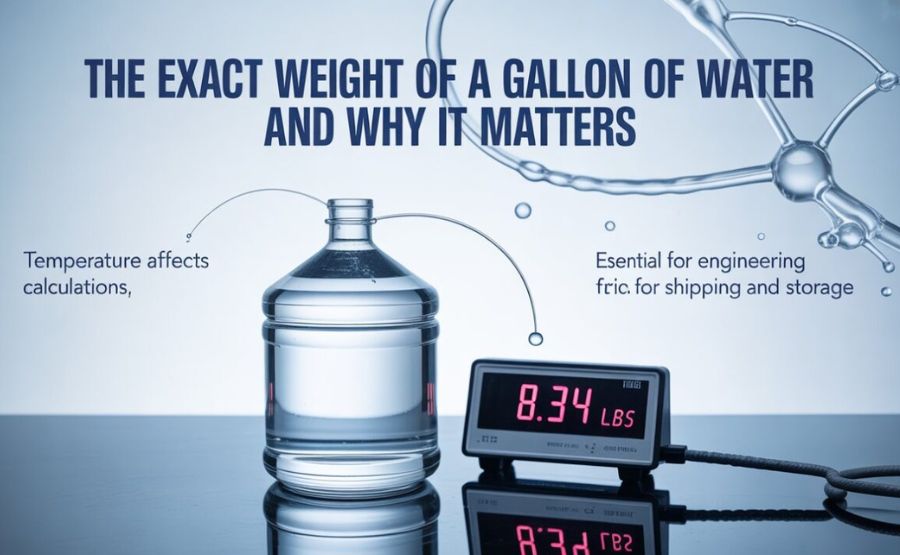
How much Weight of a Gallon of Water? The Full, Honest Answer
Here is something that seems like it should be a simple question. You ask it, you expect a number, you move on.
Except the answer depends on where you are, what temperature your water is, whether you mean a US gallon or a British one, and whether the water is fresh or salty or full of minerals. The “simple” question turns out to have layers to it — and each layer is genuinely interesting if you give it a moment.
So let’s give it a moment.
Key Facts
| Detail | The Numbers You Need |
| US gallon of water at room temperature (70°F / 21°C) | Approximately 8.33 pounds / 3.78 kg |
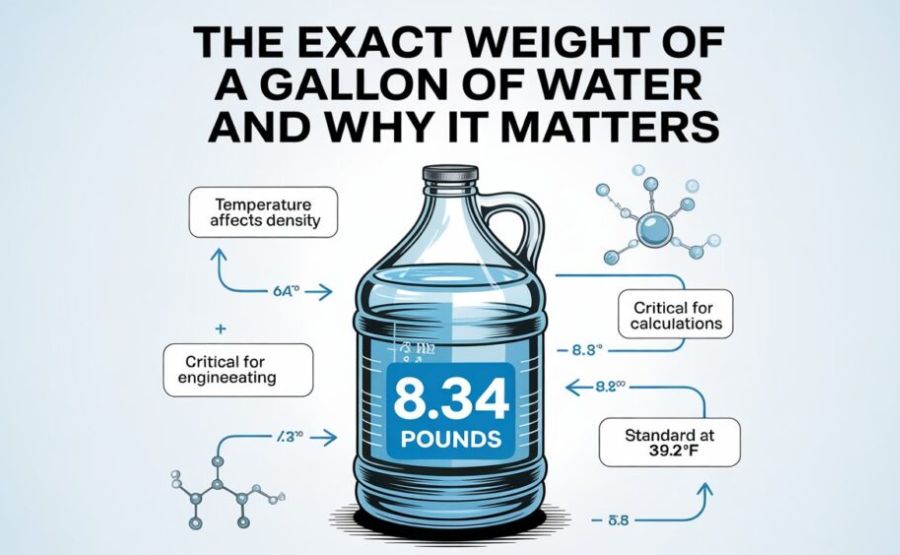
| US gallon at maximum density (39.2°F / 4°C) | Approximately 8.345 pounds / 3.785 kg |
| US gallon volume | 3.785 liters / 128 fluid ounces |
| UK Imperial gallon of water at 39.2°F / 4°C | Approximately 10.02 pounds / 4.546 kg |
| UK Imperial gallon volume | 4.546 liters / 160 fluid ounces |
| Size difference between the two gallons | UK gallon is about 20% larger |
| Water’s maximum density | 1 g/ml, occurring at exactly 39.2°F (4°C) |
| Density at room temperature (70°F) | 0.99802 g/ml — very slightly less than 1 |
| Seawater (approximate) | About 8.55 pounds per US gallon (3–4% denser than fresh water) |
| 5 US gallons at room temperature | About 41.6 pounds / 18.9 kg |
| 10 US gallons at room temperature | About 83.3 pounds / 37.8 kg |
| Weight change from cold to boiling | Roughly 0.06 lbs lighter per gallon at boiling vs near-freezing |
The Number Most People Are Actually Looking For
If you need one answer you can use right now, here it is.
A US gallon of ordinary water at room temperature weighs about 8.33 pounds, which is roughly 3.78 kilograms.
That is the number that works for everyday cooking, plumbing estimates, home aquarium calculations, and most practical purposes. You can hold onto that and stop there if you like.
But if you want to understand why that number shifts a little with temperature, why a British gallon weighs noticeably more, and why none of this is as fixed as you might expect — read on, because that is where things get genuinely interesting.
The Surprising Role Temperature Plays
Water is an unusual substance in many respects. Most liquids just get steadily denser as they cool down. Water does something different.
As water cools, it does get denser — but only to a point. At around 39.2 degrees Fahrenheit, which is 4 degrees Celsius, water reaches its maximum density. That is where it weighs the most for a given volume. Below that temperature, something unexpected happens: the water molecules start forming the hexagonal crystal structure that becomes ice, which actually pushes them farther apart. So water between 32°F and 39.2°F is less dense than water at exactly 39.2°F.
This is why ice floats. If ice were denser than liquid water, it would sink to the bottom of every lake and river in winter, and fish would have nowhere to survive. The fact that it floats is not a coincidence — it is one of the reasons life on Earth is possible in the cold seasons.
For everyday purposes, the weight difference between cold tap water and boiling water is small — about 0.06 pounds per gallon. That is not going to wreck your recipe or your plumbing estimate. But for engineering, industrial processes, pharmaceutical labs, and precision science, even a tiny shift in density changes the calculation.
A simple way to remember it: hotter water weighs less, colder water weighs more — right up until it starts to freeze.
Why There Are Two Different Gallons (And Why That Matters More Than You’d Think)
This is where a great deal of confusion arises.People in the US and people in the UK both use the word “gallon,” but they are not talking about the same amount of liquid.
The story behind this gap goes back to medieval England, when different industries used different volume measurements for different goods. Wine was measured using what was called the Queen Anne gallon — 231 cubic inches. Beer used a different, larger measure. Grain used yet another. It was chaotic.
When American colonists left England and built their new country, they took the wine gallon with them. That 231 cubic inch wine gallon became the US gallon — and that is still what the US uses today.
Back in Britain, parliament got tired of the mess in 1824 and passed the Weights and Measures Act. They created one unified imperial gallon, defined as the volume of exactly 10 pounds of distilled water at 62°F. That worked out to about 277.42 cubic inches — roughly 4.546 liters. Bigger than the old wine gallon. Bigger than the US gallon by about 20 percent.
So one “gallon” got frozen in 1707 in the United States, and a different “gallon” was created in 1824 in Britain. The word stayed the same. The volume did not.
The practical result is this:
- A US gallon of water at maximum density weighs about 8.345 pounds
- A UK Imperial gallon of water at maximum density weighs about 10.02 pounds
That nearly 2-pound gap has caused real problems. Fuel economy comparisons between American and British cars mislead people because the gallon used in each country is different. Bakers using old British recipes in American kitchens have made dry, failed cakes without understanding why. Industrial shipping contracts have created expensive misunderstandings when “gallon” was not specified clearly.
The word sounds simple. The history is anything but.
Seawater, Minerals, and Why Purity Changes the Weight
Most individuals deal with more than just fresh water. And what is dissolved in water changes how much it weighs.
Seawater is denser than fresh water because of the salts dissolved in it — mainly sodium chloride, but also magnesium, sulfur, calcium, and potassium. On average, seawater is about 3.5% more saline than fresh water, which pushes its density up to approximately 1.025 g/ml. A US gallon of seawater weighs around 8.55 pounds instead of 8.33 pounds.
That 0.22 pound difference per gallon adds up fast. An Olympic swimming pool holds roughly 660,000 US gallons of water. If you fill it with seawater instead of fresh water, the total weight difference is over 145,000 pounds. The engineers who design pool structures, ship hulls, and desalination plants think about this constantly.
Even municipal tap water is not perfectly pure fresh water. The minerals naturally dissolved in tap water — calcium, magnesium, fluoride, chlorine — technically change its density very slightly compared to distilled water. For almost all everyday uses, the difference is negligible. It isn’t in a precision lab.
Water drawn from wells in high-mineral areas, water in aquariums dosed with salt supplements, water collected near coastlines — all of these technically have a slightly different weight per gallon than the textbook number. The standard 8.33 pounds is an excellent working figure, but it is always an approximation of something that shifts depending on what is in the water and how warm it is.
Real-World Places Where This Actually Matters
Let me take you through some situations where getting the weight of water right is genuinely important.
Aquariums. A standard 55-gallon fish tank full of fresh water weighs roughly 458 pounds — and that is before you add the glass, the gravel, the decorations, and the stand. Many floors in older homes are not built to hold that. Aquarium owners who have never thought about the weight of water have put tanks through floors. If you add salt for a marine tank, that same 55 gallons comes in even heavier.
Emergency water storage. One common recommendation for emergency preparedness is to keep at least three days of water per person stored at home. At roughly a gallon per person per day, a family of four needs 12 gallons minimum. That equates to almost 100 pounds of water.. Knowing this helps people choose containers with handles, store water low to the ground rather than on high shelves, and plan for how they would move it if needed.
Hiking and backpacking. Every hiker knows that water is heavy. One liter weighs about 2.2 pounds. Carrying two liters — less than a US gallon — adds nearly 4.5 pounds to your pack. Many experienced hikers plan their routes specifically around water sources so they carry less. The weight of water is one of the most fundamental calculations in any backcountry trip.
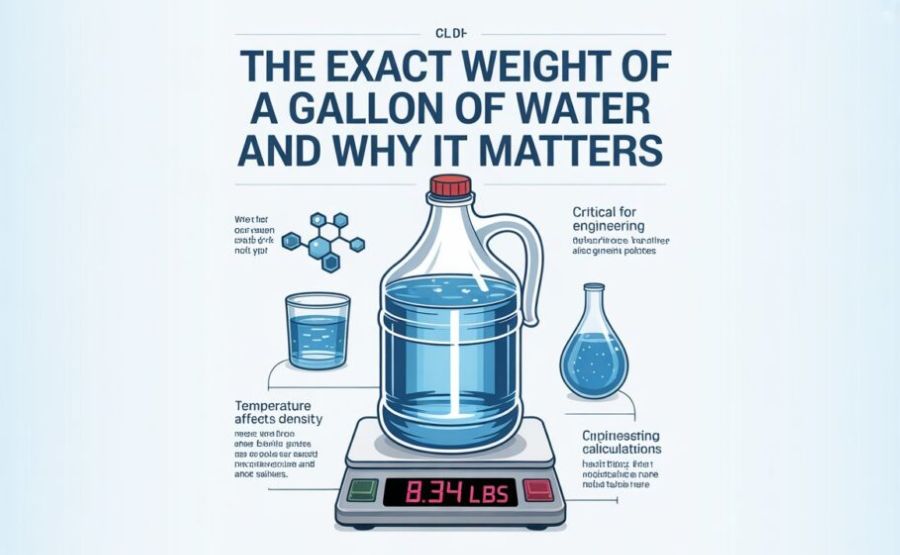
Engineering and construction. A water tank holding 10,000 US gallons exerts about 83,300 pounds of force on whatever is supporting it — and that is before the weight of the tank itself. Civil engineers calculate these loads to make sure pipes, foundations, and support structures do not fail. The standard 8.34 pounds per gallon is built into engineering tables that have been in use for generations.
Home plumbing and heating. Hot water weighs slightly less than cold water, which affects how water circulates in radiators and underfloor heating systems. Engineers who design radiant heating systems account for the density difference between hot and cool water moving through the pipes.
None of these situations require extreme precision for casual use. But each one shows how a number that seems trivial — the weight of a gallon of water — quietly underpins a surprising range of practical decisions.
The History of Measuring Water: Older Than You’d Expect
People have been thinking about the relationship between water’s volume and weight for a very long time.
The ancient Romans had standard measures for liquids. Medieval brewers and winemakers used volume measurements calibrated specifically to their trade. But the precise, scientific understanding of density — of exactly how much a given volume of water weighs under specific conditions — really began to sharpen in the 17th and 18th centuries, as European scientists developed better instruments and better experimental methods.
The hydrometer, a simple device for measuring liquid density, was refined by Robert Boyle and others in the late 1600s. It works by floating in a liquid and sitting higher or lower depending on how dense that liquid is. The hydrometer floats higher in denser liquids. Water at around 4°C — its densest point — is the standard against which other liquids are measured. A hydrometer floating in water at that temperature reads 1.000. Everything else is measured relative to that.
The British decision in 1824 to define the imperial gallon as the volume of exactly 10 pounds of water was a direct acknowledgment of this relationship. Water’s density was stable enough and well-understood enough that it could anchor an entire measurement system. That is a meaningful piece of history — the weight of water was literally used to define what a gallon was.
The metric system made the same move, more elegantly. One liter of water at maximum density weighs almost exactly one kilogram. One milliliter weighs almost exactly one gram. The metric system was designed so that volume and mass of water align cleanly at 4°C. This is one of the reasons scientists worldwide prefer metric — the coherence between volume and weight of water is built into the foundation of the system.
The Common Misunderstanding Worth Clearing Up
One question that confuses people often is: “Does water weigh the same in space?”
The honest answer is that weight and mass are different things.The amount of matter in an object is its mass.. Weight is how much gravitational force is pulling on that mass.
A gallon of water always has the same mass — about 3.785 kilograms for a US gallon at maximum density. But on the Moon, where gravity is about one-sixth as strong as Earth’s, that same gallon of water would weigh only about 1.39 pounds instead of 8.345 pounds. In orbit, where everything is in free fall, it feels weightless entirely.
When people ask “how much does a gallon of water weigh?”, they are almost always asking about weight on Earth at sea level — and that is exactly where the 8.33 pound answer applies. But the distinction between mass and weight is one of the most important ideas in physics, and water is one of the best ways to feel how they differ.
Another common point of confusion: some people say water weighs exactly 8 pounds per gallon as a rule of thumb. That is close, but about 4 percent off from the accurate figure of 8.33 to 8.345. For rough mental math, 8 pounds is fine. For any actual calculation involving load, storage, or volume, use 8.33.
The Human Side of Water Weight
There is something almost personal about water weight. Your own body is roughly 60 percent water. The average adult carries somewhere between 10 and 12 gallons of water inside them at any given moment. That is roughly 83 to 100 pounds of water, just living inside you — keeping your cells functioning, your blood flowing, your brain thinking.
When you feel suddenly lighter in the morning and heavier by evening, a good portion of that daily fluctuation is water weight. When athletes lose several pounds during a long race, most of it is water lost through sweat. A pound of sweat is roughly two cups of fluid. Losing four or five pounds in a long run means losing nearly half a gallon of water from your body.
This is why hydration matters so much more than people usually give it credit for. The weight of water in your body is not excess weight to be lost — it is active, working weight that keeps everything running. Chasing a lower number on the scale by restricting fluids is one of the less healthy things a person can do.
Understanding that a gallon of water is 8.33 pounds — substantial, tangible, real — helps explain why staying properly hydrated through the day actually takes effort. You need to drink roughly 2 liters of water daily just for basic maintenance. That is about half a US gallon, or a bit over 4 pounds of fluid entering your body every day.
A Thought Worth Carrying With You
Water is ordinary in the way that the best things often are. Most of the time you barely notice it. You flip on the faucet, fill a glass, and proceed.
But the weight of a gallon of water connects you to the whole history of measurement. It links the ancient Romans measuring wine, the British parliament reforming its chaotic gallon system in 1824, the metric system designers who built their entire framework around water’s density, the engineers keeping aquifer systems from collapsing, and the hiker calculating what their back can carry up a mountain.
The answer to “how much does a gallon of water weigh?” is technically about 8.33 pounds in the US, or about 10.02 pounds if you are working with British imperial gallons. But that number is carrying a lot of history on its back.
FAQs
1. How much does a gallon of water weigh in pounds?
A US gallon of fresh water at room temperature (around 70°F or 21°C) weighs approximately 8.33 pounds. At its maximum density of 39.2°F (4°C), it weighs very slightly more — about 8.345 pounds. For most practical purposes, 8.33 pounds is the number to use.
2. Does hot water weigh less than cold water?
Yes. Warmer water is slightly less dense, meaning fewer water molecules fit into the same volume. A gallon of boiling water weighs roughly 0.06 pounds less than a gallon of near-freezing water. The difference is small for everyday use but matters in precise scientific or industrial contexts.
3. Is a UK gallon the same as a US gallon?
No. A UK Imperial gallon is about 4.546 liters, and a US gallon is about 3.785 liters. The UK gallon is around 20 percent larger. This split happened because the US preserved the old British wine gallon from 1707, while Britain reformed its measurements in 1824 with the Weights and Measures Act, creating a larger imperial gallon.
4. How much does a UK gallon of water weigh?
A UK Imperial gallon of fresh water at maximum density weighs approximately 10.02 pounds or 4.546 kilograms. This is why the imperial gallon was originally defined the way it was — as the volume of exactly 10 pounds of water.
5. Does salt water weigh more than fresh water?
Yes. Seawater contains dissolved salts that increase its density to about 1.025 g/ml, compared to fresh water’s maximum of 1.000 g/ml. This makes a US gallon of seawater weigh approximately 8.55 pounds instead of 8.33 — about a quarter pound more per gallon.
6. How much does a 5-gallon bucket of water weigh?
At room temperature, five US gallons of water weighs about 41.6 pounds. Add the weight of the bucket itself — usually 1 to 2 pounds for a standard plastic bucket — and you are carrying roughly 43 to 44 pounds total.
7. What is the maximum density of water and when does it occur?
Water reaches its maximum density at approximately 39.2°F (4°C). At that temperature, its density is almost exactly 1 gram per milliliter. Below that temperature, water actually becomes slightly less dense as molecules begin forming the crystal structure of ice. Above it, the density decreases as molecules move farther apart with increasing heat.
8. How much does water weigh per liter?
One liter of fresh water at 39.2°F (4°C) weighs almost exactly 1 kilogram — that is 2.205 pounds. This near-perfect relationship between volume and weight in the metric system was intentional; the metric system was designed around water’s density.
9. Why does ice float on water?
Because ice is less dense than liquid water. When water freezes, the molecules arrange into a hexagonal crystal structure that spaces them slightly further apart than they are in liquid form. Less dense material floats on top of denser material — so ice stays on the surface rather than sinking.
10. How do I calculate the weight of water in my aquarium?
Multiply the tank volume in US gallons by 8.33 for fresh water. A 55-gallon freshwater aquarium holds about 458 pounds of water. For a saltwater aquarium, multiply by roughly 8.55 instead to account for added salt density. Then add the weight of the glass tank, substrate, and equipment to get the total load on your floor or stand.
11. Does dissolved minerals in tap water change its weight?
Technically yes, but by an extremely small amount. Tap water contains trace amounts of calcium, magnesium, chlorine, and fluoride that increase its density slightly above perfectly pure distilled water. In practice, the difference is too small to matter for any everyday purpose, though it is measurable in a laboratory.
12. How much does the human body’s water weigh?
The average adult body is about 60 percent water by mass. For a 150-pound adult, that is approximately 90 pounds of water — close to 11 US gallons worth. This water is not “extra” weight; it is active, essential water keeping every biological system running.
13. Is there a simple rule of thumb for estimating water weight?
The easiest one to remember is: a liter weighs a kilogram, and a US gallon weighs about 8 and a third pounds. Some people round to 8 pounds per gallon for quick mental math. That is a bit low but good enough for rough estimates. For anything requiring accuracy, use 8.33 pounds.
14. How does water weight matter in emergency preparedness?
Preparedness guidelines recommend about 1 gallon of water per person per day for drinking and sanitation during an emergency. For a family of four over three days, that is 12 gallons — about 100 pounds of water. Knowing this helps people plan where to store it (low shelves, not high ones), what containers to use (handled ones), and whether they need help moving it.
15. Does altitude affect how much a gallon of water weighs?
Technically yes, because weight is a measure of gravitational force, and gravity weakens slightly at higher altitudes. The effect is tiny — at the top of Everest, water would weigh about 0.3 percent less than at sea level. For any realistic use, altitude does not change the practical weight of water in a meaningful way.
Empowering curious minds to explore, learn, and think deeper with Fact Aura.