What Does ASL Mean in Text? A Complete, Honest Explainer
Here’s something that happens more often than people admit. You’re in a conversation online, someone sends you “asl,” and for a split second you’re not entirely sure which version they mean. The internet has given one tiny three-letter combination at least three genuinely different lives, and depending on your age, what platform you’re on, and who you’re talking to, the meaning can shift completely.
Let’s walk through all of it together, clearly and honestly.
Key Facts
| Detail | Info |
| Original Internet Meaning | Age / Sex / Location |
| Modern Slang Meaning | “As hell” (used for emphasis) |
| Formal Abbreviation | American Sign Language |
| Era of Original Usage | Peaked in AOL Instant Messenger era, 1990s–early 2000s |
| Modern Slang Platforms | TikTok, Instagram, Snapchat, casual texting |
| Still in Use Today? | Yes — all three meanings remain active in different contexts |
| Tone of Modern Usage | Casual, often humorous or emphatic |
The Original Meaning: Age, Sex, Location
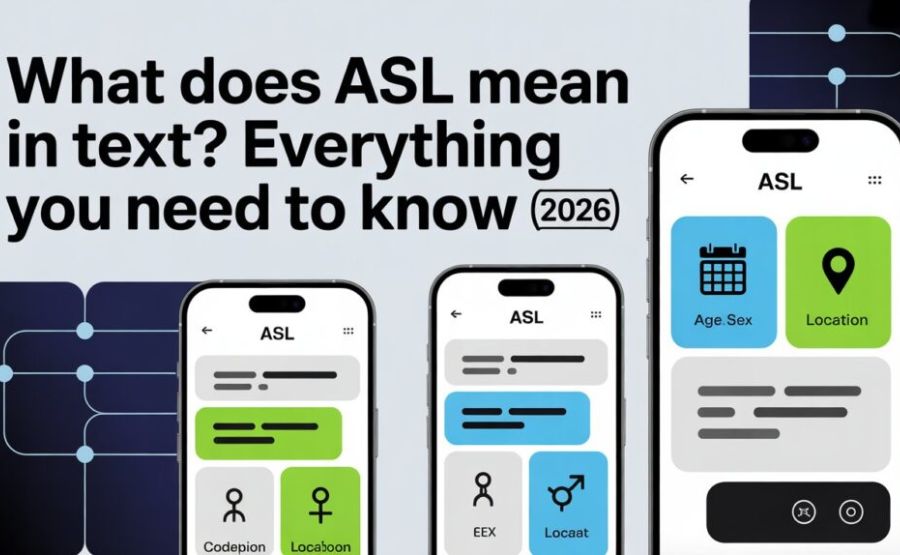
If you were online in the 1990s or early 2000s, you know this one in your bones. “ASL?” was the standard opening move in a chat room. It was essentially a fast technique to determine who you were actually speaking to on the other side of the screen and stood for Age, Sex, Location.
The logic made perfect sense for the time. Chat rooms were anonymous by default. You logged in with a username, joined a room called something like “Teens: USA,” and had absolutely no idea whether the person typing back to you was a 14-year-old from Ohio or a 45-year-old from somewhere else entirely. Asking “ASL?” was genuinely functional. It was the internet’s version of the first thirty seconds of a phone call, the moment you established who you were dealing with.
The entire “ASL?” culture was created by AOL’s Instant Messenger, IRC, and early Yahoo chat groups. into mainstream online interaction. Millions of people learned it as their very first piece of internet shorthand. For a generation of early internet users, it was as natural a conversation opener as saying “hey” in person.
See also “Cubic Yards: Everything You Actually Need to Know“
Where It Came From and Why It Spread
The speed of early internet conversations pushed people toward abbreviations constantly. Typing was slower then, connections were slower, and long blocks of text felt clunky and slow. Shorthand made sense as a practical solution, and “ASL” was a perfect three-letter package that replaced a sentence’s worth of questions in a single word.
It also spread because everyone was asking the same questions. In an anonymous space full of strangers, the most immediately useful information about another person was their age, whether they were male or female, and where in the world they were. That combination answered the three things that helped you decide whether to keep the conversation going.
AOL in particular was huge. At its peak in the late 1990s and early 2000s, it had tens of millions of subscribers in the United States alone, and a huge portion of early mainstream internet culture grew directly out of its chat rooms and messenger service. Whatever conventions AIM users developed tended to stick, and “ASL?” was one of the stickiest.
The Modern Meaning: “As Hell”
Fast forward to somewhere around the late 2010s and into the 2020s, and “asl” started picking up a completely different meaning in text conversations, particularly among younger users on TikTok, Instagram, and Snapchat.
In this newer usage, “asl” functions as a shorthand for “as hell,” used to punch up an adjective or phrase for emphasis. Someone might say “I’m tired asl” to mean “I’m tired as hell.” Or “that movie was funny asl” to mean it was genuinely hilarious. The word sits at the end of a sentence or phrase, working exactly the way “as hell” would in spoken conversation, adding intensity and a slightly casual, unfiltered tone.
This meaning became genuinely widespread on short-form video platforms, where text in comments and captions tends to be compressed and speed-typed. Saying something is “good asl” takes exactly half as long to write as “good as hell,” and it carries the same tone. That efficiency is a big part of why it caught on so quickly.
How Context Tells You Which One Someone Means
Here’s the honest, practical truth about this. You almost never need to guess which meaning someone intends, because context does the heavy lifting almost every time.
If someone sends you “asl?” as a standalone message, or opens a conversation with it, they’re almost certainly using the original meaning and asking about your age, sex, and location. This usage tends to appear in dating apps, chat platforms, or any environment where two strangers are just starting to interact.
If someone uses “asl” tucked into the middle or end of a longer statement, “that’s wild asl” or “I’m hungry asl right now,” they’re using the modern slang version for emphasis. The sentence structure alone tells you which one applies.
Age and platform give you additional context. Younger users on newer platforms lean heavily toward the “as hell” usage. Older internet users or people on platforms oriented around connection and meeting new people are more likely still using the original.
And then there’s the third meaning entirely, the formal one.
The Formal Meaning: American Sign Language
Outside of casual internet conversation, ASL is also the widely recognized abbreviation for American Sign Language, the complete, complex visual language used primarily by Deaf and hard-of-hearing communities in the United States and parts of Canada.
American Sign Language is more than just signed English. It has its own grammar, its own syntax, its own idioms and regional variations, and its own rich cultural history stretching back more than two centuries. It developed largely from a blend of Old French Sign Language and home sign systems that Deaf communities in New England were already using, brought together at the American School for the Deaf in Hartford, Connecticut, founded in 1817.
If someone online mentions they’re learning “ASL,” or asks whether you know “ASL,” or mentions studying it for a class, this is the meaning they almost certainly intend. Disability communities, education forums, and health-related conversations are where this usage shows up most frequently in written text.
Why All Three Coexist Without Too Much Confusion
It might seem like having three totally different meanings for the same three letters would be a constant source of confusion. In practice, it rarely is, because each version lives in its own context ecosystem.
You don’t often encounter the classic “ASL?” chat room question on TikTok. The phrase “as hell” is rarely used in medical or educational language conversations. And American Sign Language discussions almost never happen in the same sentence structures as either internet slang usage. The communities and contexts are sufficiently different that the three meanings mostly stay in their own lanes.
A Personal Reflection on What These Different Meanings Tell Us
There’s something quietly interesting about watching a three-letter string carry such different weight across different decades and communities. “ASL?” was one of the first real pieces of social protocol the early internet developed. It was a genuine, functional shorthand for a very human need: figuring out who’s on the other side of the screen before you invest in a longer conversation.
The modern “asl” slang is something different in character. It’s not seeking information. It’s adding color. It’s a linguistic intensifier, a way of turning “tired” into something closer to exhausted without the extra syllables. That kind of efficiency-driven language evolution is genuinely old in human communication. People have always shortened things that get said frequently enough.
And American Sign Language sits in a category of its own entirely, a rich and complete human language that happens to share its initials with internet shorthand. The abbreviation ASL for American Sign Language predates internet chat room usage by decades, since the formal abbreviation was in use among linguists and educators well before AOL made chat rooms mainstream.
The Challenges With Slang That Means Multiple Things
There are real moments where these meanings could cause genuine misreading. Imagine someone who grew up in the early internet era receiving a text from a younger person that says “I’m bored asl.” If they don’t know the newer usage, they might spend a confused second wondering whether “asl” was a typo or part of a phrase they don’t recognize.
These small misreadings are pretty low stakes in casual conversation, since context usually rescues the meaning quickly. But in situations where tone matters more, like professional messaging or conversations across generational lines, acronyms that carry multiple meanings are worth being thoughtful about.
Common Misconceptions Worth Naming
Some people assume “asl” in its modern usage is only used by a very specific age group or demographic. That’s less true than it used to be. Language patterns from younger internet communities have a documented history of spreading upward in age as those users get older and as the phrases enter broader popular culture through memes, videos, and repeated exposure.
Others assume that because the original “ASL?” usage feels dated, nobody uses it anymore. That’s also not quite right. Dating apps and chat-style platforms still see this question fairly regularly, especially in contexts where two people are just meeting for the first time and genuinely want to establish basic facts about each other.
And a surprising number of people don’t realize that ASL as an abbreviation for American Sign Language predates both internet usages and carries significant cultural weight for communities that rely on it as their primary language.
The Broader Impact of Internet Shorthand on Language
ASL is one small example of something much larger that has happened to written language since the internet became mainstream. We developed an entirely new vocabulary of abbreviations, emoticons, and compressed phrases, all driven by the practical need to communicate quickly in text-based environments where typing had real friction.
LOL, BRB, TTYL, OMG: these all started as functional chat room shorthand and eventually crossed over into spoken language, ironic usage, and even formal linguistic study. Researchers at universities in the United States and United Kingdom have published real academic work on internet language evolution, tracking how these abbreviations spread, change meaning, and sometimes die out entirely.
ASL has followed a somewhat unusual path by accumulating new meanings rather than dying out. The original chat room usage faded in frequency as that era of online interaction ended, but the letters found new life in a completely different context rather than disappearing. That’s genuinely interesting from a language evolution standpoint, even if it creates the occasional moment of confusion.
The Ethical Side of Anonymous Online Conversation
The original “ASL?” The question grew out of a specific culture of online anonymity that had real strengths and real problems running alongside each other. Anonymity lets people explore identities, find communities, and speak freely in ways that feel genuinely liberating. It also created environments where deception was common, where people misrepresented their age, gender, location, and intentions in ways that sometimes caused real harm.
The “ASL?” convention was one small attempt to create a moment of self-identification in an otherwise anonymous space. It was imperfect because nobody was required to answer truthfully. But it at least created a social norm where identifying yourself to a new conversation partner was an expected step, which wasn’t nothing.
Those same tensions between anonymity, identity, and safety are still very much alive in online spaces today, just playing out on different platforms with different tools and different stakes.
What Comes Next for Slang Like This
Slang evolves constantly, and internet slang moves faster than almost any other form of language. The “as hell” usage of “asl” is clearly well-established right now in younger communities. Whether it will still be in regular use a decade from now, or whether it will have been replaced by something newer by the time today’s teenagers are in their late twenties, is genuinely hard to predict.
What history does suggest is that abbreviations and slang that fill a genuine communicative need, that say something more efficiently or more expressively than the full phrase, tend to stick around longer than people expect. “LOL” is a prime example of an online slang term that most people thought would become outdated very soon, but it’s still widely used by people of all ages. than thirty years after it first appeared in dial-up era chat rooms.
A Few Honest Thoughts to Close On
What I like most about “ASL” as a topic is how it accidentally became a small window into three very different moments in communication history: the early internet’s need for identity verification in anonymous spaces, the compressed expressive language of short-form video platforms, and the formal linguistic recognition of a complete visual language with its own deep history.
You don’t need to know all three meanings every time someone sends you a message. You just need the small habit of reading context first, and the rest usually takes care of itself.
FAQs
1. What does ASL mean in a text message or chat?
It depends on context. It most commonly means either “Age, Sex, Location” (the classic chat room question) or “as hell” (a modern slang intensifier). Less frequently, it refers to American Sign Language.
2. Is ASL still used to mean Age, Sex, Location?
Yes, though less commonly than during its AOL-era peak. It still appears on dating apps and chat platforms where two strangers are just meeting each other.
3. What does “tired asl” mean?
It means “tired as hell,” using “asl” as a compressed version of “as hell” for emphasis. This is the modern slang usage.
4. How do I know which meaning someone intends?
Sentence structure almost always makes it clear. If “asl” appears at the end of a phrase as an intensifier, it’s the modern slang usage. If it appears as a standalone question or opening message, it’s likely the original meaning.
5. Is the modern “as hell” usage considered informal?
Yes, it’s casual slang used in relaxed, conversational contexts. It would be out of place in professional or formal writing.
6. Does ASL mean American Sign Language in text?
Yes, especially in educational, disability-related, or health-care contexts. If someone mentions learning or studying “ASL,” this is almost certainly the meaning intended.
7. What age group uses “asl” to mean “as hell”?
It’s most common among younger users, particularly teenagers and young adults on platforms like TikTok, Snapchat, and Instagram, though the usage has spread more broadly as it’s become more visible.
8. When did the original ASL chat room question originate?
It became mainstream in the mid-to-late 1990s through AOL Instant Messenger and early internet chat rooms, peaking in usage around 1998 to 2005.
9. Can ASL cause confusion in conversation?
Occasionally, especially across generational lines, but context almost always resolves the ambiguity quickly since the three meanings appear in very different sentence structures and contexts.
10. Is the modern slang “asl” related to chat room usage?
They share the same letters but evolved completely independently. The modern usage comes from compressing “as hell,” not from any connection to the Age/Sex/Location meaning.
11. Does anyone use “asl” in writing to mean American Sign Language?
Yes, though typically in educational or professional contexts where the abbreviation is well understood, rather than in casual texting or social media captions.
12. Is “asl” written in lowercase or uppercase?
The slang usages, both “as hell” and the classic chat room question, are almost always written in lowercase in casual digital communication. The formal abbreviation for American Sign Language is typically written in uppercase (ASL).
13. Has “asl” appeared in formal dictionaries?
The “as hell” slang usage has appeared in online slang dictionaries like Urban Dictionary with many entries dating back several years, reflecting its widespread informal recognition.
14. Is it rude to ask someone “asl” today?
In many contexts, yes. The classic chat room question can feel intrusive or outdated in modern conversation. In specific contexts like certain dating apps or anonymous chat platforms, it remains socially normal.
15. What other abbreviations work similarly to the “as hell” asl?
It functions similarly to “af” (as f***), another common text intensifier, though “asl” tends to be used in slightly more casual and less emphatic contexts.
Empowering curious minds to explore, learn, and think deeper with Fact Aura.