Ahref Traffic Checker: The Complete, Honest Guide to One of SEO’s Most Effective Tools
Key Facts
| Topic | Details |
| Company name | Ahrefs |
| Founded | 2010 (paid product launched 2011) |
| Founder | Dmitry Gerasimenko (Ukrainian, based in Singapore) |
| Headquarters | Singapore |
| Funding | Bootstrapped — zero outside investment ever taken |
| Annual recurring revenue (2024) | ~$149 million |
| Employees (2025–2026) | ~171–200 people across 26+ countries |
| AhrefsBot daily page visits | About 8 billion pages—the second-most active crawler after Google |
| Backlink database | 43 trillion links |
| Countries tracked | 171 |
| Traffic Checker (free version) | Available at ahrefs.com/traffic-checker — no signup needed for basic check |
| Ahrefs Webmaster Tools | Free forever for verified site owners |
| Paid plans (2025–2026) | Standard $249/month; Advanced $449/month; Lite $129/month; Enterprise $1,499/month; Starter $29/month |
| Price increase event | April 2024 — significant price rise across all plans |
| Historical data depth | 1 month (Starter), 6 months (Lite), 2 years (Standard) |
| Key competitors | Semrush, Moz, Similarweb |
The Kind of Curiosity That Started All This
Imagine you run a small business. Let’s imagine you have an internet store selling handmade candles. There’s a bigger candle shop down the internet street from you — they always seem to show up first in Google searches. You want to know how much traffic they’re actually getting. Are they huge? Are they just slightly ahead of you? Is there something they’re doing that you could learn from?
That exact feeling — that mix of competitive curiosity and genuine desire to learn — is what makes the Ahrefs Traffic Checker one of the most-used tools in all of digital marketing.
Before Ahrefs came along, understanding a competitor’s traffic meant guessing. Now it takes about 10 seconds.
See also “How to Add Someone to GitHub Repository: A Friendly, Complete Guide“
Where Ahrefs Came From — A Story Worth Knowing
Most people use Ahrefs as a tool without ever knowing the human story behind it. And honestly, it’s one of the better ones in the tech world.
Dmitry Gerasimenko grew up in the city of Nizhyn, Ukraine. His father built him his first computer when he was six years old. That first interest developed into a sincere fascination with search engine technology. By the time he was a teenager, he’d already built a small search engine for documents. Later he studied applied mathematics at Kyiv Polytechnic University and ran various tech side projects while a student — including selling e-books through a simple file search engine he built himself.
Eventually that search engine crashed. Server failure. No backups. Everything is gone.
Most people would have walked away. Dmitry used it as motivation.
By 2010, after years of freelance work and building smaller projects, he turned his attention to a proper web crawler and SEO toolkit. His co-founder and former university classmate, Igor Pikovets, joined him. Dmitry didn’t pitch investors or raise a seed round. He used his own money — around $300,000 to $400,000 saved from years of freelance work — poured it into servers and code, and hoped the product would speak for itself.
The company moved from Kyiv to Singapore in 2012, with just seven employees and revenue approaching a million dollars. Dmitry chose Singapore partly because he happened to be travelling through Asia and liked what he saw — clean, orderly, with a strong environment for technology businesses. He later tried a San Francisco office to attract talent. He didn’t like it there. He shut it down.
By 2018, Ahrefs had grown to 45 employees and was generating $40 million a year in recurring revenue — with no marketing team and no sales team.
By 2021, it had crossed $100 million a year in recurring revenue. No investors. No sales team. No advertising budget to speak of. Just a product so genuinely useful that people told other people about it, and the cycle kept going.
By 2024, that number was approximately $149 million annually. There are currently about 200 employees working there in 26 different countries.
That’s the company behind the traffic checker you’re reading about.
What the Ahrefs Traffic Checker Actually Does
Let’s be clear about what this tool is — and what it isn’t.
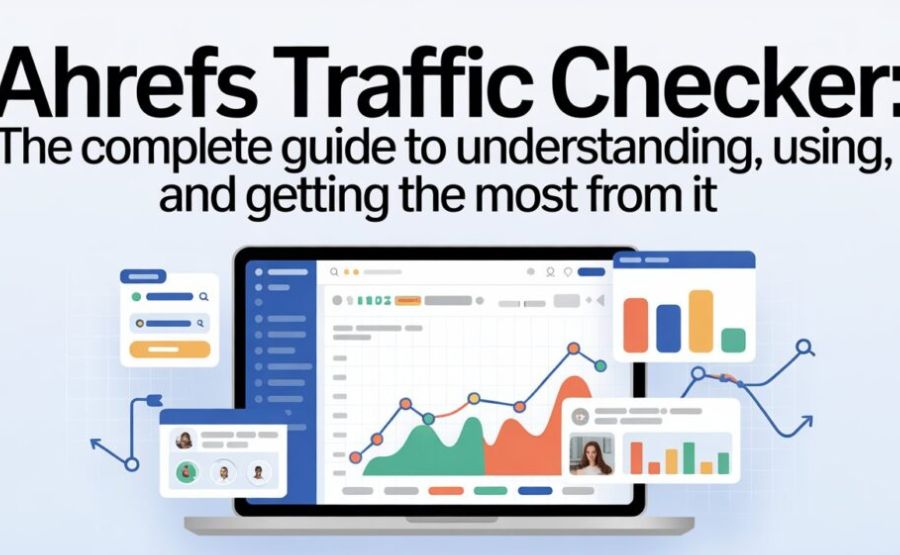
The Ahrefs Traffic Checker estimates how much organic search traffic any website is receiving. Organic traffic means visitors who found the site through a search engine like Google — not through ads, not through social media, not from someone emailing a link. Just people who searched for something and clicked a result.
You type any website address into the tool. Within a few seconds, you’re looking at an estimated monthly traffic number, the main keywords driving that traffic, the pages on the site that attract the most visitors, and a breakdown of which countries those visitors are coming from.
For your own site, that’s interesting. For your competitors’ sites, it’s genuinely powerful.
The free version at ahrefs.com/traffic-checker requires no account and no login. You enter a URL, you see a limited set of results — the top 5 keywords, approximate traffic, traffic value, and top pages. That’s enough to get a meaningful sense of any site in about 30 seconds.
The paid plans inside the full Ahrefs platform unlock the complete picture — full keyword lists, historical trends going back months or years, country-by-country breakdowns, competitor comparisons, and much more.
How the Numbers Are Actually Generated
This is the part most guides skip. And it’s worth understanding because it explains why the traffic checker is useful — and also why it isn’t always exact.
Ahrefs operates its own web crawler called AhrefsBot. Every single day, it visits around 8 billion pages across the internet. Only Google’s bot does more. That’s the engine under the hood that makes the traffic estimates possible.
The crawler is constantly checking which websites rank for which keywords in Google search results. It knows which position a page sits at — first result, fifth result, tenth — and it knows the search volume for each keyword (how many people search that phrase per month). Using those two pieces of information, it calculates an estimated number of clicks that page is probably receiving.
But Ahrefs adds a second layer on top of that. They use something called clickstream data — information about how real people actually move around the internet. By studying the browsing behaviour of millions of users, they can see patterns in how people actually click through search results. That helps calibrate the estimates and make them more realistic than pure ranking data alone would give you.
Combine those two sources — crawler rankings plus real browsing patterns — and you get a traffic estimate that’s far better than a guess. But it’s still an estimate.
Here’s where honesty matters. For large, popular websites getting hundreds of thousands of monthly visitors, Ahrefs’ estimates tend to be reasonably close to reality. Companies that have shared their actual Google Analytics data alongside Ahrefs estimates often find the tool captures the general shape and scale of their traffic well.
The smaller and more specialised a website is, the less reliable the estimate becomes. A niche blog getting a few thousand visits a month? The number you see in Ahrefs might be quite a bit off in either direction. The methodology works best when there’s enough data to work with, and small sites don’t always provide that.
No third-party traffic tool is exact. Ahrefs doesn’t claim to be. But it’s one of the more accurate ones available.
What You Can Do With It — Real Use Cases
Understanding the theory is one thing. Here’s what people actually use the Ahrefs Traffic Checker to accomplish in the real world.
Competitor research is the most common use. You type in a rival website and see exactly which pages draw their traffic, which keywords they rank for, and how their traffic has grown or shrunk over time. This is a more intelligent reading of publicly available search data, not espionage in any negative sense.
Finding content gaps is where the tool gets genuinely strategic. You can enter your own site plus several competitor sites, and Ahrefs will show you every keyword your competitors rank for that you don’t. Those gaps are opportunities. They represent topics your audience is searching for that you haven’t written about yet.
Tracking your own progress over time is another solid use. If you’ve been working on SEO for several months, the traffic trend data in Ahrefs tells you whether your efforts are moving the needle. It’s not a replacement for Google Analytics — which is far more accurate for your own site since it uses real data rather than estimates — but it gives you a useful external perspective.
Client pitches are a practical use that SEO professionals and marketing agencies use constantly. Before taking on a client, checking their site’s traffic history in Ahrefs gives you an honest baseline. And pulling a quick traffic overview for a prospect during a presentation is a simple way to show you understand their current position.
Checking traffic value is a feature many people overlook. Ahrefs doesn’t just estimate monthly visitors — it calculates what that traffic would cost if the site had to buy all those clicks through Google Ads. A site attracting 50,000 visitors per month in a competitive financial niche might have a traffic value of $200,000 per month. That figure helps you understand the real commercial weight of a site’s organic rankings.
The Free Version vs. the Paid Plans — What You Actually Get
This is where people sometimes get confused, so let’s sort it out clearly.
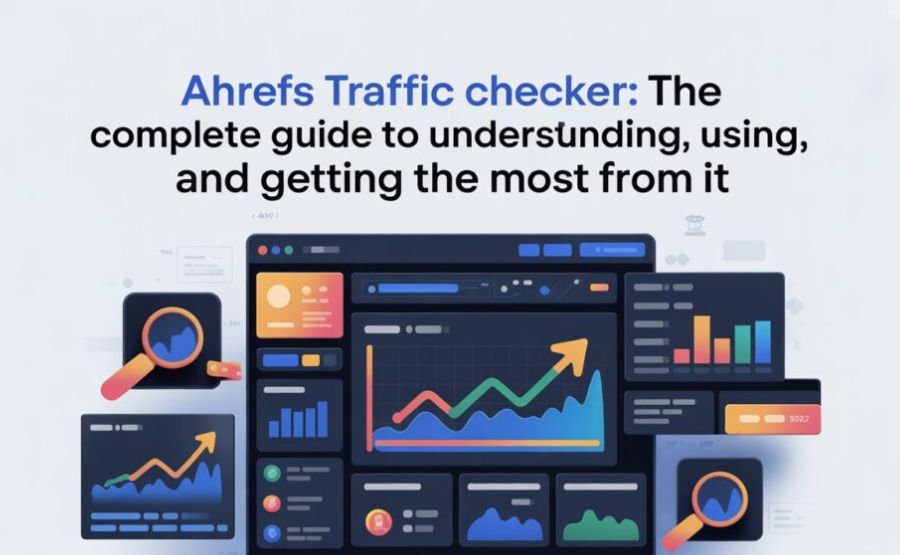
The free traffic checker at ahrefs.com/traffic-checker shows you a snapshot for any URL — top 5 keywords, estimated traffic, traffic value, and top pages. No account needed. You can check as many sites as you like, though you only see the highlights.
Ahrefs Webmaster Tools is a genuinely useful free tier for people who own a website. You verify that the site is yours (similar to Google Search Console), and in return you get access to much more detailed data about your own site — full keyword rankings, backlink data, health score, and traffic trends. This doesn’t let you check competitor sites in depth, but for your own site it’s substantial and costs nothing.
The paid plans are where things get serious — and more expensive.
April 2024 brought a pricing shift that a lot of users noticed and felt. The entry Lite plan jumped from $99 to $129 per month. Standard went from $179 to $249. Advanced went to $449. Enterprise climbed to $1,499 per month. Ahrefs also introduced a credit system on lower-tier plans — essentially a limit on how many reports you can open in a month. On the Starter plan at $29 per month, you get 100 credits monthly. Heavy use burns through those quickly.
For solo bloggers or small business owners doing light, occasional research, the free tools plus the $29 Starter plan cover a lot of ground. For SEO professionals, marketers, and agencies doing regular work across multiple sites, Standard or above is where the tool genuinely justifies its cost.
Annual billing saves around 16–17% compared to monthly. If you’re committed to Ahrefs long-term, the annual plan is worth considering.
The Features That Set It Apart
Ahrefs isn’t just a traffic checker — the traffic checker is one piece of a larger toolkit. But several things about how it approaches traffic data stand out from competitors.
The Site Explorer is the main home for traffic analysis. You enter any domain or URL and land in a dashboard showing organic traffic estimates, keyword rankings, backlink count, and traffic value all in one view. From there you can drill down into individual pages, keyword lists, and historical graphs.
Top Pages is a feature inside Site Explorer that shows which specific pages on any site are responsible for the most traffic. If a competitor has one blog post driving 40% of their entire organic visitors, you can see that. Understanding which content actually works for others is one of the fastest ways to improve your own content strategy.
The Content Gap tool lets you find keywords your competitors rank for that you don’t. You enter your domain alongside several competitors, and the tool identifies the missing pieces in your content.
Country filtering lets you see where traffic is coming from geographically. This matters enormously for businesses targeting specific regions. A site might look like it gets strong traffic overall, but if 80% comes from a country that isn’t your market, that context changes everything.
Traffic history graphs show how a site’s estimated traffic has changed over time. Sudden drops often correspond to Google algorithm updates. Consistent growth patterns reveal what working SEO looks like in practice.
The Honest Limitations
Any honest review of this tool has to say clearly what it doesn’t do well.
Traffic estimates aren’t exact. We covered this already, but it’s worth repeating because it’s the most important thing to understand. Use the numbers as directional signals, not as verified facts. “This site appears to get roughly 50,000 monthly visitors” is more accurate framing than treating the number as precise.
The credit system on lower plans is frustrating. Heavy clicking through reports and filters burns credits faster than many new users expect. On the Starter plan, you can genuinely run out in a short session if you’re exploring deeply.
Pricing increased significantly in 2024. For smaller teams and individual creators on tight budgets, the current pricing is genuinely steep. This is a real concern, and it pushed some users toward cheaper alternatives.
Paid traffic data is weaker than Semrush. For understanding what a competitor spends on Google Ads and which paid keywords they’re targeting, Semrush generally provides stronger data. Ahrefs’ strength is organic traffic and backlinks — not paid search.
Historical data depth depends on your plan. The Starter plan only shows one month of history. Lite gives six months. Standard gives two years. If you need to understand a site’s longer-term trajectory, you need a higher tier.
Ahrefs vs. Competitors — The Honest Picture
There are a few tools in this space worth comparing.
Semrush is Ahrefs’ closest and most direct competitor. For paid advertising data, Semrush has generally been considered stronger. For backlink analysis and overall data freshness, many SEO professionals consider Ahrefs the better choice. Both tools have similar pricing structures, and both offer more than just traffic checking. In practice, many agencies use both and lean on each for different tasks.
Moz has a long history in the SEO world and a strong community, but its data coverage is generally considered less broad than Ahrefs or Semrush. The Domain Authority metric Moz created has become widely cited, even by people who don’t use Moz for anything else.
Similarweb approaches traffic estimation differently, focusing more on total website traffic (including direct, social, and referral traffic) rather than primarily organic search. Similarweb’s estimates for larger sites can be illuminating, but its methodology differs enough that the numbers aren’t directly comparable to Ahrefs.
Google Search Console is free and gives you perfectly accurate traffic data — but only for your own verified site. You cannot use it to research competitors. Ahrefs and Google Search Console serve different purposes and work best when used together.
The Broader Impact — What This Tool Changed
Before tools like Ahrefs, competitive research in the online world was largely guesswork. You could see what a competitor published. You couldn’t see how well it was working for them.
Ahrefs changed that. It made search traffic — something that was once private information visible only to the site owner through their own analytics — something that could be studied from the outside. Not precisely, but directionally. Usefully.
Digital marketing was genuinely democratized by this. Small businesses without big budgets for research firms could now understand their competitive landscape. A one-person blog could audit the strategies of much larger publications and find angles to compete on. An e-commerce startup could identify which content categories were driving traffic for established players and map out a content strategy before writing a single word.
It also raised the bar on what “good SEO” means. When anyone can see how your traffic is trending, there’s more pressure to actually do the work and build something meaningful — because the evidence of whether it’s working is visible to anyone curious enough to look.
Ethical Questions Worth Thinking About
It seems sensible to wonder if it’s acceptable to check someone else’s traffic without their knowledge.
The short answer most people arrive at is yes — because the data comes from publicly visible search rankings. Ahrefs isn’t hacking into anyone’s Google Analytics. It’s observing which keywords a site ranks for in public Google results and making estimates from that public information. Any user can look at Google search results themselves. Ahrefs just does it at scale and organises the information helpfully.
That said, the ethical conversation becomes more nuanced when traffic estimates are used to make significant business or financial decisions. If someone is considering acquiring a website and uses Ahrefs traffic data as a major factor in valuation, they need to remember those numbers are estimates. Using them as verified facts in high-stakes contexts without cross-referencing actual analytics (which requires seller disclosure) would be a mistake.
There’s also a question of what you do with competitive intelligence. Understanding what your competitors are doing well to improve your own work is legitimate and healthy. Using that data to plagiarise content or target someone else’s audience through deceptive means is a different matter. The tool doesn’t control how people use the information — that’s on the person using it.
Where This Is All Going
Ahrefs has continued to expand well beyond traffic checking. In 2025, the company acquired Detailed.com and its Chrome extension, folding a popular SEO analysis tool directly into its ecosystem.
They’ve also launched Ahrefs Web Analytics — a privacy-friendly, cookie-free alternative to Google Analytics designed to track your own site’s traffic without relying on third-party cookies or generating consent banners. It’s positioning itself in a market that’s becoming more important as privacy regulations tighten globally.
And Dmitry Gerasimenko has been publicly working on an entirely different ambition — a search engine called Yep that would share 90% of its advertising revenue with content creators. The idea is to build a financial model for online publishing that doesn’t depend on the current system where platforms capture most of the value and creators get little. Whether Yep succeeds as a meaningful Google alternative remains to be seen, but the ambition reflects something genuine about how the company thinks.
For a tool that started as a backlink analyser built by one person with his own savings in a Kyiv apartment, Ahrefs has travelled quite a long way.
A Personal Reflection
If you’re new to all of this, here’s what I’d tell you: don’t let the sophistication of the tool intimidate you. The free version is genuinely usable, genuinely revealing, and requires no expertise to get something out of.
Type in a competitor’s URL. See which pages get their traffic. Look at which keywords send people there. Ask yourself: could I write something better on that topic? Could I cover an angle they’re missing?
That process — curious, honest, and oriented toward improving your own work rather than copying someone else’s — is exactly what this tool does best when it’s used well.
Final Words
Ahrefs built something rare: a tool that became genuinely indispensable to a whole profession, without ever taking outside money or running a single sales call. The traffic checker inside it is one window into what the company understands deeply — that data, when organised clearly and honestly, helps people make better decisions.
It’s not perfect. The estimates wobble for smaller sites. The pricing stings. The credit system on cheaper plans can feel restrictive.
But as a way to understand the web — to see what’s working for others, to find gaps in your own strategy, to watch trends over time — the Ahrefs Traffic Checker is one of the most practically useful things available to anyone trying to grow an online presence.
Use the free version first. Get a feel for what the data tells you. Then decide whether the paid tiers make sense for where you are and where you’re trying to go.
FAQs
1. What is the Ahrefs Traffic Checker?
It’s a tool that estimates how much organic search traffic any website receives from Google and other search engines. You enter any URL, and within seconds you see estimated monthly visitors, top keywords, top pages, traffic value, and geographic breakdown.
2. Is it really free to use?
Yes — a basic version is available at ahrefs.com/traffic-checker with no account or login required. It shows the top 5 keywords and an overview of estimated traffic. The full version with complete data requires a paid Ahrefs subscription.
3. How accurate is the traffic data?
Reasonably accurate for larger sites with significant search traffic. Less reliable for small or niche websites getting under 10,000 monthly visitors. Always treat the numbers as estimates rather than verified facts. For your own site, Google Analytics or Google Search Console will always be more accurate.
4. Can I check a competitor’s website traffic?
Yes — this is one of the most popular uses. You can check any publicly accessible website without the owner knowing or needing to give permission. The data comes from public search ranking information, not from private analytics.
5. What’s the difference between the free tool and the paid plans?
The free tool gives you a snapshot — estimated traffic, traffic value, top 5 keywords, and a limited view of top pages. Paid plans unlock full keyword lists, complete historical data, country-by-country filtering, competitive analysis features, and access to Ahrefs’ broader SEO toolkit.
6. What are the current prices for Ahrefs?
As of 2025–2026: Starter at $29/month, Lite at $129/month, Standard at $249/month, Advanced at $449/month, Enterprise at $1,499/month. Annual billing saves approximately 16–17%. Prices increased significantly in April 2024.
7. What is Ahrefs Webmaster Tools and is it free?
Yes, it’s free permanently. After verifying that you own a website (similar to Google Search Console verification), you get detailed organic traffic data, backlink analysis, and site health information for your own site at no cost.
8. How does Ahrefs estimate traffic if it can’t see a site’s actual analytics?
It uses two main sources: its own web crawler (AhrefsBot) which tracks keyword rankings across 8 billion pages daily, plus clickstream data showing how real users actually navigate search results. Combining ranking position and search volume estimates with real click behaviour produces a more calibrated estimate than rankings alone.
9. How does Ahrefs compare to Semrush?
Both are strong all-in-one SEO tools with similar traffic estimation methodologies. Ahrefs is generally considered better for backlink analysis and data freshness. Semrush is often considered stronger for paid traffic data and advertising research. Many professionals use both.
10. What is the Content Gap feature?
It lets you enter your own domain alongside up to ten competitor domains. Ahrefs then shows you every keyword those competitors rank for that you currently don’t — revealing content opportunities you could target to attract traffic you’re currently missing.
11. How far back does historical traffic data go?
It depends on your plan. The Starter plan shows only one month of history. Lite shows six months. Standard goes back two years. For understanding long-term traffic trends, Standard or above is needed.
12. Does Ahrefs show paid advertising traffic as well as organic?
Yes — the Site Explorer shows which keywords a site runs Google Ads for and estimates their ad spend. However, organic traffic analysis is where Ahrefs excels most. Many experts also utilize Semrush for more in-depth sponsored traffic study.
13. What is the credit system and how does it work?
On lower-tier plans (particularly Starter), each report you open or filter you apply costs credits from a monthly budget. The Starter plan gives 100 credits per month. Heavy use can exhaust these quickly. Higher-tier plans have more generous credit allowances or remove the restriction.
14. Who gets the most value from paying for Ahrefs?
SEO professionals, digital marketers, content agencies, and e-commerce businesses with active SEO strategies get strong value from Standard and above. Solo bloggers and casual users can do meaningful research with the free tools and the Starter plan.
15. Is Ahrefs owned by a big company?
No — Ahrefs is fully independent and bootstrapped. Founder Dmitry Gerasimenko has never taken outside investment, and as of 2025 the company generates approximately $149 million annually with around 200 employees. It remains privately owned with full control over its own direction.
Empowering curious minds to explore, learn, and think deeper with Fact Aura.