Who’s vs Whose: The Complete, Honest Guide to Getting It Right Every Time
You know that feeling when you’re typing a message and your fingers pause mid-sentence? You were moving along just fine, and then — whose or who’s? Suddenly you’re second-guessing yourself over two little words that look almost identical.
You’re not alone. This mix-up trips up native English speakers every single day. It shows up in emails, school essays, social media posts, and even published books. The confusion is completely understandable, and by the end of this article, you’ll never need to pause over it again.
Let’s sort this out together, simply and clearly.
Key Facts
| Detail | Information |
| Who’s | Contraction of “who is” or “who has” |
| Whose | Possessive pronoun showing ownership or belonging |
| Apostrophe in who’s | Replaces the missing letter(s) — “i” in “is” or “ha” in “has” |
| No apostrophe in whose | Possessive pronouns never use apostrophes in English |
| Similar confusing pairs | it’s/its, they’re/their/there, you’re/your |
| Origin of “who’s” | Old English contraction practice, standardised around 16th–17th century |
| Origin of “whose” | Old English “hwæs,” genitive form of “hwā” (who) |
| Quick test for who’s | Replace with “who is” or “who has” — if it works, use who’s |
| Quick test for whose | Replace with “his,” “her,” or “their” — if it works, use whose |
| Common in formal writing? | Whose: yes. Who’s: acceptable but often expanded in formal contexts |
| Most common error direction | Writers often use “who’s” when they mean “whose” |
Where These Words Came From
English has been evolving for over a thousand years. And somewhere in that long history, these two words developed their own separate jobs — even though they sound exactly the same when you say them aloud.
The word whose goes all the way back to Old English. Back then, the language had a form called “hwæs,” which was the possessive version of “hwā” — meaning “who.” Languages often have special forms to show ownership. Latin does it. German does it. Old English did it too. “Hwaes” eventually softened into the whose we use today over centuries of linguistic evolution.
Who’s has a different story. It’s a contraction — a shortcut that English speakers invented to join words together and save breath. The apostrophe in English contractions dates back to around the 16th and 17th centuries, when printers and writers started using that little mark to show where letters had been left out. “Who is” evolved into “who’s.” “Do not” evolved into “don’t.” “It is” evolved into “it’s.”
So these two words developed along completely separate paths. One is ancient and possessive. The other is a modern shortcut. They just happened to end up sounding identical, which is where all the confusion begins.
See also “Taper Fade vs Fade: What’s Actually Different?“
What Each Word Actually Does
Let’s be really clear about this before we go any further.
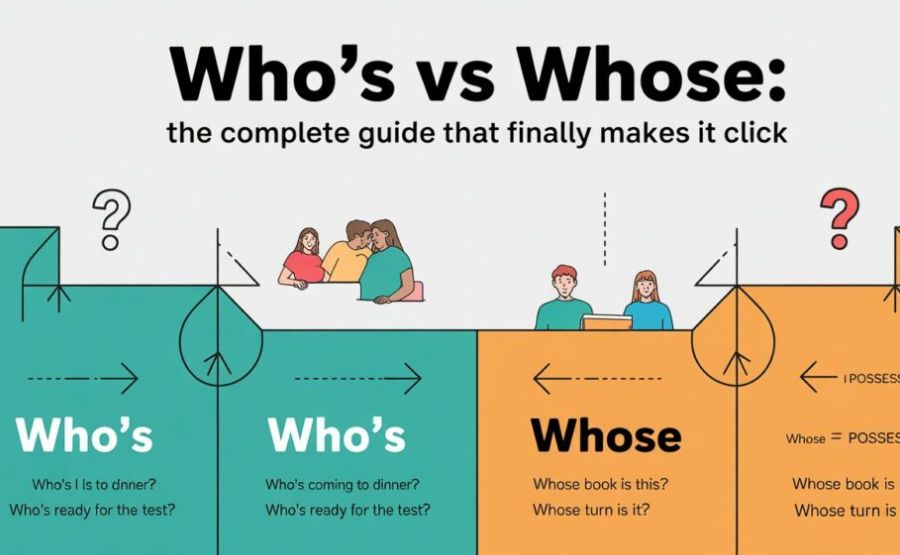
Who’s does exactly one thing. It stands in for either “who is” or “who has.” That’s it. The apostrophe is the giveaway — it’s sitting there marking the missing letters.
“Who’s coming to dinner?” means “Who is coming to dinner?”
“Who’s eaten my sandwich?” means “Who has eaten my sandwich?”
Every single time you write who’s, you should be able to swap it for one of those two phrases and have the sentence still make sense.
Whose does something completely different. It indicates that something is associated with or belongs to someone. It’s in the same family as words like his, her, their, and its — words that point to ownership without needing an apostrophe.
“Whose bag is this?”To whom does this bag belong?” is meant by “
“The child whose drawing won the prize was beaming with pride.”
Here, whose is linking the child to the drawing. It’s showing connection and belonging.
Neither word is hard on its own. The problem is that they sound identical, and the brain often grabs whichever one feels right in the moment — which isn’t always the correct one.
The Golden Test That Never Fails
Here’s something really practical that I want you to keep in your back pocket forever.
Before you write either word, try this test:
Change the term to “who is” or “who has.”
If the sentence still makes sense, you want who’s with the apostrophe.
If the sentence falls apart and sounds wrong, you want whose without the apostrophe.
Let’s try it:
“Who’s/Whose coat is that on the chair?”
Try “Who is coat is that on the chair?” — that’s nonsense. Try asking, “Who is wearing the coat on the chair?” — also nonsense.
So you need whose. ✓
Now this one:
“Who’s/Whose in charge here?”
Try “Who is in charge here?” — perfect. That works completely.
So you need who’s. ✓
This test is almost foolproof. Once you make it a habit, you’ll barely need to think about it consciously. It’ll become automatic within a few weeks of using it.
Why This Particular Mix-Up Happens So Often
It’s worth understanding why this trips people up, because it’s not random. There’s a pattern to this mistake.
English has a rule about possessives. When a noun owns something, we add an apostrophe and the letter S. “The dog’s bowl.” “Sarah’s coat.” “The company’s logo.” We learn this rule early, and our brains absorb it deeply.
So when we want to show that who owns something, our brain reaches for that same pattern. Who plus ownership equals who’s, our brain reasons. Pop in that apostrophe-S and you’re done.
Except that’s not how possessive pronouns work.
English has a separate set of words specifically for showing ownership — his, her, its, their, our, your, whose — and none of them ever use an apostrophe. They’re complete on their own. They don’t follow the apostrophe-S rule because they don’t need to.
This is the same reason people write “it’s” when they mean “its.” The possessive pronoun doesn’t get an apostrophe. The contraction does. Our instinct pulls us toward the apostrophe because we think of it as ownership, but this set of words consistently misleads us.
Understanding why the mistake happens makes it easier to catch yourself doing it.
Real Examples That Show the Difference Clearly
Let me give you a bunch of real-world examples. Seeing the words in context is the fastest way to make them stick.
Using whose correctly:
“Do you know whose phone keeps ringing?”
“Her class always wins the scientific fair.”
“The dog, whose fur was completely soaked, shook water everywhere.”
“Who came up with the notion to eat at this restaurant?”
“They discovered a wallet, but they were unsure of its owner.”
Using who’s correctly:
“Who’s ready to start?”
“I need to find out who’s responsible for this.”
“Who’s been sitting in my chair?”
“She’s the kind of person who’s always the last to leave.”
“Does anyone know who’s performing tonight?”
Common mistakes and how to fix them:
Wrong: “Do you know who’s bag this is?”
Right: “Do you know whose bag this is?”
(Try: “Do you know who is bag this is?” — that’s nonsense, so no apostrophe.)
Wrong: “Whose going to help me move this sofa?”
Right: “Who’s going to help me move this sofa?”
(Try: “Who is going to help me move this sofa?” — perfect, so use the apostrophe.)
This Is Not an Indication of Low Intelligence
Let me say this clearly, because people sometimes feel embarrassed about grammar mistakes.
Getting who’s and whose mixed up has nothing to do with how smart you are. Some extraordinarily gifted writers make this slip regularly, especially when typing quickly or when their focus is on the ideas rather than the mechanics.
The words are homophones — they sound completely identical. Our brains process language incredibly fast, and when we’re writing, we’re often thinking about what we want to say, not the mechanical details of how we’re writing it. The “wrong” word slips in before we’ve consciously noticed.
Professional editors exist partly because of this. Even people who write beautifully for a living sometimes need another pair of eyes to catch these slips. There is absolutely no shame in making this mistake. The goal is just to understand it clearly enough that you can catch it yourself before it goes out.
How This Confusion Shows Up in Everyday Life
Think about all the places where this pair of words could show up on a typical day.
A text message: “Who’s coming tonight?” or “Whose turn is it to drive?”
Workplace email: “I’d like to know whose signature is needed on this paper.”
A piece for school: “Shakespeare was a playwright whose work has lasted four hundred years.”
A social media caption: “Who’s excited for summer?” — posted with a photo of sunshine.
A letter of reference: “She is someone whose dedication I have personally witnessed.”
A news headline: “Who’s next in line for the leadership role?”
These words pop up constantly. Which is actually good news for you. It means you’ll get plenty of practice making this distinction correctly, and pretty soon it’ll feel natural.
The Broader Family: Other Homophone Pairs That Work the Same Way
Once you understand who’s and whose, you’ll recognise the same pattern in several other commonly confused pairs.
It’s vs. Its
“It’s raining outside.” (It is raining outside.)
“The cat licked its paw.” (Possessive — the paw belonging to the cat.)
Same principle exactly. The contraction gets the apostrophe. The possessive pronoun doesn’t.
You’re vs. Your
“You’re going to love this.” (You are going to love this.)
“I love your new haircut.” (Possessive — the haircut belonging to you.)
They’re vs. Their vs. There
This one has three options, which makes it trickier. But the possessive their — as in “their house,” “their decision” — follows the same rule. No apostrophe needed.
Learning the who’s and whose distinction gives you the key to unlocking all of these. Once you truly understand why possessive pronouns don’t take apostrophes, the whole confusing family suddenly makes sense.
What Formal Grammar Says About All This
Grammar books and style guides are clear and consistent on this one. There’s no debate, no regional variation, no “some experts say this and others disagree.” The rules are settled.
Who’s is a contraction. Full stop. Use it to refer to “who is” or “who has.”
Whose is a possessive pronoun. Use it to show belonging or connection.
In very formal writing — academic papers, legal documents, official reports — many style guides actually recommend expanding contractions in general. So instead of writing who’s, you’d write who is in full. This is simply a tone choice, not a grammatical rule. Contractions aren’t wrong. They’re just more casual in the register.
For everyday writing — emails, articles, social media, personal essays — who’s as a contraction is completely correct and widely used. Don’t let anyone tell you contractions are improper in general. They’re a normal and natural part of written English.
A Note on Evolving Language
Here’s something slightly more philosophical, and I think it’s worth a moment.
Language is not fixed. It has never been fixed. Words change. Grammar evolves. Rules that seemed iron-clad a hundred years ago have softened or shifted. Rules that didn’t exist a hundred years ago are now standard.
Some people wonder — might who’s eventually become accepted as a possessive too? Could the distinction collapse over time, the way other English distinctions have?
Honestly, it’s possible. Language changes because speakers use it in new ways, and eventually those new uses get accepted. “They” as a singular pronoun was once considered wrong by many grammarians. Now it’s standard and widely accepted.
But right now, in 2025, the distinction between who’s and whose is firmly maintained in standard written English. Using who’s when you mean whose is considered an error in formal and professional contexts. So while it’s interesting to think about where language might go, the practical advice is to follow current standard usage.
Learn the difference. Use it correctly. And maybe check back in fifty years to see what English decided to do.
Practical Tips to Help the Rule Stick
If you want to make this truly automatic, here are a few techniques that genuinely work.
The substitution test. We covered this above, and it really is the best tool. “Who is” or “who has” — if one of those fits, write who’s. If neither fits, write whose.
Say it aloud. When you’re proofreading, read the sentence out loud. Sometimes your ear catches what your eye misses.
Write the full form first. When composing, write “who is” or “who has” completely if you’re not sure. Then convert to the contraction at the end if you want. That forces you to consciously make the choice.
Pause at every apostrophe. When you’re proofreading something, slow down at every apostrophe and ask: is this marking missing letters, or is this on a possessive pronoun? If it’s on a possessive pronoun, the apostrophe shouldn’t be there.
Create a personal example. Think of one sentence for each word that you’ll remember easily. Something personal. Maybe use your own name, your pet, your town. Personal examples stick better than abstract ones.
Final Words
Two small words. One tiny apostrophe. And yet this is one of the most common grammar stumbles in the entire English language.
The beautiful thing is that once you understand the why behind it — once you see that who’s is just a shortcut for “who is/who has” and whose is an ancient possessive pronoun that never needed an apostrophe — it stops feeling like a rule you have to memorise and starts feeling obvious.
You’re not memorising an arbitrary fact. You’re comprehending the true operation of the language. And that understanding stays with you in a way that memorised rules often don’t.
The next time you pause at that fork in the road — who’s or whose — just ask yourself: could I replace this with “who is” or “who has”? If yes, add the apostrophe. If not, leave it clean.
That’s genuinely all there is to it.
FAQs
1. What is the simplest way to remember who’s vs whose?
Try replacing the word with “who is” or “who has.” If one of those fits in the sentence and it still makes sense, use who’s with the apostrophe. Use whose without an apostrophe if neither one is appropriate. That test works almost every single time.
2. Why doesn’t “whose” have an apostrophe if it shows possession?
Possessive pronouns in English — words like his, her, its, their, your, and whose — never use apostrophes. They’re a special group of words that already carry the meaning of ownership built into them. The apostrophe in English is used for contractions (missing letters) and for nouns, not for this group of pronouns.
3. Can “who’s” ever mean “who has”?
Yes. “Who’s” can be short for either “who is” or “who has.” For example: “Who’s eaten the last biscuit?” means “Who has eaten the last biscuit?” The substitution test works for both options.
4. Is it ever okay to use “who’s” in formal writing?
Grammatically, yes. Stylistically, some style guides prefer contractions to be written out in full for very formal documents. So in an academic paper or legal brief, you might see “who is” written out completely. But who’s isn’t wrong — it’s just more casual in tone.
5. What’s the difference between “whose” and “of whom”?
They can often mean the same thing, but “whose” is far more natural in everyday use. “The teacher whose class I enjoy” sounds normal. “The teacher of whom I enjoy the class” sounds stiff and old-fashioned. “Whose” is the better choice in almost all modern writing.
6. Can “whose” be used for objects or things, not just people?
Yes, and a lot of people are unaware of this. You can say “a house whose roof needs replacing” or “a car whose engine failed.” Using “whose” for things is completely accepted in standard English. It sounds far more natural than “a house of which the roof needs replacing.”
7. What are some other common pairs like who’s/whose?
The most similar ones are it’s/its, you’re/your, and they’re/their/there. All of these follow the same logic — the version with the apostrophe is a contraction, and the version without is a possessive pronoun or a different word entirely. Once you understand the pattern, they all click at once.
8. How do I proofread this mistake?
Slow down whenever you see a word that sounds like whose or who’s and apply the substitution test. Also, as a general habit, pause at every apostrophe while proofreading and ask: is this replacing missing letters, or is it sitting on a possessive pronoun where it doesn’t belong?
9. Does the mistake matter in casual texting or social media?
In relaxed, informal communication, people are generally more forgiving. A text to a friend using the wrong one isn’t a disaster. But in anything public, professional, or formal — a social media post representing a business, an email to a client, a job application — getting it right does matter and people do notice.
10. Are native English speakers more likely to get this right?
Not necessarily. Native speakers make this mistake regularly because they learned the sound of the words before they learned the rules. People who learned English as a second language through formal study sometimes have an advantage because they studied the grammar explicitly.
11. What if I can’t decide and I’m in a rush?
Rewrite the sentence to avoid the problem entirely. “Do you know who owns this bag?” gets around the whose question completely. “Find out who is responsible” avoids the who’s question. When in doubt, rephrase. It’s a perfectly valid strategy.
12. Is “whose” ever used as an interrogative pronoun vs. a relative pronoun?
Yes — “whose” does two different jobs. As an interrogative pronoun, it asks a question: “Whose coat is this?” As a relative pronoun, it connects a clause: “She’s the one whose voice I recognised.” Both are correct. Both are common. Both follow the same no-apostrophe rule.
13. Why do so many people find English grammar confusing?
English developed from multiple language families — Old English, Old Norse, Norman French, Latin — and absorbed different grammar rules from all of them without always tidying up the inconsistencies. The result is a language full of exceptions, irregular patterns, and words that sound identical but mean different things. It’s a lot to hold in your head. Be patient with yourself. These things take time and practice, and every person learning English — native speaker or not — trips over the same spots.
Empowering curious minds to explore, learn, and think deeper with Fact Aura.